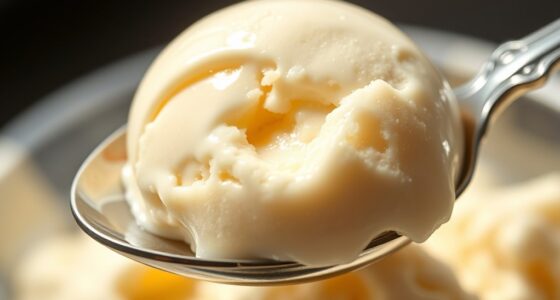
To fix icy gelato, focus on controlling air pockets and temperature during churning. Make sure you’re not overmixing or churning too fast, which traps large air bubbles or creates uneven distribution. Keep the mixture at a steady, proper temperature to slow ice crystal growth. Adjust ingredient amounts, like fat and stabilizers, to help trap air evenly. If you keep these tips in mind, you’ll learn how to create smoothly textured gelato every time.
Key Takeaways
- Ensure proper churning speed and duration to avoid trapping large air pockets that cause icy patches.
- Maintain consistent, optimal freezing temperatures to prevent rapid ice crystal growth and uneven texture.
- Adjust ingredient composition, such as increasing fat or adding stabilizers, to stabilize air bubbles and improve creaminess.
- Monitor and regulate the churning process to achieve uniform air bubble distribution and prevent overrun issues.
- Fine-tune process variables through taste testing and timing adjustments to minimize icy texture and enhance smoothness.

Have you ever struggled with achieving the perfect texture in your recipes? If you’ve been making gelato or other frozen desserts, you know how tricky it can be to get the consistency just right. One common issue is icy gelato, which can feel gritty and hard rather than smooth and creamy. The key to fixing this often lies in understanding how air pocket formation and overrun control influence the final product. When air pockets form unevenly or excessively, they create ice crystals that make your gelato icy instead of velvety. Controlling overrun—the amount of air incorporated during churning—is essential. Too much overrun introduces excessive air, leading to a fluffy texture that can collapse or develop icy patches. Too little, and your gelato may be dense and hard. Striking the right balance ensures a smooth, creamy mouthfeel without unwanted iciness.
Achieving perfect gelato texture requires balancing air pockets and overrun control for smooth, creamy results.
To tackle air pocket formation, focus on your churning process and ingredient mixture. When you churn, air gets whipped into the base, creating those tiny bubbles that give gelato its lightness. If the process is too vigorous or too fast, it can trap too much air, resulting in larger, uneven pockets that contribute to icy spots. Conversely, insufficient churning may produce a dense, heavy texture. So, it’s essential to monitor your churning speed and duration. You want enough agitation to generate a uniform distribution of small air pockets, but not so much that the overrun becomes excessive. Using a well-calibrated ice cream maker can help maintain consistent overrun control, preventing large air pockets and ensuring even texture. Additionally, understanding the role of temperature in ice crystal development helps optimize the churning process and improve overall texture.
Additionally, the composition of your base plays a significant role. Higher fat content can stabilize air bubbles and inhibit large ice crystal formation, leading to a creamier texture. Incorporating ingredients like egg yolks or stabilizers can also improve air pocket formation and overrun control, making your gelato less prone to icy patches. Proper temperature regulation during churning is equally important. If the mixture is too cold or too warm during freezing, it can affect how air is incorporated and how ice crystals develop. Aim for a steady, suitable temperature to promote even air distribution and prevent rapid ice crystal growth.
Finally, always remember to taste and adjust. If your gelato turns out icy, try reducing the churning time slightly or tweak your mixture’s fat content. Fine-tuning your process for air pocket formation and overrun control will help you consistently produce silky, smooth gelato without the dreaded icy texture. With patience and attention to detail, you’ll master the art of perfect texture in your frozen treats.

Cuisinart 1.5-Quart Ice Cream Maker and Gelato Machine, Makes Frozen Yogurt and Sorbet, Fully Automatic with Commercial-Quality Compressor and 2 Churning Paddles, ICE-100, Black/Stainless
FROZEN FAVORITES: The fully automatic Cuisinart 1.5-Quart Ice Cream Maker with high-powered compressor makes lusciously rich ice cream,…
As an affiliate, we earn on qualifying purchases.
As an affiliate, we earn on qualifying purchases.
Frequently Asked Questions
What Causes Gelato to Become Too Icy Despite Correct Freezing?
Your gelato becomes too icy despite correct freezing because of poor air circulation and the container material. When there’s inadequate airflow, ice crystals form more easily, making the texture gritty. Using a container that doesn’t insulate well can also cause uneven freezing. To fix this, guarantee proper air circulation in your freezer and switch to a better-insulating container, like one with a tight seal or a non-reactive material, to maintain a smooth, creamy texture.
How Can I Prevent Ice Crystals From Forming During Storage?
Think of your gelato like a delicate dance partner; you want smooth moves without icy stumbles. To prevent ice crystals, guarantee proper air circulation inside your freezer, avoiding overpacking. Use insulated containers to shield your gelato from temperature fluctuations, like a warm hug that keeps it steady. These steps help maintain a consistent temperature, so your gelato stays creamy and inviting, not icy and dull.
What Ingredients Influence Gelato’s Texture Stability?
You influence gelato’s texture stability through ingredient ratios and stabilizer types. Adjusting the ratio of sugar, fat, and water helps maintain a smooth consistency, while choosing the right stabilizers, like guar gum or carrageenan, prevents ice crystal formation. Properly balancing these ingredients guarantees your gelato stays creamy and prevents icy textures. Experiment with different stabilizer types and ratios to find the perfect, stable texture for your gelato.
Is It Better to Churn Gelato Slowly or Quickly for Smoothness?
You should churn gelato at a moderate speed to achieve ideal texture consistency. Churning too quickly can incorporate excess air, making it airy rather than creamy, while churning too slowly might result in larger ice crystals, causing iciness. A balanced churning speed ensures you get a smooth, dense texture that’s both rich and velvety. Adjust your speed according to your machine’s instructions to perfect your gelato’s silky finish.
Can Adding Alcohol Improve Gelato’s Texture and Prevent Iciness?
Think of alcohol as a secret weapon in your gelato arsenal. Adding alcohol with the right alcohol content can act like a gentle lullaby, preventing ice crystals from forming and keeping the texture smooth. Just remember, a splash of alcohol is enough—too much can alter flavor and consistency. Adjust your ingredients thoughtfully, and you’ll craft a luscious, velvety gelato that stays irresistibly creamy with every scoop.
![Perfect Gelato [Gelato Stabilizer] Vegan OU Kosher Certified - 50g/2oz (stabilizes and prevents crystal formation in gelato recipes)](https://m.media-amazon.com/images/I/41XkNth40xL._SL500_.jpg)
Perfect Gelato [Gelato Stabilizer] Vegan OU Kosher Certified – 50g/2oz (stabilizes and prevents crystal formation in gelato recipes)
Perfect stabilizer for gelato products
As an affiliate, we earn on qualifying purchases.
As an affiliate, we earn on qualifying purchases.
Conclusion
Now, you see, understanding the root cause of icy gelato is key to fixing it. When you identify whether it’s overfreezing, improper mixing, or too much air, you can adjust your process accordingly. Trust the process, experiment, and you’ll find the perfect texture. Remember, every batch teaches you something new. With patience and attention, your gelato will turn out smooth and creamy every time—proof that troubleshooting truly makes all the difference.

KoolMore MCF-16C Commercial Ice Cream Freezer Display Case, 16 Cu. Ft, White
Premium Ice Cream Freezer – Ideal for commercial spaces this ice cream display freezer helps keep buckets of…
As an affiliate, we earn on qualifying purchases.
As an affiliate, we earn on qualifying purchases.

Fat Daddio's MS-06 Stainless Steel Measuring Spoons Set, 6 spoons, Kitchen Gadgets for Baking & Cooking
Essential Sizes for Mixing, Baking and Cooking: Includes 6 measuring spoons: 1/8 tsp (0.6 ml), 1/4 tsp (1.25…
As an affiliate, we earn on qualifying purchases.
As an affiliate, we earn on qualifying purchases.