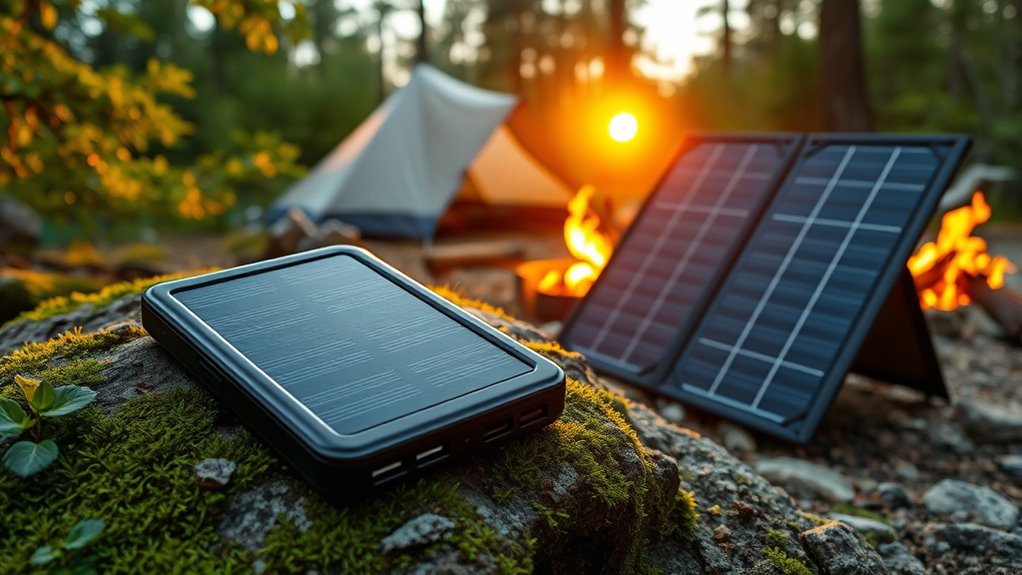
For most campers, I’d start with the BLAVOR 10,000mAh Solar Power Bank with 20W USB-C: its wired fast charging is a more dependable everyday advantage than relying on a small built-in solar panel. The Latimeria 20,000mAh stands out for its three foldable panels, while the SISIXILE 10W foldable solar panel kit better suits campers who want a separate panel for gathering sunlight. The main tradeoff is between compact capacity for phones and larger, heavier banks with more charging options. Built-in solar can help top up a battery over time, but it is not a substitute for a wall charger or a dedicated panel when you need substantial energy. Read on for the full comparison and picks by camping style.

Get baking supplies delivered free with Prime
- Fast, free delivery on millions of items
- Prime Video, Amazon Music and more included
- Member-only deals all year
Complete the kit


Key Takeaways
- Wired charging matters more than a tiny solar panel for routine use: the BLAVOR 10,000mAh model with 20W USB-C offers a clear advantage when you can recharge before or between outings.
- Solar collection varies by design: Latimeria’s three foldable panels and the separate SISIXILE 10W panel kit put more emphasis on gathering sunlight than compact models with built-in panels.
- Capacity comes with a carrying tradeoff: the SOARAISE 48,000mAh, FEELLE 50,000mAh, and BLASOUL 49,800mAh models suit longer trips better on paper, but their size and weight matter on foot.
- Extra features answer different campsite problems: built-in cables reduce loose accessories, camping lights help around camp, and wireless charging can simplify short top-ups but may be slower or less efficient than a cable.
- Hand-crank charging is an emergency feature, not a routine power plan: the FEELLE and BLAVOR crank models add an alternative input, but campers should not treat cranking as a practical way to refill a large battery.
| SOARAISE 48,000mAh Solar Power Bank with Wireless Charging and 4 Built-In Cables |  | Best for Cable-Free Group Charging | Battery capacity: 48,000mAh | Solar panels: 4 | Built-in cables: USB-C, Phone, USB-A, Micro | VIEW ON AMAZON | See Our Full Breakdown |
| Uukto 20,000mAh Solar Power Bank with Built-In Cables and Camping Lights |  | Best for Campers New to Multi-Device Charging | Battery capacity: 20,000mAh | Battery cell type: Lithium polymer | Voltage: 3.7V | VIEW ON AMAZON | See Our Full Breakdown |
| BLAVOR 10,000mAh Solar Power Bank with 20W USB-C and Qi Wireless Charging |  | Best Compact Pick | Battery capacity: 10,000mAh | USB-C output: 20W | Wireless charging: Qi compatible | VIEW ON AMAZON | See Our Full Breakdown |
| FEELLE 50,000mAh Solar Power Bank with Magnetic Wireless Charging and Hand Crank |  | Best Emergency-Ready Pick | Battery capacity: 50,000mAh | Solar panels: 4 | Wireless charging: Up to 15W magnetic | VIEW ON AMAZON | See Our Full Breakdown |
| BLAVOR 20,000mAh Solar Power Bank with Hand Crank and 4 Built-In Cables |  | Best Feature-Rich Mid-Capacity Pick | Battery capacity: 20,000mAh | Wireless charging: Up to 15W, Qi | USB-C PD charging: Up to 20W | VIEW ON AMAZON | See Our Full Breakdown |
| BLAVOR 20,000mAh Solar Power Bank with Wireless Charging |  | Best for Multi-Device Camps | Battery capacity: 20,000mAh | USB-C output: 20W | Total USB ports: 3 | VIEW ON AMAZON | See Our Full Breakdown |
| BLASOUL 49,800mAh Solar Power Bank with Wireless Charging and Built-In Cables |  | Best for Long Camps Without Outlet Access | Battery capacity: 49,800mAh | Wired output: Up to 22.5W | Wireless output: Up to 15W | VIEW ON AMAZON | See Our Full Breakdown |
| Latimeria 20,000mAh Solar Power Bank with Three Foldable Panels and Built-In Cables |  | Best for Sun-Forward Campsites | Battery capacity: 20,000mAh | Solar panels: 3 foldable panels | Built-in cables: USB-C and Lightning | VIEW ON AMAZON | See Our Full Breakdown |
| BLAVOR 10,000mAh Solar Power Bank with Wireless Charging |  | Best Compact Pick | Battery capacity: 10,000mAh | USB-C output: 20W | Ports: 3 | VIEW ON AMAZON | See Our Full Breakdown |
| SISIXILE Solar Charger Power Bank with Portable 10W Foldable Solar Panel Kit |  | Best for Emergency Charging Options | Battery capacity: 20,000mAh | Solar panel: 10W, five-foldable monocrystalline panel | Solar conversion efficiency: 24% | VIEW ON AMAZON | See Our Full Breakdown |
| solar power banks for camping | Battery capacity | Wireless charging | Built-in cables | Dimensions |
|---|---|---|---|---|
| SOARAISE 48,000mAh Solar Power | 48,000mAh | Yes | USB-C, Phone, USB-A, Micro | 6.38 × 3.43 × 1.57 inches |
| Uukto 20,000mAh Solar Power Ba | 20,000mAh | — | — | — |
| BLAVOR 10,000mAh Solar Power B | 10,000mAh | Qi compatible | — | 5.91 × 3.07 × 0.87 inches |
| FEELLE 50,000mAh Solar Power B | 50,000mAh | Up to 15W magnetic | USB-C, phone cable, Micro-USB, USB-A | — |
| BLAVOR 20,000mAh Solar Power B | 20,000mAh | Up to 15W, Qi | 4: 2 USB-C, 1 iOS, 1 USB-A | 7.16 × 3.86 × 1.7 inches |
| BLAVOR 20,000mAh Solar Power B | 20,000mAh | Qi for phones and Apple Watch | 4: 2 USB-C, 1 iOS, 1 USB-A | — |
| BLASOUL 49,800mAh Solar Power | 49,800mAh | — | iOS, USB-C, and Micro USB output; USB-A input | 7 × 3.66 × 1.28 in |
| Latimeria 20,000mAh Solar Powe | 20,000mAh | — | USB-C and Lightning | — |
| BLAVOR 10,000mAh Solar Power B | 10,000mAh | Qi | — | 5.91 × 3.07 × 0.87 inches |
| SISIXILE Solar Charger Power B | 20,000mAh | Qi, 15W magnetic | — | — |
More Details on Our Top Picks
SOARAISE 48,000mAh Solar Power Bank with Wireless Charging and 4 Built-In Cables
The SOARAISE is a strong fit for camps where several people bring different devices and nobody wants to pack a tangle of charging leads. Its four built-in cables, wireless charging pad, and separate USB outputs give it more ways to connect than the BLAVOR 10,000mAh, while the stated 48,000mAh capacity offers a larger reserve for multiple top-ups. Four solar panels and built-in camping flashlights add useful backup functions, though the solar charging rate is not specified; I would treat sunlight as a supplement, not the main way to refill it at camp. Its listed weight is only for the battery, so the full carry weight is unclear. Choose this over the Uukto if capacity matters more than a simpler setup; skip it if you need verified solar performance or a clearly documented ruggedness rating.
Pros:- Four built-in cable types reduce the need to pack separate leads.
- Wireless charging adds another way to top up compatible phones.
- Stated 48,000mAh capacity is suited to repeated charging across a group.
- Four solar panels and LED camping flashlights provide useful backup functions.
Cons:- Solar charging speed and real-world performance are not specified.
- The listed 50g battery weight does not clarify the complete unit’s carry weight.
- Waterproof, shockproof, and dustproof claims lack a stated protection rating.
Best for: Car campers or group campers who want one shared bank with built-in cables for several device types.
Not ideal for: Backpackers counting every ounce, or campers relying on solar as their primary recharge method, since total weight and solar charging speed are not provided.
- Battery capacity:48,000mAh
- Solar panels:4
- Built-in cables:USB-C, Phone, USB-A, Micro
- Ports:2 USB-A outputs; 1 USB-C input/output
- Wireless charging:Yes
- Maximum output current:3A
- Dimensions:6.38 × 3.43 × 1.57 inches
- Additional features:LED camping flashlights; auto shut-off; claimed waterproof, shockproof, and dustproof protection
Our verdict“Pick the SOARAISE for high stated capacity and cable flexibility at shared camps, but not when verified solar output or pack weight is a priority.”
Uukto 20,000mAh Solar Power Bank with Built-In Cables and Camping Lights
The Uukto keeps the camping setup straightforward: built-in cables, six ports, and stated capacity for charging up to five devices at once make it easy to share without sorting out adapters. Its 20,000mAh capacity is more modest than the SOARAISE 48,000mAh or FEELLE 50,000mAh, so it makes more sense for a short trip or a smaller group than for several days of heavy phone use. The camping light and flashlights are practical additions around a tent, and the listed protection against overheating, overcharging, and short circuits addresses charging safety. However, its solar recharge rate is unspecified, and the product data does not give a clear water- or shock-resistance rating. I would choose it over the BLAVOR 10,000mAh when more ports and built-in cables matter more than a compact, specified outdoor rating.
Pros:- Six ports and built-in cables support charging several devices without separate leads.
- Stated 20,000mAh capacity suits short trips and moderate group use.
- Includes both flashlights and a camping light.
- Lists protection against overcharging, short circuits, and overheating.
Cons:- Solar recharge speed and performance are not specified.
- Waterproof and shockproof protection is not clearly detailed.
- Lower stated capacity than the SOARAISE and FEELLE makes it less suited to prolonged group use.
Best for: New campers and small groups who want shared charging, built-in cables, and campsite lighting in one unit.
Not ideal for: Multi-day groups with high power needs, or campers who need documented water resistance and known solar recharge performance.
- Battery capacity:20,000mAh
- Battery cell type:Lithium polymer
- Voltage:3.7V
- Number of ports:6
- Simultaneous device charging:Up to 5 devices
- Connector types:USB-C in/out, iOS, USB-A
- Lighting:Flashlights and camping light
- Protection features:Overcharge, short-circuit, and overheating protection
Our verdict“Choose the Uukto for accessible shared charging and campsite lighting, but look elsewhere for documented weather protection or a larger power reserve.”
BLAVOR 10,000mAh Solar Power Bank with 20W USB-C and Qi Wireless Charging
For campers who want a pocketable backup rather than a shared power hub, the BLAVOR 10,000mAh is the clearest choice in this group. At 9.3 ounces and under an inch thick, it is easier to carry than the 1.3-pound BLAVOR 20,000mAh with hand crank, though it gives up capacity and emergency extras. Its 20W USB-C output can charge a compatible phone faster than the SOARAISE’s listed 3A output, while Qi charging and three-device support leave options for a small personal setup. IPX5 water resistance, dustproof and shockproof construction, dual flashlights, and a compass carabiner suit trail use. The tradeoff is a 10,000mAh reserve and a stated seven-hour battery recharge time; solar performance is not specified, so I would not plan around sunlight refilling it quickly.
Pros:- Compact 9.3-ounce design is easier to carry on foot than the 1.3-pound BLAVOR 20,000mAh.
- 20W USB-C output supports faster charging for compatible devices.
- Qi wireless charging and three ports allow flexible personal-device charging.
- IPX5 rating, dustproof and shockproof design, dual flashlights, and compass carabiner suit outdoor use.
Cons:- 10,000mAh capacity is limited for group charging or longer trips.
- Battery recharge time is listed as seven hours.
- Solar charging performance is not specified.
Best for: Solo hikers and minimalist campers who want a lighter phone backup with a documented water-resistance rating.
Not ideal for: Groups or campers charging tablets and several phones over multiple days, since its 10,000mAh capacity is much lower than the SOARAISE or FEELLE.
- Battery capacity:10,000mAh
- USB-C output:20W
- Wireless charging:Qi compatible
- Number of ports:3
- Water resistance:IPX5
- Weight:9.3 ounces
- Dimensions:5.91 × 3.07 × 0.87 inches
- Battery charge time:7 hours
Our verdict“Choose this BLAVOR for a lighter, weather-rated personal backup, not as the main power source for a group campsite.”
FEELLE 50,000mAh Solar Power Bank with Magnetic Wireless Charging and Hand Crank
The FEELLE is built around backup options: a stated 50,000mAh capacity, four solar panels, magnetic wireless charging, and a hand-crank generator give it more fallback features than the Uukto 20,000mAh. Built-in cables and three ports are listed for charging up to six devices, making it more appropriate for a shared base camp than a hiking pack. Its compass and steady, SOS, and strobe flashlight modes add practical emergency functions. Those extras come with uncertainty: the listing gives no solar recharge rate or crank output, so neither alternative power source can be treated as a dependable fast refill. Magnetic charging may also weaken through thick phone cases. Compared with the SOARAISE, the FEELLE adds a hand crank and magnetic charging but remains a large, feature-heavy choice best suited to car camping.
Pros:- Stated 50,000mAh capacity and support for up to six devices suit group use.
- Four built-in cable types reduce accessory clutter.
- Four solar panels and a hand-crank generator provide alternate charging options.
- Compass and multi-mode flashlight add emergency and campsite utility.
Cons:- Solar and hand-crank charging rates are not specified.
- Magnetic wireless charging can be less effective with thick phone cases.
- Its large-capacity, multi-feature design is better suited to car camping than weight-conscious hiking.
Best for: Car campers and emergency-minded groups who value multiple backup charging methods and shared-device support.
Not ideal for: Backpackers seeking low weight, or anyone who needs dependable, quantified solar or hand-crank recharging.
- Battery capacity:50,000mAh
- Solar panels:4
- Wireless charging:Up to 15W magnetic
- Ports:3
- Built-in cables:USB-C, phone cable, Micro-USB, USB-A
- USB-C output:Up to 3A
- Additional features:Hand-crank generator, compass, steady/SOS/strobe LED flashlight
- Materials:Silicone and ABS+PC
Our verdict“Pick the FEELLE for a car-camp emergency kit with several backup features, but not for lightweight travel or predictable off-grid recharging.”
BLAVOR 20,000mAh Solar Power Bank with Hand Crank and 4 Built-In Cables
This BLAVOR balances a more manageable 20,000mAh capacity with an unusually broad set of camp tools. It weighs 1.3 pounds, so it is heavier than the compact BLAVOR 10,000mAh, but in return it adds a hand crank, lantern, flashlight, compass, thermometer, and four built-in cables. Its 20W USB-C PD and up-to-15W Qi wireless charging suit a mix of phones and compatible devices, while the listing says it can charge up to seven devices at once. That makes it a better-equipped shared camp option than the Uukto, though its actual solar recharge speed is not provided. I would treat the crank as an emergency backup, not a routine charging method, since output performance is unspecified. The water-, shock-, and dust-resistant shell is useful outdoors, but the weight argues against carrying it far on foot.
Pros:- 20W USB-C PD and up-to-15W Qi charging cover wired and wireless use.
- Four built-in cables and three ports support varied devices without packing as many leads.
- Hand crank, flashlight, lantern, compass, thermometer, carabiner, and rope add camp utility.
- Water-, shock-, and dust-resistant shell is designed for outdoor conditions.
Cons:- At 1.3 pounds, it is substantially heavier than the BLAVOR 10,000mAh compact option.
- Solar recharge speed is not specified.
- Hand-crank charging output is not given, so its usefulness as a power source is difficult to gauge.
Best for: Car campers and emergency-kit buyers who want mid-range capacity, built-in cables, lighting, and multiple backup functions.
Not ideal for: Ultralight hikers or campers expecting solar power to quickly refill the bank, since it weighs 1.3 pounds and solar recharge speed is unspecified.
- Battery capacity:20,000mAh
- Wireless charging:Up to 15W, Qi
- USB-C PD charging:Up to 20W
- Built-in cables:4: 2 USB-C, 1 iOS, 1 USB-A
- Charging ports:3: 1 USB-C, 2 USB-A
- Maximum simultaneous devices:7
- Weight:1.3 lb
- Dimensions:7.16 × 3.86 × 1.7 inches
- Special features:Hand crank, flashlight, camping lantern, compass, thermometer, carabiner, rope
Our verdict“Choose this BLAVOR for a feature-packed car-camping or emergency setup, but take the lighter BLAVOR 10,000mAh for hiking.”
BLAVOR 20,000mAh Solar Power Bank with Wireless Charging
I’d choose this BLAVOR when a group campsite calls for fewer loose charging cords: four built-in cables, three USB ports, and Qi charging can cover several devices at once. Its 20W USB-C output also gives a wired phone a faster option than the compact BLAVOR 10,000mAh model, while the larger stated capacity suits longer trips between outlet access. The flashlight, camping light, compass, and carabiner add practical campsite utility beyond charging. The tradeoff is that the listing gives no solar charging rate, so I would treat sunlight as a backup rather than count on it to refill the battery. Weight and dimensions are also absent, making pack-space planning harder than with the smaller BLAVOR.
Pros:- Four built-in cables plus USB ports and Qi charging reduce the need to pack separate leads.
- 20W USB-C output supports faster wired charging for compatible devices.
- Flashlight, camping light, compass, and carabiner add useful outdoor functions.
- IPX5 water resistance and stated shock and dust protection suit rougher campsite use.
Cons:- Solar charging speed is not specified, so sunlight may be an unreliable recharge plan.
- Weight and dimensions are not provided, limiting packability comparisons.
- Multiple-device charging can draw down the 20,000mAh reserve quickly.
Best for: Campers sharing power among phones and other small devices who want built-in cables and campsite lighting in one unit.
Not ideal for: Ultralight hikers or campers relying on solar as their main recharge source, since weight, dimensions, and solar input speed are not specified.
- Battery capacity:20,000mAh
- USB-C output:20W
- Total USB ports:3
- Built-in cables:4: 2 USB-C, 1 iOS, 1 USB-A
- Wireless charging:Qi for phones and Apple Watch
- Water resistance:IPX5
- Outdoor features:Flashlight, camping light, compass, and carabiner
Our verdict“Pick this BLAVOR for shared campsite charging and useful built-in tools, but not if you need verified solar performance or known pack dimensions.”
BLASOUL 49,800mAh Solar Power Bank with Wireless Charging and Built-In Cables
The BLASOUL’s main advantage over the 20,000mAh Latimeria is its 49,800mAh stated capacity, giving campers a much larger stored reserve for repeated device top-ups. Three built-in output cables and wireless charging also make it practical for a mixed-device group, while its IP65 protection and SOS-capable flashlight suit exposed campsites better than a basic battery pack. I’d still plan to recharge it from an adapter when possible: the solar input rate is not listed, so the large capacity does not mean it will refill quickly from sunlight. There is also a specification mismatch: the wired output is listed up to 22.5W, but the built-in USB-C cable is stated to top out at 20W. Its listed 180g battery weight alongside a fairly large body is worth verifying before a long hike.
Pros:- Large stated 49,800mAh capacity provides a substantial stored reserve for several devices.
- Built-in iOS, USB-C, and Micro USB output cables reduce loose accessories.
- Supports wired charging up to 22.5W and wireless charging up to 15W.
- IP65 protection and steady, SOS, and strobe flashlight modes suit outdoor use.
Cons:- Solar recharging speed is not specified, making solar-only planning uncertain.
- The built-in USB-C cable is listed at 20W, below the stated 22.5W wired maximum.
- Its 7 × 3.66 × 1.28-inch body may be awkward for compact packs, and the listed battery weight merits checking.
Best for: Car campers and base-camp groups who want a large stored charge, multiple connection options, and weather protection.
Not ideal for: Backpackers counting grams or campers expecting solar alone to replenish a high-capacity battery quickly.
- Battery capacity:49,800mAh
- Wired output:Up to 22.5W
- Wireless output:Up to 15W
- Built-in cables:iOS, USB-C, and Micro USB output; USB-A input
- Dimensions:7 × 3.66 × 1.28 in
- Flashlight modes:Steady, SOS, and strobe
Our verdict“Choose the BLASOUL for a large campsite power reserve and rugged protection, not for lightweight trekking or dependable solar replenishment.”
Latimeria 20,000mAh Solar Power Bank with Three Foldable Panels and Built-In Cables
Among these options, the Latimeria makes the most visible effort to collect sunlight: its three foldable panels give it a more solar-focused design than the BLAVOR 20,000mAh, whose solar charging rate is also unspecified. Built-in USB-C and Lightning leads keep phone charging simple, and 20W USB-C output makes it a useful conventional power bank when the panels are not producing much. The flashlight’s SOS and strobe modes, plus red and blue warning lights, add an emergency signaling role that the BLAVOR’s compass and camping light do not emphasize. The limitation is that panel count alone cannot establish how quickly the battery recharges; the listing provides no charging-time figure, and output depends on sunlight. I’d use it where panels can be placed in sustained sun, not as a guaranteed off-grid power supply.
Pros:- Three foldable solar panels make solar collection a more prominent part of the design.
- 20,000mAh capacity and 20W USB-C output work for regular phone charging as well as solar-assisted use.
- Built-in USB-C and Lightning cables cover common phone connections.
- Flashlight modes and red-and-blue warning lights add emergency visibility.
Cons:- Solar charging time and panel output are not specified.
- Solar performance depends on sunlight, limiting reliability at shaded or overcast campsites.
- Only USB-C and USB-A output ports are listed, which may constrain simultaneous wired charging.
Best for: Campers who can leave a compact power bank exposed to good daylight and want built-in phone cables plus emergency signaling lights.
Not ideal for: Hikers expecting fast solar replenishment in shade, cloudy weather, or short winter days, since charging time and solar output are unspecified.
- Battery capacity:20,000mAh
- Solar panels:3 foldable panels
- Built-in cables:USB-C and Lightning
- USB-C maximum output:20W
- USB-A maximum output:18W
- Water resistance:Resists water splashes
- Lighting:Flashlight with normal, SOS, and strobe modes; red and blue warning lights
Our verdict“Pick the Latimeria when you can give its foldable panels steady sun and want emergency lights, but choose a conventional charging plan for cloudy trips.”
BLAVOR 10,000mAh Solar Power Bank with Wireless Charging
At 9.3 ounces and under six inches long, this BLAVOR is the easiest option here to justify in a smaller daypack. It trades the 20,000mAh BLAVOR’s larger reserve and camping light for pocket-sized carry, Qi charging, and 20W USB-C output—useful when a phone needs a quick wired top-up between hikes. Three ports and wireless charging allow up to three devices to connect, though charging several at once will use its smaller capacity faster. IPX5 water resistance, dual flashlights, and a compass carabiner keep it more campsite-ready than an ordinary compact battery. The weak point is solar: no panel output or solar recharge time is specified. I’d regard it as a rechargeable power bank with solar as a possible supplement, not a dependable solar source.
Pros:- Compact 9.3-ounce body is easier to carry than the larger-capacity options.
- 20W USB-C output and Qi wireless charging offer both fast wired and cable-free charging.
- Three ports support charging up to three devices simultaneously.
- IPX5 protection, dual flashlights, and a compass carabiner suit day hikes and campsites.
Cons:- 10,000mAh capacity offers less reserve than the 20,000mAh and 49,800mAh alternatives.
- Solar charging performance is not specified.
- The listed four-hour battery charge time means it is not a rapid refill option.
Best for: Day hikers and minimalist campers who want a lighter emergency phone reserve with wireless charging and basic outdoor tools.
Not ideal for: Multi-day groups or campers who need repeated charges for several devices, since its 10,000mAh capacity is half that of the larger BLAVOR.
- Battery capacity:10,000mAh
- USB-C output:20W
- Ports:3
- Wireless charging:Qi
- Water resistance:IPX5
- Weight:9.3 ounces
- Dimensions:5.91 × 3.07 × 0.87 inches
- Battery charge time:4 hours
Our verdict“Choose this BLAVOR for compact day-trip carry and phone-focused backup, but select a higher-capacity model for longer camps or group charging.”
SISIXILE Solar Charger Power Bank with Portable 10W Foldable Solar Panel Kit
The SISIXILE stands apart from the Latimeria by pairing its battery with a specified 10W foldable solar panel and a hand-crank generator, giving campers more than one fallback when outlets are unavailable. The listed 20,000mAh capacity, 20W single-device output, built-in cables, and 15W magnetic wireless charging cover a broad mix of phones and small electronics. I’d favor it for a fixed campsite or emergency kit, where the panel can be set out and the extra charging methods justify carrying more gear. The tradeoff is a listed 1.2kg item weight, far heavier than the compact BLAVOR 10,000mAh. Solar recharge is estimated at about 10 hours in direct sun, so cloudy conditions can stretch that further; the hand crank is an emergency option, not a substitute for reliable replenishment.
Pros:- Included 10W five-fold solar panel provides a stated solar input option.
- Hand-crank generator offers another emergency charging method when sunlight is unavailable.
- 20,000mAh capacity, 20W single output, built-in cables, and 15W magnetic wireless charging cover varied devices.
- Listed 24% solar conversion efficiency and pass-through charging support off-grid use.
Cons:- At 1.2kg, the kit is much heavier than compact power banks such as the BLAVOR 10,000mAh.
- Solar recharge is listed at about 10 hours in direct sun and may take longer in poor light.
- The listed dimensions appear unusually small for a power bank with a foldable panel kit, so packed size should be confirmed.
Best for: Car campers and emergency-kit planners who value multiple backup charging methods and can carry a heavier setup.
Not ideal for: Backpackers prioritizing low weight or campers needing a quick solar refill, since the kit weighs 1.2kg and its stated direct-sun recharge takes about 10 hours.
- Battery capacity:20,000mAh
- Solar panel:10W, five-foldable monocrystalline panel
- Solar conversion efficiency:24%
- Maximum single-device output:20W
- Wireless charging:Qi, 15W magnetic
- Item weight:1.2kg
- Charging methods:Solar, hand crank, and corded electric
- Water resistance:Silicone seals; no IP rating specified
Our verdict“Choose the SISIXILE for car camping or emergency use when its panel and hand crank justify the weight, not for lightweight backpacking.”

How We Picked
I compared these 10 camping-oriented power banks by how well their stated features match real trip needs: keeping a phone available for navigation and safety, limiting loose accessories, and managing charging away from an outlet. Capacity, USB-C charging, cable and wireless options, lighting, crank input, panel design, and likely portability all shaped the evaluation. I also treated solar charging claims cautiously: built-in panels are typically best viewed as a supplemental input, while larger foldable panels have more room to gather sunlight.
The order favors useful, dependable charging options and a clear camping role over headline capacity or feature count alone. Compact models rank well when they offer a practical wired charging path; larger banks earn consideration for extended trips, but size can make them less appealing for backpacking. Panel kits rank for campers who prioritize solar collection, not for buyers who only need a small emergency reserve. Since specifications and real-world output can vary, I would check current manufacturer details, device compatibility, and carry weight before buying.
| solar power banks for camping | Water resistance |
|---|---|
| SOARAISE 48,000mAh Solar Power | — |
| Uukto 20,000mAh Solar Power Ba | — |
| BLAVOR 10,000mAh Solar Power B | IPX5 |
| FEELLE 50,000mAh Solar Power B | — |
| BLAVOR 20,000mAh Solar Power B | — |
| BLAVOR 20,000mAh Solar Power B | IPX5 |
| BLASOUL 49,800mAh Solar Power | — |
| Latimeria 20,000mAh Solar Powe | Resists water splashes |
| BLAVOR 10,000mAh Solar Power B | IPX5 |
| SISIXILE Solar Charger Power B | Silicone seals; no IP rating specified |
Factors to Consider When Choosing Solar Power Banks For Camping
Before choosing a solar power bank for camping, match its charging design to your trip rather than treating capacity or panel count as a complete answer. These broader checks help set realistic expectations and avoid carrying features that will not earn their space.
Choose Capacity Around Your Devices and Trip Length
Start with what you need to keep powered: a phone used for maps and photos has a different demand from several phones, a headlamp, or a camera. Advertised milliamp-hour capacity describes the internal battery, not the exact charge your devices will receive; conversion losses and charging conditions reduce usable output. For a short trip with access to a car or outlet before departure, a smaller bank may be easier to carry than a high-capacity model. Longer trips without resupply call for more reserve, but check weight and dimensions before choosing the largest number on the page. A common mistake is buying capacity for a hypothetical emergency while leaving everyday essentials too heavy to carry. Match the bank to a realistic charging schedule, including whether you can recharge it before the next outing.
Treat Solar as a Supplement Unless the Panel Is Built for the Job
Small panels attached to a power bank have limited surface area, so their output depends heavily on strong, direct sunlight and careful positioning. They can be useful for gradual replenishment while camped, but clouds, shade, changing sun angle, and short daylight hours can make charging slow. Foldable panel designs offer more collection area, though they take longer to position and may need a separate connection to the battery. A separate panel kit can make more sense for a base camp where you can leave equipment in the sun while keeping the power bank nearby. Avoid planning a trip around a promised solar recharge time unless the manufacturer states test conditions that match your use. For remote travel, start with a charged bank and treat sunlight as extra capacity rather than your only charging source.
Check Charging Speed and Port Compatibility
A high-capacity bank is less useful if it takes too long to recharge your phone or cannot connect conveniently to your devices. Check the listed USB-C output and input separately: output affects how quickly a device charges, while input affects how long the bank takes to refill. Confirm that the ports and built-in cables match your phone and other gear, and check whether fast charging requires a compatible cable and device. Wireless charging can reduce cable clutter, but alignment, phone cases, and energy loss can make it less predictable than a wired connection. If you need to charge several items at once, look for the number of simultaneous outputs and whether the stated output is shared across them. Do not assume that a connector built into the bank supports every fast-charging standard.
Balance Capacity Against Pack Weight and Camp Setup
For car camping, a heavier bank or foldable panel may be easy to manage because you can set it beside your tent or vehicle. On a hike, every extra feature adds to the load, and a compact bank that reliably handles a phone may be a better fit than a very large unit. Consider where the bank will sit while charging: a panel that must remain in sun may need to be secured, while the battery itself should stay protected from heat, rain, and dirt. Foldable panels are easier to aim at the sun but take up more room and need handling at camp. Before buying, compare product dimensions and weight with the space in your pack, not just the battery capacity. The right balance depends on whether your trip prioritizes walking light or staying powered at a fixed campsite.
Pay for Features You Will Use, Not a Longer Feature List
Built-in cables can reduce forgotten accessories, while lights may be handy when moving around camp after dark. Wireless charging helps when you want fewer cables, but it can be less efficient and is not a replacement for a compatible wired output. A hand crank offers a manual backup option, yet it takes effort and should not be mistaken for a fast way to recharge a large bank. More functions also mean more controls and components to protect from dust, moisture, and rough handling. Look for clear information about water resistance and operating limits rather than assuming a rugged-looking case is weatherproof. Spend extra attention on the feature that solves a problem you actually face, such as cable access or a larger solar panel, instead of collecting add-ons that stay unused.
Frequently Asked Questions
Can a built-in solar panel recharge a power bank during a weekend camping trip?
It may add charge in sustained, direct sunlight, but the small panels on many power banks are generally too limited to count on as the main recharge method. Shade, clouds, panel angle, and the number of daylight hours all affect the result. For a weekend trip, begin with the bank fully charged and treat built-in solar as a gradual top-up. If you expect to use solar as a regular energy source, compare panel area and output rather than relying on the word “solar” in a product name. A separate foldable panel can be a better fit when the campsite has good sun and you can leave it positioned for longer periods.
Is a 50,000mAh power bank a better choice for camping than a 10,000mAh model?
Not for every camper. A larger-capacity bank can provide more reserve for longer trips or multiple devices, but it is usually bulkier and heavier to carry. A 10,000mAh option can be a more sensible match for a short outing focused on keeping one phone charged, especially when it has a useful wired output. Also, the printed capacity is not the same as the amount of usable energy delivered to a device. Choose based on your devices, trip length, and chances to recharge—not capacity alone.
Should I choose wireless charging or built-in cables for camping?
Built-in cables are helpful when you want fewer loose accessories and know the connectors suit your devices. Wireless charging avoids a cable connection at the phone, but it requires compatible hardware and careful placement, and it can waste more energy than a wired connection. For navigation or an urgent top-up, a cable is often the more dependable option. If your group carries different devices, check whether the bank’s ports or cables cover them before setting out. Some campers may prefer a bank with both methods, though that added flexibility can mean more bulk or features to manage.
Are hand-crank solar power banks a dependable emergency backup?
A hand crank can provide a manual charging option when sunlight and outlets are unavailable, but it is best treated as an emergency aid rather than a routine power source. Generating useful energy by hand takes time and effort, and a crank is unlikely to refill a high-capacity bank quickly. Its value depends on the situation: it may be reassuring for occasional emergency use, but it adds a feature and mechanism you may never need on a typical campsite. Keep a charged bank and a realistic charging plan as your main backup. Check the manufacturer’s instructions for what the crank can power and how it is meant to be used.
What matters more for a camping solar charger: panel output or battery capacity?
They answer different needs: battery capacity stores energy for later, while panel output affects how much sunlight the setup can collect at camp. If you can charge the bank before leaving and mainly need a reserve, capacity and portability may matter more. If you will stay several days without access to an outlet, panel size and rated output deserve closer attention, alongside sun exposure and setup space. A large battery paired with a tiny panel can take a long time to replenish, while a larger panel without enough storage may not cover nighttime use. For multi-day trips, compare the whole charging system rather than choosing by either specification in isolation.
Conclusion
My best overall choice for everyday camping use is the BLAVOR 10,000mAh Solar Power Bank with 20W USB-C, because its wired charging feature is more useful for dependable phone top-ups than relying on a compact solar panel alone. For best value in versatility, I’d look at the Uukto 20,000mAh if built-in cables and campsite lighting suit your needs; check its connections and carry size against your gear. The best premium-style pick for capacity and added options is the FEELLE 50,000mAh, though its size makes more sense for car camping than a lightweight hike. For beginners, the BLAVOR 20,000mAh with built-in cables offers a straightforward way to reduce accessory clutter. For solar-focused campsite use, consider the Latimeria three-panel bank or the separate-panel SISIXILE 10W kit; choose the latter if you want a distinct panel setup, and treat either as a supplement to a charged battery.