For a camping fridge with power consumption in mind, my best overall pick is the BougeRV CRH20, whose included 240Wh battery can help reduce reliance on a vehicle or campsite outlet. The EcoFlow Glacier Classic 35L stands out for campers seeking a battery-ready setup, while the compact Alpicool CL9 suits trips where keeping capacity and electrical demand modest matters more than storing a week’s food. The central tradeoff is straightforward: larger capacity and dual zones add flexibility, but can require more energy and space than a small single-zone fridge. Actual consumption also varies with ambient heat, set temperature, ventilation, and how often the lid opens, so advertised capacity alone cannot identify the most efficient choice. Read on for my full breakdown of all 15 models and guidance on matching a fridge to your power setup.

Get baking supplies delivered free with Prime
- Fast, free delivery on millions of items
- Prime Video, Amazon Music and more included
- Member-only deals all year
Complete the kit


Key Takeaways
- Battery inclusion changes the power plan: The BougeRV CRH20 and CRX3 include 240Wh LiFePO4 batteries, while many other picks need a separate power source; a built-in battery offers flexibility but does not make energy use disappear.
- Small capacity is the simplest route to a lighter power load: The 10-quart Alpicool CL9 and 19-quart EUHOMY are easier to match with limited portable power than the 58- and 61-quart dual-zone models.
- Dual-zone convenience has a real energy tradeoff: The EUHOMY 58-quart, Feelfunn 50-quart, and Feelfunn 61-quart models separate cooling areas, but buyers should plan for the demands of larger interiors and two temperature zones.
- App control is not an efficiency rating: Models such as the VEVOR 40L and EUHOMY 31-quart offer app control, which can make monitoring easier; buyers still need to compare measured energy use under similar conditions.
- Capacity and battery are separate buying decisions: The 30-quart BougeRV CRX3 adds an included battery to a larger format than the 21-quart CRH20, while models without bundled batteries may suit campers who already own a compatible power station.
| BougeRV CRH20 12V Portable Refrigerator with 240Wh Battery, 21 Quart |  | Best for Off-Grid Battery Runtime | Capacity: 21 quarts | Temperature range: -4°F to 68°F (-20°C to 20°C) | Battery: 240Wh detachable LiFePO4 | VIEW ON AMAZON | See Our Full Breakdown |
| BODEGA 26-Quart Portable Car Refrigerator and Freezer |  | Best for Efficient Flexible Power Modes | Capacity: 26 quarts | Temperature range: -4°F to 68°F (-20°C to 20°C) | Cooling method: Compressor | VIEW ON AMAZON | See Our Full Breakdown |
| BougeRV 23-Quart Portable 12V Refrigerator and Freezer |  | Best for Measurable Low-Draw Operation | Capacity: 23 quarts | Temperature range: -8°F to 50°F | Cooling method: Compressor | VIEW ON AMAZON | See Our Full Breakdown |
| Alpicool CL9 10-Quart Portable Car Refrigerator |  | Best Compact Pick for Minimal Loads | Capacity: 9.23 L (10 quarts) | Internal dimensions: 9.61 × 8.23 × 7.13 inches | External dimensions: 16.8 × 12.6 × 10.3 inches | VIEW ON AMAZON | See Our Full Breakdown |
| VEVOR 12 Volt Refrigerator, 42.3 QT / 40L Car Fridge, Portable Ultra-Light EPP Freezer with App Control, 12V/24V DC, 14°F to 50°F |  | Best for Larger Loads with Published Energy Use | Capacity: 40 liters | Freezing temperature range: 14°F to 32°F (-10°C to 0°C) | Refrigeration temperature range: 32°F to 50°F (0°C to 10°C) | VIEW ON AMAZON | See Our Full Breakdown |
| EUHOMY 59 Qt 12V Portable Car Refrigerator |  | Best High-Capacity Pick | Capacity: 59 qt | Can capacity: Up to 58 standard 12 oz cans | Temperature range: -4°F to 68°F | VIEW ON AMAZON | See Our Full Breakdown |
| EUHOMY 58-Quart Dual-Zone 12V Portable Refrigerator and Freezer |  | Best Listed Power Efficiency for a Large Dual-Zone Fridge | Capacity: 58 qt | Power consumption: 33 W | Temperature range: -4°F to 68°F | VIEW ON AMAZON | See Our Full Breakdown |
| EcoFlow Glacier Classic 35L Portable Fridge Freezer with Battery |  | Best for Off-Grid Runtime | Capacity: 35L | Battery runtime: Up to 43 hours | Charging options: AC outlet, car power, solar panel, alternator, USB-C, or combined input | VIEW ON AMAZON | See Our Full Breakdown |
| Feelfunn 50 qt Dual-Zone 12V Portable Refrigerator | 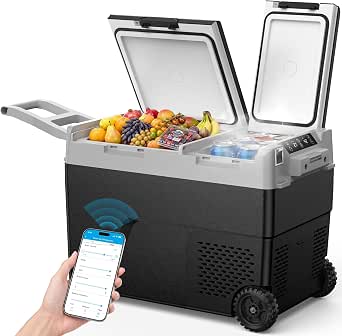 | Best for Wheeled Dual-Zone Transport | Capacity: 50 qt (48 L) | Annual energy consumption: 143 kWh | Temperature range: -4°F to 68°F | VIEW ON AMAZON | See Our Full Breakdown |
| EUHOMY 19-Quart Portable 12V Car Refrigerator |  | Best Compact Power-Conscious Pick | Capacity: 19 qt | Average power consumption: 36 W | Temperature range: -4°F to 68°F | VIEW ON AMAZON | See Our Full Breakdown |
| EUHOMY 31-Quart Portable 12V Refrigerator with Battery and App Control | 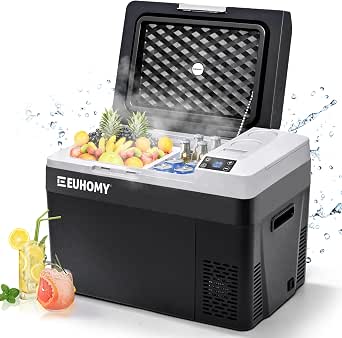 | Best for Flexible Power Options | VIEW ON AMAZON | See Our Full Breakdown | |||
| EUHOMY 23QT 12V Refrigerator –4°F to 68°F Electric Cooler for Car |  | Best Compact Low-Noise Pick | VIEW ON AMAZON | See Our Full Breakdown | |||
| A-Premium 21-Quart Portable Car Refrigerator |  | Best for ECO-Mode Power Planning | VIEW ON AMAZON | See Our Full Breakdown | |||
| Feelfunn 61-Quart Dual-Zone 12V Portable Car Refrigerator |  | Best Large-Capacity Dual-Zone Pick | VIEW ON AMAZON | See Our Full Breakdown | |||
| BougeRV CRX3 Portable Car Refrigerator with 240Wh LiFePO4 Battery, 30 Quart |  | Best for Extended Battery Runtime | VIEW ON AMAZON | See Our Full Breakdown |
| camping fridge for power consumption | Capacity |
|---|---|
| BougeRV CRH20 12V Portable Ref | 21 quarts |
| BODEGA 26-Quart Portable Car R | 26 quarts |
| BougeRV 23-Quart Portable 12V | 23 quarts |
| Alpicool CL9 10-Quart Portable | 9.23 L (10 quarts) |
| VEVOR 12 Volt Refrigerator | 40 liters |
| EUHOMY 59 Qt 12V Portable Car | 59 qt |
| EUHOMY 58-Quart Dual-Zone 12V | 58 qt |
| EcoFlow Glacier Classic 35L Po | 35L |
| Feelfunn 50 qt Dual-Zone 12V P | 50 qt (48 L) |
| EUHOMY 19-Quart Portable 12V C | 19 qt |
| EUHOMY 31-Quart Portable 12V R | — |
| EUHOMY 23QT 12V Refrigerator – | — |
| A-Premium 21-Quart Portable Ca | — |
| Feelfunn 61-Quart Dual-Zone 12 | — |
| BougeRV CRX3 Portable Car Refr | — |
More Details on Our Top Picks
BougeRV CRH20 12V Portable Refrigerator with 240Wh Battery, 21 Quart
The BougeRV CRH20 is the clearest choice here for campers who want some cooling without keeping a vehicle running or adding a separate battery: its included 240Wh detachable LiFePO4 battery is listed for up to 30 hours under certain conditions. That runtime claim is conditional, so temperature settings and ambient heat can change how long it lasts. Compared with the BougeRV 23-Quart, which needs an external power source, the CRH20 offers more independence at camp, though the 23-Quart provides a stated ECO-mode draw under 45W and faster compressor cooling. The CRH20’s 21-quart capacity suits a small food load, not a group’s full provisions. Its listed thermoelectric cooling also makes power draw and performance worth checking against your conditions rather than assuming compressor-like efficiency. Manual defrost adds upkeep.
Pros:- Detachable 240Wh LiFePO4 battery is included
- Can operate as a refrigerator or freezer
- Compact 21-quart capacity with carrying handle
- Supports 12/24V DC and 110V AC power
Cons:- Up-to-30-hour runtime depends on operating conditions
- Manual defrost requires periodic maintenance
- Thermoelectric cooling may be less suited to buyers prioritizing documented low power draw
Best for: Solo campers or couples who want a compact cooler with an included battery for short off-grid stays.
Not ideal for: Groups needing substantial food storage or campers who need predictable all-day runtime regardless of heat and temperature settings.
- Capacity:21 quarts
- Temperature range:-4°F to 68°F (-20°C to 20°C)
- Battery:240Wh detachable LiFePO4
- Listed runtime:Up to 30 hours under certain conditions
- Power options:12/24V DC; 110V AC
- Cooling method:Thermoelectric
- Dimensions:20.35 × 15.39 × 20.43 inches
- Weight:27.8 pounds
Our verdict“Choose the CRH20 if an included battery matters more than larger capacity or a clearly specified ECO-mode consumption figure.”
BODEGA 26-Quart Portable Car Refrigerator and Freezer
The BODEGA 26-Quart earns its place for campers who want to adjust cooling behavior to the power available. Its ECO and MAX modes offer a choice between lower-intensity operation and faster cooling, though the supplied data does not give a wattage or energy-use figure to quantify the difference. Compared with the BougeRV 23-Quart, which specifies under 45W in ECO mode, BODEGA leaves power planning less precise; in return, it has a little more capacity, automatic defrost, and both vehicle and household power support. IPX4 splash resistance and shock resistance are useful for rougher trips, while 31 dB operation is listed as low-noise. No portable battery is listed as included, so campers planning to leave the vehicle need another power source. Warranty information is also listed as unavailable.
Pros:- ECO and MAX modes provide different cooling settings
- Supports 12/24V DC and 100–240V AC
- IPX4 splash resistance and shock-resistant travel design
- Automatic defrost and reversible door orientation
Cons:- No portable battery is listed among included components
- No power-consumption figure is provided for energy planning
- Manufacturer warranty is listed as unavailable
Best for: Road campers who can power the fridge from a vehicle or outlet and want ECO/MAX choices plus splash resistance.
Not ideal for: Off-grid campers relying on an included battery or anyone who needs a published wattage figure to size a power station.
- Capacity:26 quarts
- Temperature range:-4°F to 68°F (-20°C to 20°C)
- Cooling method:Compressor
- Power input:12/24V DC; 100–240V AC
- Cooling modes:ECO and MAX
- Noise level:31 dB
- Water resistance:IPX4
- Dimensions:13.6 × 22.5 × 14.9 inches
Our verdict“Pick the BODEGA for adaptable vehicle-or-outlet use and travel protection, but choose the BougeRV 23-Quart if a stated ECO draw is central to your power plan.”
BougeRV 23-Quart Portable 12V Refrigerator and Freezer
For buyers comparing camping fridges by stated power use, the BougeRV 23-Quart provides one of the most actionable figures in this group: its ECO mode uses less than 45W, with maximum power listed at 60W. That gives a power-station owner a clearer starting point than the BODEGA 26-Quart, whose ECO mode is named but not quantified. The compressor also cools from 77°F to 32°F in about 15 minutes, helping bring provisions down quickly instead of relying on passive cooling. A three-level battery protection system can help reduce the risk of draining a vehicle battery, but this unit has no built-in battery, unlike the BougeRV CRH20. It is also DC-powered in the listed specs, and its 45 dB noise level and manual defrost make it less appealing for quiet, maintenance-free camping.
Pros:- ECO-mode consumption is specified as under 45W
- Rapid cooling from 77°F to 32°F in about 15 minutes
- Three-level voltage protection helps protect the vehicle battery
- Functions as a refrigerator or freezer
Cons:- Requires an external power source
- Manual defrost adds maintenance
- Listed noise level is 45 dB
Best for: Campers with a 12/24V supply or power station who want a stated ECO-mode draw for planning their energy budget.
Not ideal for: Campers wanting included battery operation, household AC input, or especially quiet performance.
- Capacity:23 quarts
- Temperature range:-8°F to 50°F
- Cooling method:Compressor
- Power input:12V/24V DC
- Maximum power:60W
- ECO-mode consumption:Less than 45W
- Cooling time:About 15 minutes from 77°F to 32°F
- Weight:22.3 pounds
Our verdict“Choose this BougeRV when a documented low ECO-mode draw matters more than an included battery or quiet operation.”
Alpicool CL9 10-Quart Portable Car Refrigerator
The Alpicool CL9 is the space-saving option for a solo traveler or pair carrying only drinks, snacks, and a small amount of chilled food. Its listed 45W average power consumption gives a useful planning figure, though actual energy use can vary with settings and surroundings. Compared with the BougeRV 23-Quart, the CL9 takes up less space and weighs less, but its 10-quart capacity is less than half as large and its stated average draw is not lower. It has ECO and MAX modes, plus three-level low-voltage shutoff to help preserve starting power when connected to a vehicle. Dual DC and AC input adds flexibility, but the single temperature zone cannot chill one section while freezing another. This is a compact, single-purpose load solution, not a substitute for a family-sized camp fridge.
Pros:- Compact 10-quart format weighs 15 pounds
- 45W average power consumption is specified
- ECO and MAX modes offer different operating settings
- Three-level low-voltage auto-shutoff and DC/AC input
Cons:- Small capacity is limited to modest supplies for one or two people
- Single-zone control cannot maintain separate fridge and freezer temperatures
- Listed average consumption is not lower than the BougeRV 23-Quart’s ECO-mode figure
Best for: Solo campers and two-person day-trip travelers who need a small compressor fridge and can work within a 10-quart load.
Not ideal for: Families, multi-day groups, or campers who need separate fridge and freezer zones or larger food storage.
- Capacity:9.23 L (10 quarts)
- Internal dimensions:9.61 × 8.23 × 7.13 inches
- External dimensions:16.8 × 12.6 × 10.3 inches
- Weight:15 pounds
- Power input:12/24V DC; 100–240V AC
- Average power consumption:45W
- Minimum temperature:-20°C
- Battery protection:Three-level low-voltage auto-shutoff
Our verdict“Choose the CL9 when compact size and a stated average draw matter more than storage capacity or dual-zone control.”
VEVOR 12 Volt Refrigerator, 42.3 QT / 40L Car Fridge, Portable Ultra-Light EPP Freezer with App Control, 12V/24V DC, 14°F to 50°F
The VEVOR 40L suits campers who need substantially more room than the 21–26-quart options and want an annual energy figure for broader power planning. Its listed 156 kWh/year gives a comparison point, but it is not a direct promise of campsite runtime: daily use and conditions determine what a battery must supply. The 40-liter capacity is far larger than the BougeRV 23-Quart, while the 17.9-pound EPP body keeps listed weight relatively low for that size. App control makes temperature adjustments easier from nearby, and three-level battery guard helps protect a vehicle battery. The tradeoff is power flexibility: unlike the BODEGA and Alpicool, the listed input is only 12/24V DC, so household AC use is not specified. Its temperature range also bottoms out at 14°F, warmer than some freezer-capable alternatives.
Pros:- 40-liter capacity accommodates larger camp provisions
- Annual energy consumption is listed as 156 kWh/year
- App control and three-level battery guard add operating convenience
- EPP construction keeps listed weight to 17.9 pounds
Cons:- Only 12/24V DC power input is listed
- Minimum temperature of 14°F is warmer than several freezer-capable alternatives
- Annual energy figure does not specify campsite runtime for a given battery
Best for: Road-tripping couples or small families who need 40 liters of storage and can run the unit from a 12/24V system.
Not ideal for: Campers needing household AC operation, a built-in battery, or freezer temperatures below 14°F.
- Capacity:40 liters
- Freezing temperature range:14°F to 32°F (-10°C to 0°C)
- Refrigeration temperature range:32°F to 50°F (0°C to 10°C)
- Power input:12V/24V DC
- Annual energy consumption:156 kWh/year
- Dimensions:16.7 × 20.1 × 15.2 inches
- Weight:17.9 pounds
- Battery guard:Three-level
Our verdict“Choose the VEVOR for more storage and an annual energy-use reference if DC-only power and a 14°F freezer floor fit your setup.”
EUHOMY 59 Qt 12V Portable Car Refrigerator
For group camping where stored food and drinks matter more than a small footprint, this 59-quart compressor fridge offers the largest stated capacity among these five picks. Its 45 W average consumption, ECO mode, and three-level battery protection give buyers practical ways to manage vehicle power, though the wattage alone does not indicate how much energy it will use over a full day. Compared with the EUHOMY 58-Quart Dual-Zone, this model lists a removable basket and a 58-can capacity, while the 58-quart alternative specifies two independently controlled zones and a lower 33 W consumption figure. The tradeoff is slower stated pull-down: cooling from 68°F to 32°F takes about 15 minutes. AC/DC support and app controls add flexibility, but its one-year warranty is brief.
Pros:- 59-quart capacity accommodates supplies for group trips
- ECO/MAX modes and three-level battery protection support power-conscious operation
- AC and DC inputs allow use at camp or in a vehicle
- App and LCD controls, removable basket, and interior LED improve access
Cons:- Listed 45 W average consumption is higher than the 33 W listed for the EUHOMY 58-Quart Dual-Zone
- Takes about 15 minutes to cool from 68°F to 32°F
- One-year manufacturer warranty
Best for: Campers traveling with a group who need room for food and drinks and can monitor battery use.
Not ideal for: Solo campers or people with tight vehicle storage who do not need 59 quarts, or buyers prioritizing the lowest listed power consumption.
- Capacity:59 qt
- Can capacity:Up to 58 standard 12 oz cans
- Temperature range:-4°F to 68°F
- Average power consumption:45 W
- Power input:12/24V DC and 100–240V AC
- Cooling method:Compressor
- Battery protection:Three levels
- Noise level:As low as 45 dB
Our verdict“Choose this EUHOMY when group-sized capacity and flexible power inputs matter more than minimizing listed wattage or storage space.”
EUHOMY 58-Quart Dual-Zone 12V Portable Refrigerator and Freezer
The standout power figure here is 33 W consumption, paired with 58-quart capacity and two independently controlled zones. That combination suits campers who want chilled food and frozen items kept separately without stepping down to a compact fridge. Against the EUHOMY 59 Qt 12V Portable Car Refrigerator, it gives up a little stated capacity but lists 12 W less consumption; the two models share AC/DC input, ECO/MAX modes, and three-level battery protection. The number is useful for comparison, but actual draw will vary with conditions and settings, and the supplied data does not give a daily energy figure. Its one-year warranty is limited, and the product information contains inconsistent model numbers—CFH-55X and CFH-35X—so buyers should confirm the exact unit before ordering.
Pros:- 33 W listed power consumption is lower than the 45 W listed for the EUHOMY 59 Qt
- Two independently controlled zones separate chilled and frozen supplies
- AC and DC power support use at camp and in a vehicle
- ECO/MAX modes and three-level battery protection provide operating flexibility
Cons:- Product details list both CFH-55X and CFH-35X model numbers
- One-year warranty
- No daily energy-consumption figure is provided for planning battery capacity
Best for: Campers who need separate refrigerator and freezer zones in a large unit and want a lower listed wattage than the other large EUHOMY option.
Not ideal for: Buyers who need a clearly documented model identity, a longer warranty, or measured daily energy-use information.
- Capacity:58 qt
- Power consumption:33 W
- Temperature range:-4°F to 68°F
- Storage zones:2 independently controlled zones
- Power sources:12/24V DC and 100–240V AC
- Cooling method:Compressor
- Battery protection:3-level (L/M/H)
- Model:CFH-55X listed; CFH-35X also appears in product details
Our verdict“Pick this model for a large dual-zone setup with the lowest stated wattage in this five-product group, after verifying its model number.”
EcoFlow Glacier Classic 35L Portable Fridge Freezer with Battery
For power-conscious camping, the supplied battery and up to 43 hours of cooling without external power make this the clearest choice here for reducing reliance on a vehicle or campsite outlet. Its six charging methods—including solar, car power, alternator, and USB-C—give buyers several ways to replenish power, while app monitoring helps track temperature and battery status. Compared with the EUHOMY 19-Quart Portable 12V Car Refrigerator, the EcoFlow offers more capacity and built-in battery operation, but it is also a larger 35L unit rather than a compact trip fridge. The stated runtime is a maximum, not a guarantee for every temperature or use pattern, and no wattage or daily energy figure is supplied for direct consumption comparisons. Its sub-38 dB operation and two-year warranty add appeal, but capacity remains below the large 58- and 59-quart options.
Pros:- Included battery provides up to 43 hours of cooling without external power
- Six charging methods include solar, car power, alternator, and USB-C
- App control supports temperature and battery monitoring
- Operating noise is under 38 dB and warranty is two years
Cons:- 35L capacity is smaller than the 58- and 59-quart EUHOMY models
- Maximum runtime can vary with operating conditions
- No wattage or daily energy-consumption figure is supplied
Best for: Off-grid campers who want battery-powered cooling, multiple recharging routes, and app-based battery monitoring.
Not ideal for: Campers who need the largest food capacity or want a stated wattage or daily energy figure for precise power-system planning.
- Capacity:35L
- Battery runtime:Up to 43 hours
- Charging options:AC outlet, car power, solar panel, alternator, USB-C, or combined input
- Cooling time:25°C to 0°C in 25 minutes
- Noise level:Under 38 dB
- Cooling method:Compressor
- Sections:2
- Warranty:2 years
Our verdict“Choose the EcoFlow for battery-backed, off-grid cooling and flexible recharging, not for the largest capacity or clearest wattage comparison.”
Feelfunn 50 qt Dual-Zone 12V Portable Refrigerator
The Feelfunn pairs two independently controlled zones with wheels and a handle, a useful combination when a loaded fridge needs to move around camp. Its 50-quart capacity is smaller than the EUHOMY 58-Quart Dual-Zone, but the Feelfunn provides explicit cooling-time, noise, and annual energy figures: it reaches 32°F from 77°F in 15 minutes, runs below 45 dB, and lists 143 kWh annually. That annual figure gives more context than a wattage rating alone, though real consumption still depends on conditions and settings. App control and automatic three-level battery protection help with vehicle use. The tradeoff is substantial weight at 42.1 lb before adding contents, so wheels help on level ground but do not solve lifting into a vehicle. Its stated support is one year of technical support, not a detailed warranty term.
Pros:- Two independently controlled compartments support separate chilled and frozen storage
- Annual energy consumption is listed at 143 kWh
- Wheels, handle, and LED lighting aid campsite handling
- App control and three-level vehicle battery protection with automatic shutoff
Cons:- At 42.1 lb, it may be difficult to lift into or out of a vehicle
- 50-quart capacity is below the EUHOMY 58- and 59-quart options
- Product data specifies one-year technical support rather than a detailed warranty
Best for: Campers who want dual-zone storage, app controls, and wheels for moving a loaded fridge across relatively level campsites.
Not ideal for: People who frequently lift gear into high vehicle cargo areas or need the largest capacity or a clearly stated long-term warranty.
- Capacity:50 qt (48 L)
- Annual energy consumption:143 kWh
- Temperature range:-4°F to 68°F
- Compartments:2 independently controlled zones
- Power input:12/24V DC and 110–240V AC
- Noise level:Under 45 dB
- Weight:42.1 lb
- Cooling time:77°F to 32°F in 15 minutes
Our verdict“Choose the Feelfunn if wheels, dual zones, and an annual energy figure matter more than easy lifting or maximum storage.”
EUHOMY 19-Quart Portable 12V Car Refrigerator
At 19 quarts, this EUHOMY is the compact choice for campers who want compressor refrigeration without dedicating cargo space to a large chest. Its 36 W average consumption is stated more clearly than the EcoFlow Glacier Classic’s unspecified wattage, though the EcoFlow includes a battery and offers up to 43 hours of operation away from external power. ECO mode and three-level vehicle battery protection help manage draw from a car, while AC/DC cords make the fridge usable at home or on the road. Compared with the EUHOMY 59 Qt, this model is much easier to fit into a compact setup but cannot carry group provisions. Its reversible, removable door and interior LED make access more adaptable; the real compromise is limited storage, and it still needs a power source rather than offering ice-based cooling.
Pros:- 36 W average consumption is specified for power planning
- ECO mode and three-level vehicle battery protection support managed operation
- AC and DC cords allow use in vehicles and at home
- Reversible removable door and interior LED improve placement and access
Cons:- 19-quart capacity is limited for group trips or extended food storage
- Requires an AC or DC power source
- No battery is included or listed
Best for: Solo campers and couples with limited vehicle space who want a small compressor fridge with a stated average wattage and battery protection.
Not ideal for: Families or longer trips needing substantial food storage, or campers who need cooling without access to a power source.
- Capacity:19 qt
- Average power consumption:36 W
- Temperature range:-4°F to 68°F
- Power input:12/24V DC and 100–240V AC
- Cooling method:Compressor
- Door:Reversible and removable
- Battery protection:Three levels; adjustable input from 8.5V to 12.4V
- Modes:ECO and MAX
Our verdict“Choose this compact EUHOMY for space-limited trips where a stated 36 W average draw matters more than storage capacity or built-in battery runtime.”
EUHOMY 31-Quart Portable 12V Refrigerator with Battery and App Control
For campers who want to switch between vehicle power, campsite AC, and battery operation, this 31-quart EUHOMY offers more ways to manage power than the 23QT EUHOMY, which has no stated built-in battery. Its 45W average consumption gives a useful reference for planning, while three-level battery protection helps reduce the risk of draining a vehicle battery. The rechargeable battery can run the fridge for up to six hours, handy for short stops away from the car but far less suited to a full day off-grid than the BougeRV CRX3’s stated ECO runtime. App and panel controls, frost-free operation, and a reversible door add flexibility. The tradeoff is that the battery’s limited runtime cannot replace a larger power station for extended camping, and the warranty information separates one-year coverage from two-year technical support.
Pros:- Runs on AC, DC, or its rechargeable battery
- Three-level battery protection helps limit vehicle battery drain
- App control and a wide -4°F to 68°F temperature range
- Frost-free design, reversible door, LED light, and USB port
Cons:- Battery runtime is limited to up to six hours
- 45W average consumption still calls for power planning during extended trips
- One-year manufacturer warranty is distinct from the stated two-year technical support
Best for: Campers who alternate between car, campsite AC, and short periods away from the vehicle and want app-based temperature control.
Not ideal for: Off-grid campers needing overnight or multi-day battery operation without recharging; its stated battery runtime is up to six hours.
Our verdict“Choose this EUHOMY if you value several power-source options and short battery breaks more than long off-grid runtime.”
EUHOMY 23QT 12V Refrigerator –4°F to 68°F Electric Cooler for Car
The 23QT EUHOMY is a compact choice for campers who want compressor cooling without adding a large unit to the vehicle. Its stated 45W power consumption matches the larger 31-quart EUHOMY, so the smaller capacity does not come with a lower listed wattage; buyers should weigh space savings against that power figure. A magnetic seal is intended to limit cold-air loss, and the 40dB operation is quieter on paper than the A-Premium’s under-45dB rating. App and Bluetooth control make temperature changes convenient, while three battery-protection modes provide some help against vehicle drain. Unlike the 31-quart sibling, this model’s supplied specifications do not list an onboard battery, so it relies on AC or vehicle power. Its one-year warranty and battery-monitoring needs are worth factoring into frequent travel plans.
Pros:- Compact 23-quart capacity for tighter vehicle setups
- 40dB noise rating is lower than the A-Premium’s stated under-45dB level
- App and Bluetooth temperature control
- Magnetic seal and three battery-protection modes
Cons:- No onboard battery is listed, so it needs an external power source
- Listed 45W consumption is the same as the larger 31-quart EUHOMY
- One-year manufacturer warranty may not suit frequent, heavy use
Best for: Solo travelers and couples with limited vehicle space who want quiet compressor cooling and app control while connected to AC or DC power.
Not ideal for: Campers seeking built-in battery operation or a lower stated wattage than larger options; neither is specified here.
Our verdict“Pick the 23QT EUHOMY when compact size and quiet operation matter more than built-in battery flexibility or a lower stated wattage.”
A-Premium 21-Quart Portable Car Refrigerator
The A-Premium earns its place for campers who want a specific efficiency figure to use when planning a power budget: it lists under 0.5kWh per day in ECO mode. That is a more directly useful daily energy estimate than the 45W figures supplied for the two EUHOMY models, though actual consumption can vary with conditions. At 21 quarts, it is also the smallest of this batch, making it easier to fit into a crowded vehicle but limiting room for food and drinks. MAX and ECO modes let owners trade faster cooling for lower reported energy use; the BougeRV CRX3 offers a lower stated ECO wattage and a much longer battery runtime, but it is built around a detachable battery and a larger capacity. Manual defrost is a practical chore, and the one-year warranty offers only modest reassurance for frequent trips.
Pros:- Lists ECO-mode energy use at under 0.5kWh per day
- Compact 21-quart size holds up to 32 standard beverage cans
- MAX and ECO modes offer a speed-versus-power-use choice
- Touchscreen controls and USB charging port
Cons:- Manual defrost requires occasional maintenance
- Actual energy use can vary with operating conditions
- Smaller capacity than the 23QT and 31-quart EUHOMY models
Best for: Campers with limited cargo room who want a stated daily ECO energy figure for estimating power-station needs.
Not ideal for: Groups storing food for several people or travelers who want automatic defrost or long battery-powered operation.
Our verdict“Choose the A-Premium if compact storage and a stated daily ECO energy estimate matter more than capacity or battery runtime.”
Feelfunn 61-Quart Dual-Zone 12V Portable Car Refrigerator
For a group that needs both chilled food and frozen supplies, the 61-quart Feelfunn offers two independently controlled zones—something the single-compartment A-Premium and BougeRV CRX3 do not. Its power figures make the operating tradeoff visible: under 30W in ECO mode, compared with 50W in MAX mode, while annual energy use is listed as 207kWh. ECO can help limit draw during steady operation, but the sizable capacity and two-zone setup still call for more careful power planning than a small cooler. The removable basket, drain, and LED lights make loading and cleanup easier, and anti-shake mounting points suit rougher travel. At 42.2 pounds and nearly 29 inches wide, it is far less convenient to move than the compact A-Premium. Its 45dB noise rating and one-year warranty are also worth noting.
Pros:- Two independently controlled zones can handle chilled and frozen goods separately
- ECO mode is listed below 30W, versus 50W in MAX mode
- Removable basket, drain, and built-in LED lights aid access and cleanup
- Three-level battery protection and anti-shake mounting points
Cons:- 42.2-pound weight makes loading and carrying harder
- Large dimensions take up substantial vehicle space
- One-year warranty and 45dB noise rating may disappoint frequent users seeking quieter, longer-term operation
Best for: Families or group campers who need separate fridge and freezer zones and have enough vehicle space and power capacity.
Not ideal for: Solo campers, compact-car owners, or anyone prioritizing easy lifting and the smallest possible power setup.
Our verdict“Choose the Feelfunn when two-zone storage and group capacity justify its weight, footprint, and higher power-planning demands.”
BougeRV CRX3 Portable Car Refrigerator with 240Wh LiFePO4 Battery, 30 Quart
The BougeRV CRX3 is the strongest fit here for campers who need cooling away from the vehicle: its detachable 240Wh LiFePO4 battery is rated for up to 28 hours in ECO mode, depending on settings and use. That is a substantial step beyond the six-hour battery runtime listed for the 31-quart EUHOMY, though it is not a guarantee of a full day under every condition. The CRX3’s ECO consumption is stated as less than 35W, and its 35dB noise rating is lower than the Feelfunn’s 45dB. At 30 quarts, it offers more room than the 21-quart A-Premium without taking on that model’s manual power-source limitations; it accepts both vehicle DC and household AC. Fast cooling, app control, and an LED light add convenience, but the battery runtime depends on use, defrosting is manual, and only two-year technical support is specified.
Pros:- Detachable 240Wh LiFePO4 battery rated for up to 28 hours in ECO mode
- ECO consumption listed below 35W
- 35dB noise rating and cooling from 77°F to 32°F in 12 minutes
- Accepts 12/24V DC and 100–240V AC, with app control and an LED light
Cons:- Battery runtime varies with settings and usage conditions
- Manual defrost requires periodic upkeep
- The supplied warranty information specifies two-year technical support rather than a stated warranty period
Best for: Campers who regularly park away from their vehicle and want a removable battery for longer stretches of compressor cooling.
Not ideal for: Buyers who need a guaranteed runtime regardless of conditions or prefer an automatic defrost system.
Our verdict“Choose the CRX3 if longer battery-powered camping stretches matter more than automatic defrost or a guaranteed runtime.”

How We Picked
I ranked these fridges around the needs behind the search for low power consumption while camping: a setup that can keep food cold without forcing buyers to carry oversized batteries or run a vehicle unnecessarily. I considered available battery options, capacity, single- versus dual-zone layouts, power-source flexibility, controls, and the practical fit between storage volume and off-grid use. A smaller fridge can be a better power-conscious choice than a feature-rich large model when a trip does not call for extra storage.
The ranking gives more weight to usable power flexibility and a sensible capacity-to-use match than to headline size or app features. Models with included batteries earn attention for self-contained planning, but battery capacity is not the same as fridge efficiency, and the provided product information does not establish directly comparable watt-hour-per-day figures for every model. I treat claims and listed features as buying clues rather than proof of lower real-world consumption; conditions such as heat, ventilation, and set temperature can change results. Larger dual-zone fridges remain useful for groups and varied food storage, but they rank below compact options for buyers whose main priority is minimizing power demand.
Factors to Consider When Choosing Camping Fridge For Power Consumption
Choosing a camping fridge for power consumption starts with your actual power budget, not the biggest capacity or the longest feature list. I would match food volume to trip length, then check how the fridge will be powered and what conditions it must handle. These factors can help you avoid buying a fridge that is either too small for the trip or more demanding than your battery setup can support.
Match Capacity to the Food You Really Carry
A fridge with unused space still has to cool its interior, so avoid treating maximum capacity as an automatic advantage. Start by estimating meals, drinks, and how often you can restock, then leave room for airflow around stored items rather than packing the compartment solid. A compact unit may be a sensible fit for solo trips or short weekends, while a group trip can justify a larger model if it replaces several coolers. The common mistake is buying extra volume “just in case” without checking whether the vehicle and power supply can handle the added load. When deciding between a compact single-zone unit and a large dual-zone fridge, count the food you will actually separate into different temperatures.
Ask for Comparable Energy Data
Do not infer low consumption from a 12V label, an app, or a battery bundle. Look for power draw and daily energy use measured under stated conditions, including ambient temperature, set point, and whether the compressor cycles or runs continuously. If two manufacturers report figures using different test conditions, those numbers may not describe a fair comparison. A useful planning estimate should leave a buffer for hot weather, frequent lid openings, and warm food added at camp. If detailed consumption figures are unavailable, treat the spec sheet as incomplete and size your battery conservatively rather than assuming the fridge will run at its lowest possible draw.
Size the Battery Around Runtime, Not the Fridge Label
Estimate how many watt-hours your fridge may use over the hours you need it running, then compare that figure with the usable capacity of your battery. Battery labels can state total capacity while the amount available to power appliances is lower, and conversion losses can reduce energy delivered through an inverter. The 240Wh batteries bundled with the BougeRV CRH20 and CRX3 simplify the initial setup, but buyers should still check expected runtime for their temperature and weather conditions. A separate power station can be a better fit if you already own one or need to run other gear, though it adds cost, weight, and cabling. Avoid planning around a best-case runtime that assumes mild weather and infrequent access.
Choose One Zone or Two for a Reason
A dual-zone fridge can chill drinks while freezing food, but the extra flexibility may come with greater energy demand and a larger footprint. If you rarely need two temperatures at once, a single-zone model can simplify both power planning and packing. Check whether the product permits one zone to be turned off or reconfigured, and confirm how its compartments are divided before counting on a particular layout. A common mistake is choosing dual-zone capacity for occasional use without considering the added space and power budget on every trip. Pay for two zones when separate temperatures solve a recurring problem, not simply because the feature sounds useful.
Plan for Heat, Airflow, and Access
Even a power-conscious fridge can use more energy when its compressor must fight heat or poor ventilation. Leave clearance around vents, shade the unit, and keep it out of a hot vehicle when possible; placement is part of the power plan, not an afterthought. Pre-chilling food and the fridge at home can reduce the energy needed after loading, while repeated lid openings let cold air escape. Think about where the fridge will sit and whether you can reach it without leaving the lid open in direct sun. If the planned location blocks airflow or bakes in afternoon heat, a smaller unit alone may not solve the problem.
Weigh Portability Against Capacity and Controls
A fridge that is hard to lift or awkward to fit in the vehicle can push buyers toward poor placement, which may affect cooling conditions. Lightweight construction, handles, dimensions, and the route from car to campsite matter alongside capacity. App control can make it easier to check settings without opening the lid, but it does not prove that a model uses less electricity. Before paying for remote controls, ask whether they solve a real access or monitoring need and whether the display is clear enough to use without a phone. A compact, straightforward unit can be the better choice for beginners, while a larger feature-rich model suits buyers who need its added storage and will manage the extra power requirements.
Frequently Asked Questions
Can I tell which camping fridge uses the least power from its capacity or battery bundle?
No. Capacity and included battery size do not provide a direct measurement of the fridge’s daily energy use. A small fridge may be easier to power because it has less space to cool, but insulation, compressor behavior, ambient heat, temperature settings, and lid openings also matter. A bundled 240Wh battery tells you about the battery’s stated capacity, not how long the fridge will run in every situation. Compare watt-hour-per-day figures measured under similar conditions whenever manufacturers provide them.
Will the BougeRV CRH20 or CRX3 run all night on its included 240Wh battery?
The listed 240Wh battery alone cannot guarantee an overnight runtime because actual use depends on weather, set temperature, ventilation, loading, and how often the fridge is opened. The CRH20 is the smaller 21-quart option, while the CRX3 offers 30 quarts, so their capacity difference may matter to both packing and power planning. Check the manufacturer’s runtime guidance and whether it states the conditions behind that estimate. For a trip where food safety depends on uninterrupted cooling, plan a backup power source instead of relying on a best-case figure.
Is a dual-zone camping fridge a poor choice if I want to conserve battery power?
Not automatically, but two temperature zones can add demands that are hard to justify if you only need one chilled compartment. If you regularly carry frozen food and fresh food together, a dual-zone layout may replace separate appliances and make the extra capacity worthwhile. If you mainly need drinks and a few meals cold, a smaller single-zone fridge is usually the simpler power-conscious direction. Check whether the model lets you disable or repurpose a zone, and compare energy figures under equivalent settings before deciding.
Should I buy a fridge with a built-in battery or use a separate power station?
A built-in battery can make setup more convenient and reduce the number of separate items to pack, which is why the BougeRV CRH20 and CRX3 stand out in this roundup. A separate power station may be more flexible if you already own one or want to run lights and other devices from the same supply. Compare usable capacity, charging options, total weight, and how easy it is to replace or recharge the battery away from camp. Either setup needs enough reserve for hot conditions and the full time between charging opportunities.
How should I estimate runtime when product listings use different power figures?
First check whether each figure describes peak watts, average draw, or energy consumed over a day; these are not interchangeable measures. Look for test details such as ambient temperature, fridge setting, ventilation, and loading, since different conditions can make a comparison misleading. For a rough plan, divide the usable battery watt-hours by a comparable average energy-use figure, then leave headroom for conversion losses and changing weather. If a listing provides no test conditions or daily consumption estimate, do not treat a runtime claim as directly comparable to another model’s claim. A small power meter test under your own expected conditions can give a more useful estimate before a longer trip.
Conclusion
For the strongest match to the power-conscious brief, I would choose the BougeRV CRH20 as best overall: its 21-quart size and included 240Wh battery make a more contained setup than the larger battery-equipped CRX3. My best value direction is a compact single-zone model such as the Alpicool CL9 if its 10-quart capacity covers the trip; buyers needing more room should compare the 23-quart BougeRV and EUHOMY options before moving to a larger class. For a premium, battery-ready choice, the EcoFlow Glacier Classic 35L is the standout for campers who prioritize a more capable portable setup, while the CRX3 suits those who want a bundled battery and more storage. Beginners should start with a compact single-zone fridge and a clearly sized power source rather than a large dual-zone model. Choose the EUHOMY or Feelfunn dual-zone models when separate chilled and frozen storage is a genuine need, and plan extra power capacity for their larger formats. I would verify comparable energy-use data before treating any one model as the lowest-consuming option, since the listed features alone do not establish a definitive efficiency winner.
Halloween Picks
halloween
As an affiliate, we earn on qualifying purchases.