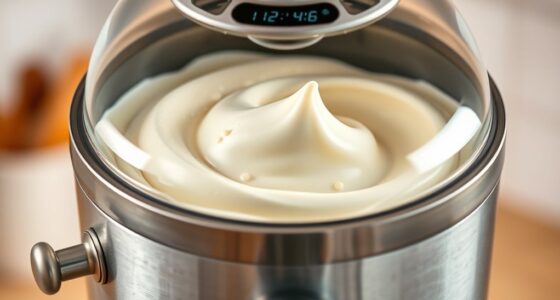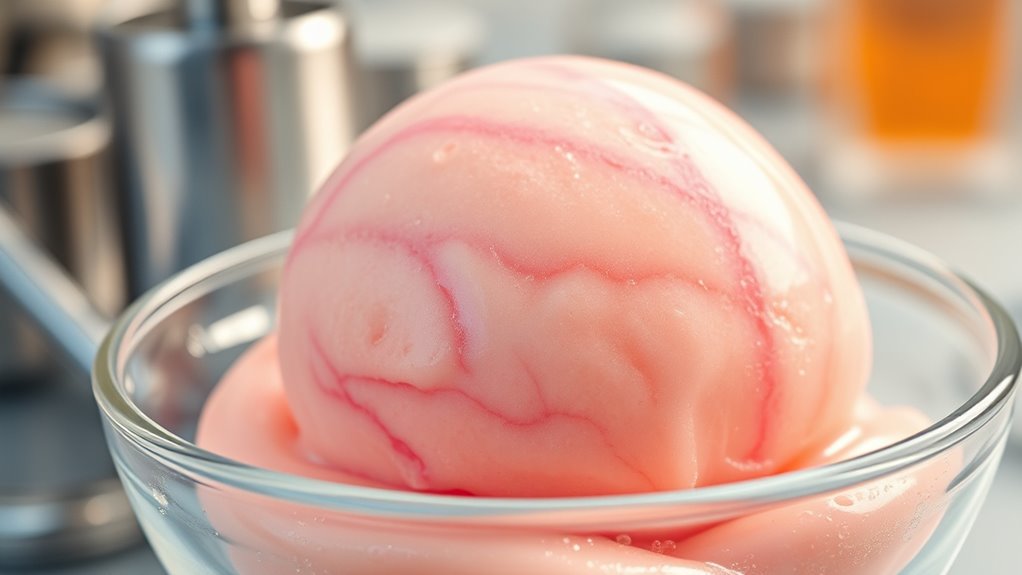

The science of freezing your gelato involves understanding heat transfer and phase change. When you freeze the mixture, heat moves from the warmer surroundings to the colder gelato, causing rapid or slow ice crystal formation depending on temperature control. Proper management guarantees small, smooth crystals and a creamy texture, while poor control results in a grainy, coarse one. If you want to see how precise thermodynamics influences each scoop, keep exploring this fascinating process.
Key Takeaways
- Heat transfer control during freezing determines ice crystal size, impacting gelato’s texture and smoothness.
- The phase change from liquid to solid involves latent heat removal, requiring efficient heat dissipation.
- Proper thermodynamic management ensures uniform freezing, preventing large ice crystals and coarse textures.
- Equipment design and process control optimize heat removal, affecting gelato’s mouthfeel and flavor development.
- Understanding heat exchange and phase transitions enables precise manipulation of gelato’s quality and sensory experience.
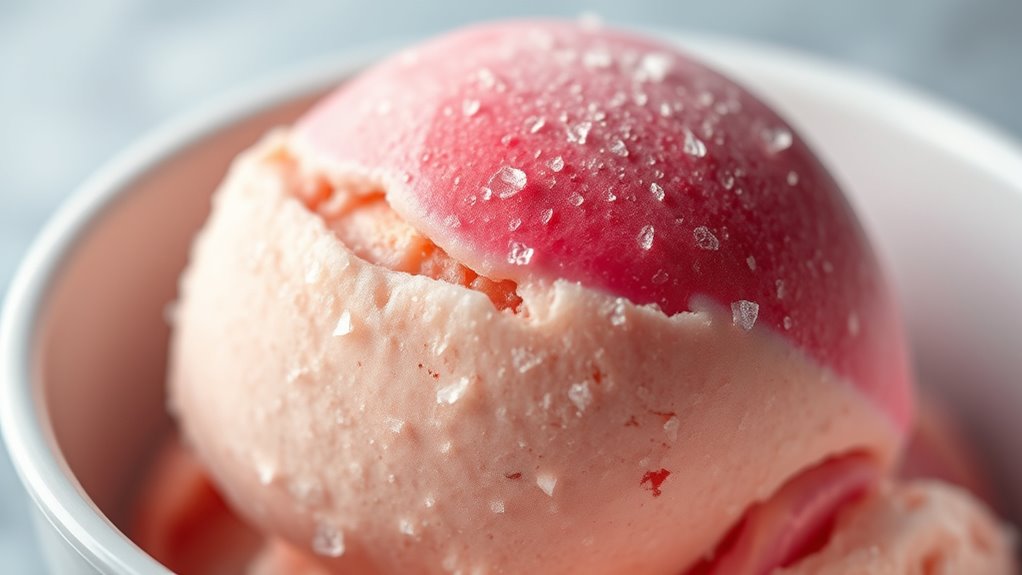
Understanding the thermodynamics of gelato reveals how temperature, heat transfer, and phase changes influence its texture and flavor. When you’re making or enjoying gelato, you’re witnessing a delicate balance of heat exchange and phase change processes that create its creamy consistency. As the mixture cools, heat transfer occurs between the warmer surroundings and the colder gelato base, gradually lowering its temperature. This heat transfer is essential because it determines how quickly the gelato freezes and impacts the final texture. If heat escapes too rapidly, the formation of ice crystals becomes too large, resulting in a grainy mouthfeel. Conversely, controlled heat transfer allows for smaller ice crystals, yielding that smooth, velvety finish you love.
Proper heat transfer ensures smooth, creamy gelato by controlling ice crystal size and texture.
The phase change from liquid to solid is at the core of gelato’s creation. When the temperature drops to the freezing point, the liquid mixture begins its transition into a solid state. During this phase change, heat is continuously removed from the mixture, and the temperature remains constant until the entire liquid has frozen. This is a key point because, during the phase change, the mixture releases latent heat, which must be dissipated for freezing to proceed fully. Managing this heat transfer effectively ensures that the gelato achieves uniform freezing, avoiding ice crystal growth that can ruin its texture. The precise control of temperature during this phase change influences not only texture but also flavor development, as certain ingredients like milk proteins and sugars behave differently depending on the freezing process.
As heat transfer continues, the temperature of the gelato drops below freezing, and the ice crystals grow slowly, which is desirable. If the heat transfer is too rapid, large crystals form, leading to a coarse texture. If it’s too slow, the formation of a stable network of small ice crystals occurs, resulting in that characteristic smoothness. The process relies on carefully controlling temperature and heat removal, often through specialized equipment like gelato machines that ensure even cooling. This control allows you to manipulate the phase change process, optimizing texture and flavor by preventing unwanted ice crystal growth and ensuring proper incorporation of air and flavor molecules.
In essence, understanding the thermodynamics behind heat transfer and phase change in gelato helps you appreciate how scientific principles shape your delicious experience. It’s not just freezing; it’s a finely tuned process where temperature management and phase transitions work together to deliver that ideal, creamy consistency that makes gelato so irresistible.

FOHERE Waffle Cone Maker Machine and Ice Cream Bowl Maker with Temperature Control, Double Side Nonstick Waffle Bowl Maker with Cone Roller, 7.5” Thin Waffle Maker for Home Kitchen (White)
- Fast and Uniform Heating: Crisp waffle cones in 3-4 minutes
- Adjustable Temperature Control: Customize browning from light to dark
- Indicator Lights: Show preheat, on/off, and baking status
As an affiliate, we earn on qualifying purchases.
As an affiliate, we earn on qualifying purchases.
Frequently Asked Questions
How Does Air Incorporation Affect Gelato’s Texture During Freezing?
Air incorporation creates air bubbles that considerably impact gelato’s texture during freezing. These bubbles make the gelato smoother and creamier by preventing large ice crystal formation, which can cause a grainy texture. As you freeze gelato, the air bubbles expand slightly, giving it a lighter, more delicate feel. Proper air incorporation enhances the overall mouthfeel, making each spoonful more enjoyable and ensuring a desirable freezing impact on the final product.
What Role Do Stabilizers Play in Gelato’s Thermodynamic Properties?
Stabilizers play a vital role in gelato’s thermodynamic properties by enhancing stabilizer interactions that prevent ice crystal growth. They improve molecular stability, ensuring a smoother, creamier texture. When you include stabilizers, they bind water molecules, reducing ice formation and controlling viscosity during freezing. This helps maintain consistent texture and quality, making your gelato less prone to melting or developing ice crystals, delivering a delightful, uniform experience with every scoop.
How Does the Fat Content Influence Gelato’s Freezing Point?
Think of gelato’s fat content as a thermostat; the more fat you add, the lower its freezing point. For example, with higher fat composition, gelato stays softer longer, melting at a lower temperature. This is because fat acts like an insulator, reducing the melting point. So, tweaking fat levels allows you to control gelato’s texture and firmness, making each scoop uniquely delightful.
Can Temperature Fluctuations Impact Gelato’s Quality After Freezing?
Temperature fluctuations can greatly impact gelato’s quality after freezing. When temperatures aren’t stable, ice crystal formation becomes uneven, leading to a grainy texture instead of smoothness. You need to maintain temperature stability to preserve gelato’s creamy consistency and prevent melting or ice crystal growth. Keep your freezer at a consistent temperature, avoiding frequent opening, to ensure your gelato remains luscious and smooth, with ideal texture and flavor.
What Is the Optimal Storage Temperature for Maintaining Gelato’s Texture?
Ever wondered what keeps gelato smooth and creamy? The essential storage temperature is around -20°C, which minimizes ice crystal formation and preserves its texture. Maintaining temperature stability is vital because fluctuations can cause ice crystals to grow, ruining the gelato’s consistency. By keeping it consistently cold at this temperature, you guarantee each scoop remains perfectly creamy and delicious, avoiding the dreaded grainy or icy texture.
Conclusion
Now that you understand the thermodynamics behind gelato, isn’t it amazing how science transforms simple ingredients into a creamy masterpiece? By controlling temperature and freezing processes, you can master the art of perfect gelato at home. So, next time you indulge, remember the physics at play—it’s a delicious blend of science and flavor. Who knew that freezing could be so fascinating? Enjoy crafting your own frozen delights with confidence!