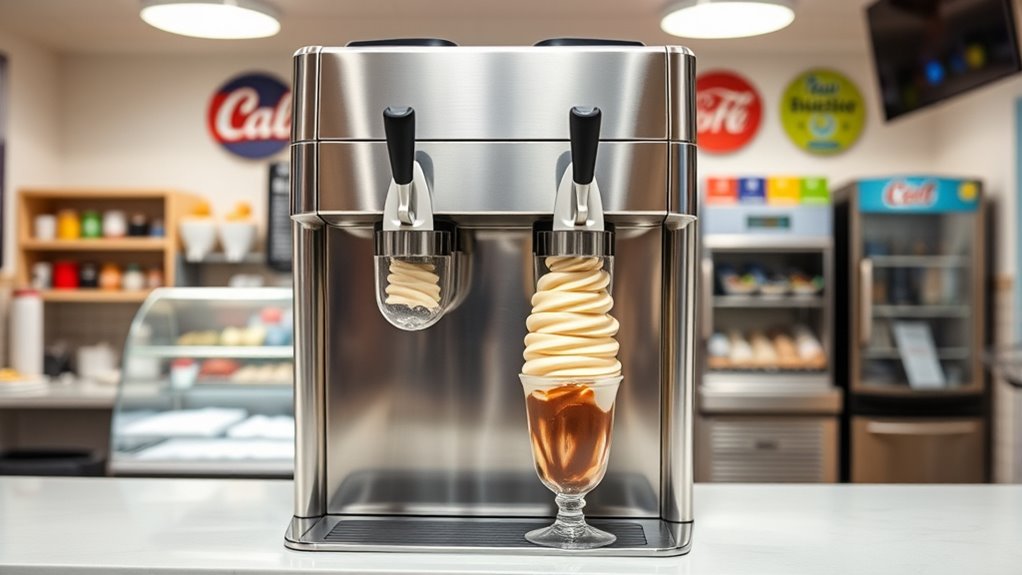

For a small business, the best overall pick is the GSEICE Soft Serve Ice Cream Machine with a 7-inch touch display and ETL certification, which pairs a commercial-oriented feature set with a useful certification signal. The VEVOR 22–30 L/H dual-hopper model stands out for higher-volume service, while the XPW 1000W single-flavor machine suits a simpler, lower-output menu. The main tradeoffs are throughput versus counter space, one flavor versus more menu variety, and easier cleaning versus added operating complexity. Published yield figures are not directly comparable across every listing, so buyers should check capacity and service conditions with the seller. Read on for how these 14 options differ and which fits your business.

Get baking supplies delivered free with Prime
- Fast, free delivery on millions of items
- Prime Video, Amazon Music and more included
- Member-only deals all year
Complete the kit


Key Takeaways
- Certification and output are different buying signals: the GSEICE 7-inch display model lists ETL certification, while several other machines emphasize yield or controls without the same stated certification detail.
- Higher stated throughput comes with a bigger service commitment: VEVOR‘s dual 6 L hopper model lists 22–30 L/H, a stronger fit for steady demand than the single-flavor 4–5 L/H countertop options.
- Three-flavor designs widen the menu but add operating complexity: the 2200W and 1800W three-flavor models may suit businesses selling variety, while a single-flavor model can simplify service and replenishment.
- Self-cleaning appears across multiple lower-output models: it can reduce routine cleaning effort, but buyers should confirm what the cycle cleans and what parts still need manual washing.
- Several listings cluster around similar claimed yields: VEVOR, GarveeLife, and Arsupen models list about 21–21.2 QT/H, so hopper capacity, dimensions, support, and service requirements may help distinguish them.


| soft serve machine for small business | Hopper capacity | Material | Subsequent batch time | Power |
|---|---|---|---|---|
| Commercial Soft Serve Ice Crea | — | Food-grade stainless steel | — | 2200W |
| VEVOR Commercial Soft Serve Ic | 2 × 4 L (1.1 gal each) | SUS201 stainless steel body; SUS304 food-grade cylinder | 6 minutes or less | — |
| Soft Serve Ice Cream Machine | — | — | 4–6 minutes | 450W |
| Commercial Countertop Soft Ser | 8 L total (4 L × 2) | 304 stainless steel | 6 minutes or less | 1800W |
| Commercial Countertop Soft Ser | 2.5 L | Food-grade stainless steel | 4–6 minutes | — |
| XPW Commercial Single-Flavor S | 1.2 gal (4.5 L) | — | — | 1000W |
| GarveeLife Commercial Soft Ser | 1.6 gal (6 L) | Stainless steel | 6 minutes or less | — |
| Arsupen Commercial Soft Serve | 1.6 gal (6 L) | Food-grade stainless steel | 6 minutes or less | 1350W |
| GSEICE GT Commercial Soft Serv | 6 L | — | — | — |
| GSEICE Soft Serve Ice Cream Ma | 1.6 gal | — | — | — |
| Commercial Soft Serve Ice Crea | 4 L | 304 stainless steel | 6 minutes or less | — |
| VEVOR Commercial Soft Serve Ic | — | SUS304 stainless steel | — | — |
| VEVOR Commercial 3-Flavor Coun | 2 × 6 L | — | 6 minutes or less | 2200 W |
| VEVOR Commercial Soft Serve Ic | 4 L / 4.2 Qt | — | — | 1000 W |
More Details on Our Top Picks
Commercial Soft Serve Ice Cream Machine, 2200W 3-Flavor Countertop Maker with LCD Touch Screen
For a small business with sharp rushes and room for a full commercial unit, the Festisoul pairs 20–28 liters per hour of stated output with three dispensing choices: two single flavors and a twist. That menu flexibility gives it an advantage over the single-flavor B0GVZ1DVV2, while the 13–17 minute first freeze is quicker than the 25 minutes listed for the B0G4VXNGXR. The tradeoff is its 2200W power draw, which calls for suitable electrical capacity, and its output may be more machine than a modest café needs outside busy periods. LCD hardness and temperature controls and one-touch cleaning can simplify daily operation, but buyers should plan counter space and power before choosing it. I’d rank it highest for shops where keeping a line moving matters more than a compact setup.
Pros:- Stated output of 20–28 L per hour supports busy service periods.
- Two single flavors plus a twist give the menu more choice than a single-flavor machine.
- LCD controls adjust hardness and temperature.
- One-touch self-cleaning and a removable drip tray aid routine cleanup.
Cons:- The 2200W rating requires electrical capacity suited to a commercial appliance.
- Its high stated output may be unnecessary for shops with light or uneven demand.
- Countertop dimensions are not provided, making space planning harder.
Best for: Small ice cream shops and busy cafés that need a twist option and substantial output during concentrated rushes.
Not ideal for: Food trucks or low-volume cafés with limited electrical capacity, counter space, or demand for multiple flavors.
- Brand:Festisoul
- Power:2200W
- Output:20–28 L/h (5.3–7.4 gal/h)
- Flavors:3: two single flavors and one mixed twist
- Batch size:8–12 servings
- Freeze time:13–17 minutes
- Controls:LCD touch screen with hardness and temperature controls
- Material:Food-grade stainless steel
- Installation:Countertop
Our verdict“Choose the Festisoul if peak-hour output and three flavor options justify its power and space demands.”
VEVOR Commercial Soft Serve Ice Cream Machine, 21 QT/H Yield
The VEVOR is a practical fit for a café or drink bar that needs steady service across two flavors and values a quick return to dispensing after the first batch. It lists 20 L per hour, a 15-minute initial freeze, and subsequent batches in six minutes or less. That repeat-batch pace is a useful distinction from the Festisoul B0FH4SNHSS, whose listing emphasizes higher peak output and a twist option instead. Two 4 L hoppers let operators keep separate flavors ready, while the LCD panel, timer, and one-click cleaning support a regular service routine. The tradeoffs are a large footprint and only two listed flavors; it also provides less stated output than the Festisoul. I’d favor it where repeat service and two dependable choices matter more than maximum throughput.
Pros:- Subsequent batch time is listed as six minutes or less.
- Two 4 L hoppers hold separate flavors.
- SUS304 food-grade steel is used for the cylinder.
- LCD controls include a timer and one-click cleaning.
Cons:- The large footprint may crowd a compact counter.
- Two hoppers provide fewer dispensing choices than the Festisoul’s three-flavor setup.
- The stated 20 L/h yield is lower than the Festisoul’s listed maximum.
Best for: Cafés, drink bars, and food stalls that serve two flavors steadily and need short waits between batches.
Not ideal for: Very small counters or shops that need a twist flavor or output above the listed 20 L/h.
- Yield:20 L/h (5.3 gal/h)
- Hopper capacity:2 × 4 L (1.1 gal each)
- Initial freeze time:15 minutes
- Subsequent batch time:6 minutes or less
- Serving capacity:8–10 servings (80 g each)
- Operating temperature:5–32°C (41–89.6°F)
- Material:SUS201 stainless steel body; SUS304 food-grade cylinder
- Controls:LCD panel with timer and one-click cleaning
Our verdict“Pick the VEVOR for a two-flavor operation that values quick repeat batches and straightforward controls.”
Soft Serve Ice Cream Machine – Countertop Single Flavor Maker, 4-5L/H Yield, Auto Clean, LCD Panel, Silver
For a new dessert counter testing one signature flavor, this machine offers a smaller stated production scale than either the Festisoul B0FH4SNHSS or the VEVOR B0GD7STDLJ. Its 4–5 L per hour yield and 450W rating point toward a lighter operation, while the listing says the first cone is ready in about 10 minutes and later batches take four to six minutes. That can suit short service windows, though the listing’s separate claim of 80–100 cones per hour depends on serving size and should not be treated as a guaranteed count. One-touch cleaning and a single-flavor setup keep the workflow focused; the same setup rules out twists and side-by-side flavor choice. Compared with the compact B0H4L2KPFR, it offers double-puffing technology, but gives no dimensions to help a small business plan its counter.
Pros:- Listed first-cone time is about 10 minutes.
- One-touch automatic cleaning reduces routine cleanup steps.
- Double-puffing technology is intended to increase overrun and produce a creamier texture.
- 450W rating is lower than the listed power of the high-output Festisoul.
Cons:- Single-flavor dispensing limits menu variety.
- The listed 4–5 L/h output is far below the Festisoul and VEVOR machines.
- Dimensions are not provided for counter planning.
Best for: New dessert counters, small food trucks, or businesses trialing one core soft-serve flavor at modest volume.
Not ideal for: Shops that need two flavors, twist servings, or a clearly specified footprint before purchasing.
- Power:450W
- Yield:4–5 L/h
- First batch time:About 10 minutes
- Subsequent batch time:4–6 minutes
- Flavor capacity:Single flavor
- Controls:LCD panel
- Cleaning:One-touch automatic cleaning
- Installation:Countertop
- Color:Silver
Our verdict“Choose this model to start with one flavor and moderate output, provided its unspecified size fits your counter.”
Commercial Countertop Soft Serve Ice Cream Machine, 3 Flavors, 5.3-7.4 Gal/H, 8L Hopper, 1800W
This three-flavor machine is aimed at a small shop that wants separate base flavors plus a twist, with features for handling ingredients across the daily schedule. Its 8 L total hopper capacity is split between two 4 L hoppers, and the listing includes pre-cooling and preservation mode. Those functions distinguish it from the Festisoul B0FH4SNHSS, which lists a faster first freeze, while this model takes about 25 minutes to make its initial batch. Both advertise up to 28 L per hour and three dispensing choices, but this machine uses 1800W rather than the Festisoul’s 2200W. That may ease the power demand, though it still needs a commercial setup and ample counter space. The stated operating range also gives buyers an ambient-temperature limit to check before placing it in a hot kitchen or food truck.
Pros:- Two 4 L hoppers support two single flavors and a mixed option.
- Pre-cooling and preservation mode support ingredient holding between service periods.
- Listed output reaches 20–28 L per hour.
- 304 stainless steel construction is specified.
Cons:- The initial freeze takes about 25 minutes, longer than the Festisoul’s listed 13–17 minutes.
- The machine has a large countertop footprint.
- The stated operating range tops out at 35°C (95°F).
Best for: Cafés and dessert shops that want three dispensing choices and need pre-cooling or preservation features for planned service.
Not ideal for: Businesses with limited counter space, hot operating environments, or a need for the quickest first batch.
- Production capacity:20–28 L/h (5.3–7.4 gal/h)
- Hopper capacity:8 L total (4 L × 2)
- Flavors:3: two single flavors and one mixed flavor
- Power:1800W
- Material:304 stainless steel
- Operating temperature:5–35°C (41–95°F)
- Initial freeze time:25 minutes
- Subsequent batch time:6 minutes or less
- Features:Pre-cooling, auto clean, preservation mode
Our verdict“Choose this model if ingredient holding and three flavor options outweigh its slower startup and space needs.”
Commercial Countertop Soft Serve Ice Cream Machine, 4-5L/H Output with Digital Panel & Self-Cleaning, Stainless Steel
Among these five, the B0H4L2KPFR has the clearest fit for a small counter: it measures 20 × 40 × 51 cm and produces a listed 4–5 L per hour. That puts it in the same lower-output class as the single-flavor B0GVZ1DVV2, but its stated dimensions make planning easier, and its 2.5 L hopper plus 1 L cylinder spell out the working capacity. A 450W compressor, roughly 10-minute first batch, and automatic pre-cooling suit a café that serves soft serve intermittently and wants chilled mix on standby. It cannot match the 20–28 L/h Festisoul or B0G4VXNGXR for a rush, and no voltage or plug details are given. I’d place it ahead of the less dimension-specific single-flavor option for operators whose counter space is the deciding constraint.
Pros:- Specified dimensions help with counter and vehicle fit planning.
- Auto pre-cooling keeps ingredients chilled during standby.
- One-click self-cleaning, defrost, and timer functions are included.
- First batch is listed at approximately 10 minutes.
Cons:- 4–5 L/h output is much lower than the high-output three-flavor machines.
- The 2.5 L hopper and 1 L cylinder limit the amount held in the machine.
- Voltage and plug compatibility are not specified.
Best for: Small cafés, milk tea shops, and food trucks with a measured counter space and intermittent soft-serve demand.
Not ideal for: High-volume shops that need a twist or multiple flavors, or buyers who require confirmed voltage and plug compatibility.
- Output:4–5 L/h (1.06–1.32 gal/h)
- Hopper capacity:2.5 L
- Freezing cylinder capacity:1 L
- Compressor power:450W
- First batch time:Approximately 10 minutes
- Subsequent batch time:4–6 minutes
- Material:Food-grade stainless steel
- Dimensions:20 × 40 × 51 cm (7.9 × 15.7 × 20.1 in)
- Features:LCD panel, auto pre-cooling, self-cleaning, defrost, timer
Our verdict“Choose this compact model for a measured, space-constrained counter with modest demand and one-flavor service.”
XPW Commercial Single-Flavor Soft Serve Ice Cream Machine, 1000W
The XPW is the clearest fit here for a small business that wants a straightforward, single-flavor service station. Its 1.2-gallon hopper and stated 10–15 liters per hour suit a focused menu better than the higher-output GSEICE GT, which is designed for heavier throughput. The 7-inch touch display tracks temperature and production, while pre-cooling and an ingredient-shortage alarm give staff useful cues during service. One-touch cleaning may also simplify closing duties. The tradeoff is capacity: with one flavor and a smaller hopper, a busy shop may need frequent refills and cannot offer flavor variety from this machine. I’d choose it for a café or snack counter with modest, predictable demand, and skip it if soft serve is a major draw during peak periods.
Pros:- Touch display shows temperature and production quantity
- Pre-cooling and ingredient-shortage alarm support routine service
- One-touch cleaning can simplify daily maintenance
- Food-grade 304 stainless steel hopper and freezing cylinder
Cons:- Single-flavor operation limits menu choice
- The 1.2-gallon hopper may need frequent refilling during busy service
- Stated output is below the 21.2-quart-per-hour GarveeLife and Arsupen models
Best for: Cafés and snack counters serving one popular soft serve flavor at a steady, modest pace
Not ideal for: Busy parlors or venues needing multiple flavors and fewer refills during rush periods
- Power:1000W
- Voltage:110V
- Flavor capacity:Single flavor
- Hopper capacity:1.2 gal (4.5 L)
- Freezing cylinder capacity:1.6 L (0.4 gal)
- Stated production:10–15 L/hour
- Display:7-inch smart touch LCD
- Cleaning:One-touch cleaning
Our verdict“Choose the XPW for a small operation built around one flavor and manageable demand; look to a higher-output model for rush-heavy service.”
GarveeLife Commercial Soft Serve Ice Cream Machine, 21.2 Qt/H
GarveeLife’s appeal is its combination of 21.2 quarts per hour of stated output and a built-in timer, which can help a small team coordinate batches during a busy service window. The listed first batch time is about 15 minutes, followed by batches in six minutes or less. That puts it in a similar output class to the Arsupen 1350W, while the Arsupen provides a stated power figure and the GarveeLife leaves power requirements unspecified. Its 1.6-gallon hopper, auto-cooling, touchscreen, and one-click cleaning cover useful day-to-day needs. The missing dimensions and electrical requirements make counter and utility planning harder, though. I’d shortlist it when its controls fit the workflow, but favor the better-documented Arsupen if equipment planning depends on known power specifications.
Pros:- Stated output of up to 21.2 quarts per hour
- Built-in timer and touchscreen controls support consistent operation
- Auto-cooling and one-click cleaning address routine service tasks
- 1.6-gallon hopper helps reduce refill interruptions
Cons:- Power requirements are not specified in the supplied product data
- Dimensions are not provided, complicating counter-space planning
- First batch takes about 15 minutes
Best for: Small cafés and food counters that want timed batch cues and a comparatively high stated hourly output
Not ideal for: Businesses that need confirmed power requirements or exact dimensions before planning a countertop installation
- Stated output:Up to 21.2 qt/h
- Hopper capacity:1.6 gal (6 L)
- First batch time:About 15 minutes
- Subsequent batch time:6 minutes or less
- Controls:Touchscreen
- Cooling:Auto-cooling
- Cleaning:One-click cleaning
- Material:Stainless steel
Our verdict“Pick the GarveeLife for its timer and stated throughput if you can confirm the installation details before buying.”
Arsupen Commercial Soft Serve Ice Cream Machine, 21.2 QT/H, Touch Screen
The Arsupen earns a distinct place among the countertop machines by pairing 21.2 quarts per hour of stated output with a specified 1350W draw. For a small operator checking electrical capacity, that detail makes initial planning more concrete than with the GarveeLife, whose supplied data omits power requirements. Both offer a 1.6-gallon hopper, touchscreen controls, auto-cooling, one-click cleaning, and similar batch timing, so the Arsupen’s stated wattage is its clearest point of difference. Its first batch takes 15 minutes, with later batches listed at six minutes or less. The product information does not give dimensions, and a high output rating alone cannot determine real-world service capacity. I’d consider it for a café with a suitable circuit and counter space; a tighter setup may suit the narrower GSEICE GT better.
Pros:- Specified 1350W power draw aids electrical planning
- Stated output of 21.2 quarts per hour
- 1.6-gallon hopper supports longer runs between refills
- Touchscreen, auto-cooling, timer, and one-click cleaning
Cons:- Countertop footprint may be difficult to accommodate
- Dimensions are not included in the supplied specifications
- First batch takes 15 minutes
Best for: Café and restaurant operators who need a stated power figure while planning a high-output countertop machine
Not ideal for: Small kitchens with limited counter space or buyers who need confirmed dimensions before installation
- Model:1350W Countertop
- Power:1350W
- Stated output:21.2 quarts per hour
- Hopper capacity:1.6 gal (6 L)
- First batch time:15 minutes
- Subsequent batch time:6 minutes or less
- Material:Food-grade stainless steel
- Controls and functions:Touch screen, auto-cooling, one-click cleaning, built-in timer
Our verdict“Choose the Arsupen if its stated power draw helps your planning and your counter can accommodate a full-size countertop unit.”
GSEICE GT Commercial Soft Serve Ice Cream Maker Machine
For a business where counter width is the main constraint, the GSEICE GT stands apart with its stated 8.3-inch-wide body. That slim profile is a meaningful alternative to the GarveeLife and Arsupen, which have countertop designs but no dimensions in the supplied data. The GT also claims 4–4.5 gallons per hour, a first batch in 10 minutes, and up to 25% overrun, giving operators useful details for estimating service and texture. Pre-cooling and freshness modes support holding the machine ready between serving periods, while its three-step cleaning requires no disassembly. At 100 pounds, however, it is not easy to move, and its listed 6L hopper calls for planning around replenishment. I’d favor it for a narrow café counter, but compare its output carefully with the GSEICE touch-display model before choosing between them.
Pros:- Stated 8.3-inch width can fit narrow counter layouts
- Stated output of 4–4.5 gallons per hour with a 10-minute first batch
- Pre-cooling and freshness modes support service readiness
- Three-step one-touch cleaning without disassembly
Cons:- At 100 pounds, it is difficult to relocate
- 6L hopper may require replenishment during sustained service
- Up to 25% overrun is lower than the other GSEICE model’s stated 32%
Best for: Cafés and compact food counters that need a narrow machine with stated commercial output
Not ideal for: Operators who need portable equipment, or who prioritize a larger hopper and higher stated overrun
- Model:GT
- Hopper capacity:6 L
- Stated output:4–4.5 gal/h
- First batch time:10 minutes
- Dimensions:30 × 8 × 22 in
- Weight:100 lb
- Overrun:Up to 25%
- Certification:ETL
- Noise level:Approximately 62 dB
Our verdict“Choose the GT when a narrow footprint matters most and the machine can stay in one place.”
GSEICE Soft Serve Ice Cream Machine, Commercial Countertop Maker with 7″ Touch Display, ETL Certified
This GSEICE model is the strongest fit in the batch for operators who want more control over finished texture: its dual overrun system is listed at up to 32%, compared with up to 25% for the GSEICE GT. The 1.6-gallon hopper is also larger than the GT’s listed 6L hopper, and both models share a stated output of 4–4.5 gallons per hour and a 10-minute first batch. A 7-inch touch display and one-button cleaning give staff clear controls and a simpler routine. Its 8.3-inch body is designed to sit against a wall, but the product notes that it still needs rear heat clearance, so the slim width does not eliminate installation planning. I’d pick it over the GT when hopper size and stated overrun matter more than the GT’s compact listed dimensions.
Pros:- 1.6-gallon hopper is larger than the GT’s listed 6L hopper
- Dual overrun system is specified up to 32%
- Stated output of 4–4.5 gallons per hour with a 10-minute first batch
- 7-inch touch display and one-button cleaning
Cons:- Requires rear heat clearance despite its slim body
- Commercial-grade size and weight may not suit home use
- No exact machine weight is provided in the supplied specifications
Best for: Ice cream shops and cafés that want a larger hopper and adjustable texture potential in a narrow-bodied machine
Not ideal for: Small home kitchens or counters without room for rear heat clearance and a heavy commercial appliance
- Hopper capacity:1.6 gal
- Freezing cylinder capacity:0.42 gal
- Stated output:4–4.5 gal per hour
- First batch time:10 minutes
- Overrun:Up to 32%
- Body width:8.3 in
- Display:7-inch touch display
- Certification:ETL
- Noise level:Approximately 62 dB
Our verdict“Choose this GSEICE model over the GT if you value its larger hopper and higher stated overrun and have suitable rear clearance.”
Commercial Soft Serve Ice Cream Machine, 10.4-20 QT/H Yield, 4L Hopper & 1.6L Cylinder, Pre-Cooling & Auto Clean, Touch LCD
For a small café or food truck serving one flavor at a time, this countertop model pairs a 10–20 L/h stated output with quick batch turnover: the first batch is listed at 12 minutes, with later batches taking six minutes or less. Its 4 L hopper is smaller than the dual 6 L hoppers on the VEVOR 22–30 L/H machine, so busy operators may need to refill more often, but it also suits a narrower menu and more modest service volume. Pre-cooling and freshness functions can help keep mix ready between rushes, while one-touch cleaning may simplify end-of-shift upkeep. The tradeoff is limited flavor capacity and a hopper that may not keep pace with sustained high demand. I’d rank it for quick, focused service rather than a multi-flavor menu.
Pros:- Stated output of 10–20 L/h supports steady service for a focused menu.
- First batch is listed at 12 minutes, with later batches at six minutes or less.
- Pre-cooling and freshness functions can help keep mix ready between rushes.
- One-touch automatic cleaning and an LCD touch screen simplify routine operation.
Cons:- A single 4 L hopper needs more frequent refills than the dual 6 L hoppers on the VEVOR 22–30 L/H model.
- One flavor at a time limits menu variety compared with dual-hopper machines.
- Countertop placement still requires dedicated workspace.
Best for: Small cafés, bars, and food trucks that want quick single-flavor service and have room for a countertop commercial machine.
Not ideal for: High-volume shops needing several flavors at once or long stretches between mix refills.
- Yield:10–20 L/h (10.4–20 QT/H)
- Hopper capacity:4 L
- Freezer cylinder capacity:1.6 L
- First batch freeze time:12 minutes
- Subsequent batch time:6 minutes or less
- Material:304 stainless steel
- Controls:LCD touch screen
- Operating ambient temperature:41–95°F / 5–35°C
Our verdict“Choose this model for quick, single-flavor service in a small business; pick a dual-hopper machine if menu variety or fewer refills matter more.”
VEVOR Commercial Soft Serve Ice Cream Maker, 22–30 L/H, Dual 6 L Hoppers
This VEVOR is the capacity pick in this group: its 22–30 L/h output and two 6 L hoppers are aimed at shops serving a steady queue, while the two base flavors and mixed option let one machine cover more of the menu. Compared with the single-flavor BQL-9200ST, it offers substantially more stated throughput and flavor choice, but its 29.3 × 21.3 × 34 in footprint asks for a sizable counter area. Adjustable texture, pre-cooling, shortage alerts, thawing, and self-cleaning offer useful controls for daily service, though the listed features do not include a power rating. That missing detail makes electrical planning less straightforward. I’d favor this machine for an established café or snack bar with space and demand to use its capacity, not a low-volume stall.
Pros:- Stated production capacity of 22–30 L/h is the highest in this batch.
- Two 6 L hoppers support more mix on hand than the 4 L single-flavor models.
- Two base flavors plus a mixed option give small menus more variety.
- Texture adjustment, shortage alerts, pre-cooling, thawing, and self-cleaning support day-to-day operation.
Cons:- Its listed dimensions require substantial counter space.
- The product data does not state its power rating, complicating electrical planning.
- Its capacity and dual-flavor setup may be excessive for a low-volume business.
Best for: Busy cafés, bakeries, and snack bars with counter space for a large machine and demand for two base flavors plus a mixed serving.
Not ideal for: Food stalls or compact cafés with limited counter space, modest demand, or strict electrical planning needs before purchase.
- Production capacity:22–30 L/h
- Mixing hopper capacity:2 × 6 L
- Freezing cylinder capacity:2 × 2 L
- Flavor options:2 single flavors and 1 mixed flavor
- Serving capacity:150–200 servings per hour (100 g per serving)
- Dimensions:29.3 × 21.3 × 34 in
- Material:SUS304 stainless steel
- Controls:LCD panel with adjustable texture
Our verdict“Choose this VEVOR when your shop needs high throughput and three serving options; skip it if counter space or electrical details are limiting.”
VEVOR Commercial 3-Flavor Countertop Soft Serve Ice Cream Machine
For an operator who wants three serving options and more control over the mix, this VEVOR combines two 6 L hoppers with a built-in puffing pump, hopper agitation, adjustable hardness, and a low-mix alert. Those features distinguish it from the VEVOR 22–30 L/H model, whose data highlights adjustable texture and self-cleaning but does not specify a puffing rate. Here, the listed yield is 20–28 L/h, slightly below that higher-capacity VEVOR’s range, and first-batch freezing takes 13–17 minutes. Subsequent batches are listed at six minutes or less. The product data omits dimensions and weight, so fitting it into a tight café line will take extra planning. I’d pick it when texture adjustment and mix monitoring matter more than maximizing stated hourly output.
Pros:- Two 6 L hoppers support two base flavors and a mixed serving.
- Adjustable hardness gives operators control over serving texture.
- Hopper agitation and a low-mix alert help manage mix consistency and refills.
- One-touch self-cleaning and pre-cooling add convenient operating functions.
Cons:- Stated yield of 20–28 L/h is below the 22–30 L/h VEVOR dual-hopper alternative.
- First batch takes a listed 13–17 minutes.
- Dimensions and weight are not provided, making placement harder to plan.
Best for: Cafés and dessert counters that want two base flavors plus a mixed option, with adjustable hardness and mix-level alerts.
Not ideal for: Small kitchens that need confirmed dimensions before allocating counter space, or high-volume shops prioritizing the lineup’s highest stated yield.
- Yield:20–28 L/h
- Power:2200 W
- Flavors:2 base flavors plus mixed
- Hopper capacity:2 × 6 L
- First batch freeze time:13–17 minutes
- Subsequent batch time:6 minutes or less
- Puffing rate:25–35%
- Controls:LED display with hardness adjustment, pre-cooling, and one-touch self-cleaning
Our verdict“Choose this model for three flavor options and hands-on texture and mix controls, provided you can confirm its footprint before buying.”
VEVOR Commercial Soft Serve Ice Cream Machine, 10.6 Qt per Hour
The BQL-9200ST is the more modest single-flavor option for a café, shop, or food stall that does not need the output of the dual-hopper VEVOR machines. Its up to 10 L/h output and 4 L hopper suit a focused menu; the product data lists continuous service for four to six 80 g portions, then six minutes or less for an additional batch. A touch panel with automatic cooling and one-touch cleaning keeps the controls simple, while the food-grade SUS304 cylinder offers a clear material distinction from its SUS201 body. Compared with the other single-flavor model in this batch, its specified 1,000 W power and included components give buyers more concrete planning details, though that model lists up to 20 L/h. The tradeoff is lower throughput and no second flavor. I’d place it with low-volume operators.
Pros:- Up to 10 L/h output and a 4 L hopper fit a focused, lower-volume service plan.
- Touch controls include automatic cooling and one-touch cleaning.
- The cylinder is food-grade SUS304 stainless steel.
- Specified 1,000 W power and included components help with setup planning.
Cons:- Single-flavor operation limits menu choice compared with either dual-hopper VEVOR model.
- Its stated output is below the other single-flavor model in this batch, which lists up to 20 L/h.
- Continuous serving capacity is listed as four to six 80 g portions.
Best for: Small cafés, food stalls, and shops with a single-flavor menu and modest, intermittent demand.
Not ideal for: Businesses that need multiple flavors, a high hourly output, or continuous service through a long rush.
- Model:BQL-9200ST
- Output:Up to 10 L / 10.6 Qt per hour
- Hopper capacity:4 L / 4.2 Qt
- Cylinder capacity:1.6 L
- Power:1000 W
- Initial freeze time:About 15 minutes
- Materials:SUS201 stainless steel body; food-grade SUS304 stainless steel cylinder
- Operating ambient temperature:41°F–89.6°F / 5°C–32°C
Our verdict“Choose the BQL-9200ST for a small business with a simple single-flavor menu and modest demand; choose a higher-capacity model for busy service.”

How We Picked
I ranked these machines for the realities of a small business: how much product they claim to serve, how much menu variety they support, and whether their controls and cleaning features seem manageable during a shift. I also weighed build and compliance details when a listing supplied them, along with the footprint implied by countertop or hopper design. The ranking favors a balance of commercial fit and decision-useful information over one headline specification.
The GSEICE 7-inch display model leads because the listing combines a touch interface with stated ETL certification. The dual-hopper VEVOR ranks highly for businesses prioritizing output, while the three-flavor models are better matches for broader menus. Single-flavor machines with lower stated yields rank as practical candidates for modest service needs, though listings that omit important operating details are harder to recommend confidently. Yield figures and feature descriptions come from the supplied product names; verify current specifications, electrical requirements, cleaning instructions, and certification directly with the seller before buying.
Factors to Consider When Choosing Soft Serve Machine For Small Business
A machine’s fit depends on the service pattern around it: when demand peaks, how much counter and storage space you have, and who will clean and maintain it. I would settle those operating questions before comparing touchscreens or headline output figures.
Match Rated Output to Your Busiest Rush
Start with the number of servings you expect to sell during your busiest hour, rather than your daily average. A machine that can keep up across a lunch rush may be more useful than one with a large daily capacity but slow recovery between servings. Ask the seller how the stated yield was measured and whether it assumes continuous dispensing or ideal conditions. Mix temperature, ambient heat, and time between batches can affect real service. Avoid buying far beyond demand, since idle capacity still takes up space and requires cleaning. If demand is uncertain, plan for a machine that can cover a rush without forcing you to staff around a complicated workflow.
Choose Flavor Count Around Your Menu
Multiple flavors can make a dessert menu more appealing, but every additional flavor brings another mix supply to manage and another part of the machine to clean. A three-flavor setup makes sense when customers regularly choose different flavors or when a twist option supports your menu. A single-flavor unit can be the better business decision for a café adding one frozen item or a kiosk with limited storage. Think through how often each hopper will be replenished and whether slow-selling flavors could lead to waste. Check whether a machine’s advertised flavor count includes twist dispensing or refers to separate flavors only. Menu variety pays off when it serves a clear customer demand.
Measure the Full Installation Footprint
Countertop machines still need room for ventilation, access, and safe cleaning, so measure more than the machine’s width and depth. Confirm the electrical supply, plug type, and circuit requirements before committing; higher wattage can affect where the machine can be installed. Check the height under shelves and the clearance needed to open panels or remove parts. Also map where mix containers, cleaning supplies, and spare parts will live. A compact body can be difficult to use if it blocks a prep surface or sits too far from a sink. Ask the seller for a dimension drawing and operating weight, then plan the installation around the whole work area.
Treat Cleaning Claims as a Routine, Not a Button
Self-cleaning can shorten parts of the cleaning process, but it does not automatically replace disassembly, sanitizing, or manual washing. Ask which components the cycle reaches, how long it takes, and what the operator must do before and after it runs. For a small team, the best cleaning system is one staff can follow consistently during a busy day. Confirm whether cleaning consumes mix or requires specific supplies, since those needs affect daily operations. Read the sanitation instructions before purchase and check that the procedure works with your local food-safety rules. A machine with a simple, documented routine may be easier to manage than one with more automation but unclear steps.
Check Serviceability and Seller Support
A machine can have appealing controls and output claims yet become a problem if a small part fails and replacements are hard to source. Before buying, ask about warranty coverage, response times, parts availability, and who performs repairs. Request the user manual and cleaning schedule so you can see whether staff can handle routine care without specialist help. For a business that depends on frozen desserts, ask what backup options exist during downtime. Compare support details across sellers rather than assuming that similar-looking machines have equivalent service. Clear answers reduce the chance that a promising listing turns into an operational bottleneck.
Verify Compliance for Your Location
Certification language can matter for commercial installation, insurance, inspections, and workplace policies, but requirements depend on your location and the equipment’s use. The GSEICE 7-inch display listing states ETL certification; for other models, do not infer certification from the word commercial. Ask for the exact certification documentation and verify it against the requirements that apply to your premises. Check food-contact material details and any local rules for sanitation and electrical equipment. Keep those documents with your equipment records. A lower-output model with paperwork and support that satisfy local requirements may be a better fit than a higher-output machine that cannot be approved for your site.
Frequently Asked Questions
How much output does a small business actually need?
Estimate servings during your busiest hour and compare that with the machine’s stated hourly yield, while leaving room for slower real-world conditions. The listings here range from 4–5 L/H single-flavor models to a VEVOR dual-hopper model listed at 22–30 L/H, so they address very different demand patterns. Ask sellers how their figures are measured and how quickly the machine recovers after repeated dispensing. If you are opening a new menu item, start from realistic foot traffic and avoid paying for capacity you cannot use. A small buffer for rushes is useful, but the machine should still fit your normal staffing and storage limits.
Should I choose a single-flavor machine or a three-flavor model?
Choose based on how much flavor choice contributes to sales, not on the largest menu the machine can offer. A three-flavor countertop model can support a broader menu and may help a venue with varied customer preferences. A single-flavor unit usually means fewer mixes to store and a simpler routine for a small team. Consider whether you can keep each flavor fresh and whether all options will sell regularly. If one signature flavor is the main draw, extra flavor capacity may add work without improving the offer.
Does an auto-clean feature mean I can skip manual cleaning?
No. The feature may automate a rinse or cleaning cycle, but the scope differs by machine and does not necessarily cover every food-contact component. Ask for the exact cleaning procedure, including parts to remove, sanitizer steps, and required frequency. The listings for several 4–5 L/H models mention self-cleaning, but that phrase alone does not describe the full routine. Compare the written instructions with your local food-safety requirements and staff schedule. Buy only after you know what the operator still needs to do by hand.
What should I verify before ordering a countertop machine?
Confirm dimensions, ventilation clearance, weight, electrical requirements, and access for cleaning before placing an order. Countertop placement can save floor space, but the machine still needs room for mix storage and staff movement. Ask whether the stated wattage requires a dedicated circuit and verify that the plug matches your site. Request a manual and parts list, then check warranty coverage and local service availability. For models advertised as certified, request the documentation rather than relying on a product title alone.
Are machines with similar advertised yields interchangeable?
No. Similar yield claims do not establish that machines have the same hopper size, freezing capacity, recovery time, or service needs. For example, several listings cluster near 21 QT/H, while their descriptions differ in brand, interface, and other details. Ask each seller to define the yield conditions and provide hopper and cylinder capacities. Compare the cleaning procedure, footprint, electrical needs, and support alongside output. Those details may matter more to daily operations than a small difference in a headline figure.
Conclusion
For a balanced commercial feature set, I would start with the GSEICE 7-inch touch display model, especially if its stated ETL certification fits your site’s requirements. For a business expecting steady volume, the VEVOR dual 6 L hopper model is the output-focused choice; for a broader menu, compare the three-flavor countertop machines and confirm their capacity and installation needs. A new operator with modest demand may prefer a single-flavor 4–5 L/H model with self-cleaning, after checking the full manual cleaning routine. For a lower-power single-flavor option, consider the XPW 1000W listing, while treating its suitability as dependent on verified capacity and service support. The best value is the machine whose verified output, support, and cleaning demands match your actual service—not simply the one with the largest number in its title.