Humidity can make pastry work harder: sugar may clump, chocolate can lose its clean finish, and damp storage areas need extra attention. For a pastry kitchen, I put steady moisture removal and practical drainage ahead of broad room-coverage claims, since those claims do not tell me how a unit will perform under every kitchen’s conditions. The AEOCKY BOREAS-001 is my leading all-around choice for its stated capacity and included drain hose; the SEMKAP 32-Pint is the quieter, compact alternative on paper; and the AEOCKY RHEA-003 is the heavy-duty option for large, persistently humid spaces. The tradeoff is clear: higher capacity can mean a larger, louder machine, while smaller units may need frequent tank emptying or struggle with moisture loads. I compare the five picks by how those differences fit real pastry-kitchen needs, not by room-size claims alone.

Get baking supplies delivered free with Prime
- Fast, free delivery on millions of items
- Prime Video, Amazon Music and more included
- Member-only deals all year
Complete the kit


Key Takeaways
- The AEOCKY BOREAS-001 balances high stated extraction, approximately 40 dB operation, and a supplied drain hose, but its 0.8-gallon tank makes continuous drainage the sensible setup.
- The SEMKAP is listed at 35 dB on its lowest fan setting and includes a hose, though its compact tank still calls for a drain point during busy production.
- The AEOCKY RHEA-003 is the capacity choice for a large or very humid workspace, but its 50 dB minimum fan noise and 43.4-pound weight are real compromises.
- The Waykar offers a useful middle ground with 34-pint stated capacity, flexible modes, and quiet operation, but its 0.62-gallon tank is the smallest listed.
- The Midea suits a smaller kitchen that values app control and ENERGY STAR certification, but its 22-pint capacity and hose-not-included setup make it less suited to heavy moisture loads.
| AEOCKY BOREAS-001 50-Pint Dehumidifier with Drain Hose |  | Best Overall for a Humid, Active Pastry Kitchen | Model: BOREAS-001 | Moisture removal: Up to 50 pints/day at 95°F and 95% RH; 38 pints/day at 86°F and 80% RH | Noise level: Approximately 40 dB | VIEW ON AMAZON | See Our Full Breakdown |
| Waykar 34-Pint Dehumidifier for Spaces up to 2,000 Sq. Ft. | 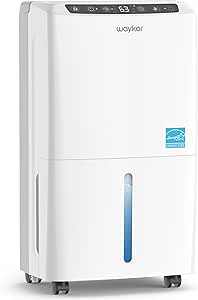 | Best Mid-Range Fit for Flexible Everyday Use | Dehumidification capacity: 34 pints per day | Recommended area: Up to 2,000 sq. ft. | Water tank: 0.62 gallons | VIEW ON AMAZON | See Our Full Breakdown |
| Midea 22-Pint Dehumidifier for Up to 1,500 Sq. Ft. |  | Best for Smaller Kitchens and App-Based Control | Coverage area: Up to 1,500 square feet | Dehumidification capacity: 22 pints per day | Tank capacity: 0.8 gallons | VIEW ON AMAZON | See Our Full Breakdown |
| SEMKAP 32-Pint Dehumidifier with Drain Hose |  | Best Compact, Quiet-Spec Option | Coverage area: Up to 2,500 sq. ft. | Moisture removal: Up to 32 pints per day | Tank volume: 2.5 liters | VIEW ON AMAZON | See Our Full Breakdown |
| AEOCKY RHEA-003 8,000 Sq. Ft. Dehumidifier |  | Best Premium-Capacity Option for Large Kitchens | Coverage: Up to 8,000 sq. ft. | Dehumidification capacity: Up to 140 pints/day at 95°F and 95% RH; 95 pints/day at 86°F and 80% RH | Certification: ENERGY STAR Most Efficient 2025 | VIEW ON AMAZON | See Our Full Breakdown |
| dehumidifiers for pastry kitchen | Drainage | Noise level | Dehumidification capacity | Dimensions |
|---|---|---|---|---|
| AEOCKY BOREAS-001 50-Pint Dehu | Included 2 m gravity drain hose; 3/4 in. GHT adapter | Approximately 40 dB | — | — |
| Waykar 34-Pint Dehumidifier fo | Tank or 3.3 ft drain hose | — | 34 pints per day | 10.87 × 8.39 × 19.3 in. |
| Midea 22-Pint Dehumidifier for | Tank or continuous hose drainage; hose not included | 47 dBA | 22 pints per day | — |
| SEMKAP 32-Pint Dehumidifier wi | Manual tank or continuous drainage; 3.28 ft hose | 35 dB at lowest fan speed | — | 6.7 × 11.4 × 16.3 in. |
| AEOCKY RHEA-003 8,000 Sq. Ft. | — | — | Up to 140 pints/day at 95°F and 95% RH; 95 pints/day at 86°F and 80% RH | 17.68 × 11.14 × 24.09 in. |
More Details on Our Top Picks
AEOCKY BOREAS-001 50-Pint Dehumidifier with Drain Hose
The BOREAS-001 takes my top position because it combines a strong stated extraction rate with details that suit regular operation: an included 2-meter drain hose, smart humidity control, and automatic defrost. Its output is listed as up to 50 pints per day at 95°F and 95% RH, falling to 38 pints at 86°F and 80% RH. That second figure is a useful reminder that a pastry kitchen should not size equipment from the most favorable headline figure alone.
Compared with the Waykar 34-Pint, the BOREAS-001 gives more stated removal capacity and supplies a longer drain hose, making it a better fit when moisture loads are steady. It is also listed at approximately 40 dB, quieter than the RHEA-003’s 50 dB minimum, though the SEMKAP claims a lower 35 dB at its lowest fan setting. Its 0.8-gallon tank is not generous, so I would plan on continuous drainage rather than relying on manual emptying through a shift. The tank must remain installed while draining through the hose, which may affect how a buyer expects to service it. This is my most balanced pick, not a substitute for a commercial HVAC solution in a very large or high-output kitchen.
Pros:- High stated capacity, with output figures supplied for two hot, humid conditions
- Includes a 2-meter gravity-drain hose and 3/4-inch GHT adapter
- Approximately 40 dB operating noise and smart humidity control
- Automatic defrost supports operation in cooler spaces
Cons:- The 0.8-gallon tank may fill quickly without a drain hose
- Tank must remain installed during continuous drainage
- Actual extraction varies with room temperature and humidity
Best for: A small or medium pastry workspace with recurring humidity and a nearby gravity-drain point.
Not ideal for: A large production kitchen needing industrial-scale moisture control, or a setup where continuous drainage is unavailable and staff cannot empty a small tank often.
- Model:BOREAS-001
- Moisture removal:Up to 50 pints/day at 95°F and 95% RH; 38 pints/day at 86°F and 80% RH
- Noise level:Approximately 40 dB
- Tank capacity:0.8 gallons
- Drainage:Included 2 m gravity drain hose; 3/4 in. GHT adapter
- Defrost:Automatic
- Coil material:Pure copper tubing
Our verdict“I would choose the BOREAS-001 for a humid pastry kitchen that needs capable extraction and can make continuous drainage part of the setup.”
Waykar 34-Pint Dehumidifier for Spaces up to 2,000 Sq. Ft.
The Waykar sits between the compact Midea and the higher-capacity AEOCKY models. Its 34-pint daily rating, adjustable 30%–80% humidity range, and three modes give it useful flexibility for a kitchen that also needs a drying mode for damp areas. It is listed as operating as low as 38 dB, which can be appealing where staff work close to the unit, and automatic defrost, shutoff, and power-outage memory reduce routine intervention.
Against the BOREAS-001, the Waykar gives up stated capacity and includes a shorter 3.3-foot drain hose, but it offers a clear middle-ground configuration rather than the largest extraction claim. Its 0.62-gallon tank is the smallest in this lineup, so I would not choose tank-only operation for a busy production day. The drain-pipe switch also needs to be tightened when using the tank to prevent leaks. At 22.1 pounds, it is lighter than the Midea’s listed 33.5 pounds and the RHEA-003’s 43.4 pounds, a practical advantage when staff need to move it between rooms. It is best viewed as a versatile room dehumidifier, not equipment for severe moisture loads.
Pros:- 34-pint stated daily capacity with a 30%–80% humidity setting range
- Tank or continuous hose drainage, with three operating modes
- Noise listed as low as 38 dB
- Automatic shutoff, defrost, and power-outage memory
Cons:- The 0.62-gallon tank can require frequent emptying
- Drain-pipe switch must be tightened for tank use to prevent leaks
- The supplied hose is only 3.3 feet long
Best for: A small business or home pastry workspace seeking multiple operating modes, modest capacity, and a portable unit.
Not ideal for: A high-output kitchen where moisture removal needs to stay high all day, or buyers who want a large reservoir and minimal drainage maintenance.
- Dehumidification capacity:34 pints per day
- Recommended area:Up to 2,000 sq. ft.
- Water tank:0.62 gallons
- Drainage:Tank or 3.3 ft drain hose
- Humidity range:30%–80%
- Modes and fan speeds:Dehumidifying, drying, and continuous; 2 fan speeds
- Noise and weight:As low as 38 dB; 22.1 lbs
- Dimensions:10.87 × 8.39 × 19.3 in.
Our verdict“I’d pick the Waykar when portability and flexible modes matter more than maximum extraction or a larger water tank.”
Midea 22-Pint Dehumidifier for Up to 1,500 Sq. Ft.
The Midea is the lower-capacity choice for a pastry room where humidity is a manageable nuisance rather than a heavy, constant load. It removes up to 22 pints per day, is ENERGY STAR certified, and offers Wi-Fi, app, Alexa, and Google Assistant controls. Remote adjustments can be handy when the unit sits in a back room, although connected controls do not make its extraction capacity comparable to the BOREAS-001 or the RHEA-003.
Compared with the Waykar, the Midea has a smaller stated capacity but a similar 0.8-gallon tank and a wider set of connected controls. Its 47 dBA operating figure is higher than the listed low settings for the Waykar and SEMKAP, so I would not rank it first for a quiet work area. It rolls on four wheels, but its listed 33.5-pound weight is heavier than the Waykar. A drain hose is not included, which adds a setup step if continuous drainage is important. I see this as the sensible pick for a smaller kitchen that values energy certification and remote control more than raw moisture removal; buyers with frequent steam or dishwashing moisture should step up to a stronger unit.
Pros:- ENERGY STAR certified
- Wi-Fi and app control, with Alexa and Google Assistant support
- Four-wheel design helps reposition the unit
- Tank or continuous drainage options
Cons:- 22-pint capacity trails the Waykar and both AEOCKY models
- Drain hose is not included
- 47 dBA listing is louder than the lowest stated figures for several alternatives
Best for: A compact pastry kitchen with moderate humidity where app control and ENERGY STAR certification are priorities.
Not ideal for: A high-moisture production space, or anyone needing an included drain hose and lower listed operating noise.
- Coverage area:Up to 1,500 square feet
- Dehumidification capacity:22 pints per day
- Tank capacity:0.8 gallons
- Humidity setting range:35%–85%
- Noise level:47 dBA
- Controls:Wi-Fi, SmartHome app, Alexa, and Google Assistant
- Drainage:Tank or continuous hose drainage; hose not included
- Dimensions and weight:10.51 × 15.31 × 19.8 in.; 33.5 lb
Our verdict“I’d choose the Midea for a smaller, moderately humid kitchen where connected controls matter more than high extraction capacity.”
SEMKAP 32-Pint Dehumidifier with Drain Hose
The SEMKAP is the small-footprint pick, with listed dimensions of 6.7 × 11.4 × 16.3 inches and a stated 35 dB at the lowest fan speed. That makes it attractive for a pastry kitchen where an appliance must fit around work areas and conversation matters. It removes up to 32 pints per day and supports manual or continuous drainage, with a 3.28-foot hose supplied. Automatic defrost and full-tank shutoff add basic safeguards, while wheels and a handle make moving it less awkward.
On paper, its low-noise figure is more appealing than the BOREAS-001’s approximately 40 dB and the Midea’s 47 dBA, but those specifications are not necessarily measured under identical conditions. The BOREAS-001 has a higher stated extraction figure and a longer hose; the SEMKAP counters with a compact body and a larger 2.5-liter tank than the Waykar’s 0.62 gallons. Still, that reservoir can need emptying during sustained use, so continuous drainage remains the better approach. The manual also calls for leaving the unit upright for 24 hours before first use, a setup delay to plan around. I’d favor it where a compact form and low fan setting matter, not as a proven replacement for a larger commercial system.
Pros:- 32-pint stated moisture-removal capacity
- Listed at 35 dB on the lowest fan speed
- Includes a 3.28-foot drain hose and supports manual drainage
- Compact dimensions, wheels, and handle aid placement and movement
Cons:- The 2.5-liter tank may need frequent emptying without continuous drainage
- Requires 24 hours upright before first use
- Its listed extraction capacity is below the BOREAS-001 and far below the RHEA-003
Best for: A compact pastry workspace that values a small footprint, included drain hose, and a low listed noise setting.
Not ideal for: A kitchen that needs the highest stated extraction rate, or a buyer who cannot wait 24 hours before initial operation.
- Coverage area:Up to 2,500 sq. ft.
- Moisture removal:Up to 32 pints per day
- Tank volume:2.5 liters
- Drainage:Manual tank or continuous drainage; 3.28 ft hose
- Noise level:35 dB at lowest fan speed
- Humidity range:30%–90% RH
- Dimensions:6.7 × 11.4 × 16.3 in.
- Other features:Automatic defrost, 24-hour timer, child lock, full-tank shutoff
Our verdict“I’d select the SEMKAP when compact placement and a quiet low-speed setting outweigh maximum moisture-removal headroom.”
AEOCKY RHEA-003 8,000 Sq. Ft. Dehumidifier
The RHEA-003 is the outlier in this group. Its stated removal reaches 140 pints per day at 95°F and 95% RH, or 95 pints at 86°F and 80% RH, far beyond the other four models’ published capacities. For a large pastry production space with persistent humidity, that headroom is its main appeal. It also carries ENERGY STAR Most Efficient 2025 certification, power-off memory, humidity controls, and low-temperature operation.
That capacity comes with a substantial fit penalty: at 43.4 pounds and 17.68 × 11.14 × 24.09 inches, it is the largest and heaviest choice here. Its minimum listed fan noise is 50 dB, making the SEMKAP, Waykar, and BOREAS-001 more appealing where staff work beside the appliance. Unlike those smaller picks, the information supplied does not list a tank capacity or hose details, so I would verify drainage arrangements and operating requirements before buying. The certification is a useful signal, but it does not establish how much energy a particular kitchen will save. I rank it for scale, not convenience: buyers with a modest room or light moisture load should favor the BOREAS-001 or Waykar instead.
Pros:- Highest stated extraction capacity in this lineup
- ENERGY STAR Most Efficient 2025 certification
- Power-off memory supports restart after an interruption
- Designed for low-temperature operation
Cons:- Large and heavy at 43.4 pounds
- 50 dB minimum fan noise is higher than the other listed low-noise options
- Energy-savings and durability claims are manufacturer-provided, and drainage details are not supplied here
Best for: A large production kitchen with substantial, ongoing humidity and space for a heavier appliance.
Not ideal for: A small or quiet pastry workspace, or a buyer who needs confirmed tank and drain-hose details before choosing.
- Coverage:Up to 8,000 sq. ft.
- Dehumidification capacity:Up to 140 pints/day at 95°F and 95% RH; 95 pints/day at 86°F and 80% RH
- Certification:ENERGY STAR Most Efficient 2025
- Minimum noise level:50 dB
- Dimensions:17.68 × 11.14 × 24.09 in.
- Weight:43.4 lbs
- Features:Humidity control, power-off memory, low-temperature operation
Our verdict“I’d reserve the RHEA-003 for a large, persistently humid kitchen where its capacity is worth the noise, weight, and need to confirm drainage details.”

How We Picked
I ranked these dehumidifiers around the demands of a pastry kitchen rather than treating their advertised coverage areas as interchangeable performance guarantees. Kitchens generate moisture from dishwashing, boiling, proofing, and frequent door openings, while pastry work can benefit from a more controlled environment. I therefore gave the most weight to stated moisture-removal capacity, drainage practicality, and noise where staff may work nearby. I also looked at controls, mobility, cold-weather features, and the burden of managing a water tank during a production shift.
Capacity figures need context: the AEOCKY units list output at specific hot, humid test conditions, and actual extraction changes with temperature and relative humidity. I did not treat square-foot coverage as a promise that a unit can manage a working kitchen’s moisture load. Nor do I assume any of these appliances can safely operate beside splashing water, hot equipment, or food-contact surfaces. Placement, airflow, drainage access, and the manufacturer’s operating instructions still matter. The ranking favors useful combinations of capacity and operating convenience; it does not replace measuring the room’s humidity or checking electrical and food-safety requirements.
| dehumidifiers for pastry kitchen | Drainage |
|---|---|
| AEOCKY BOREAS-001 50-Pint Dehu | Included 2 m gravity drain hose; 3/4 in. GHT adapter |
| Waykar 34-Pint Dehumidifier fo | Tank or 3.3 ft drain hose |
| Midea 22-Pint Dehumidifier for | Tank or continuous hose drainage; hose not included |
| SEMKAP 32-Pint Dehumidifier wi | Manual tank or continuous drainage; 3.28 ft hose |
| AEOCKY RHEA-003 8,000 Sq. Ft. | — |
Factors to Consider When Choosing Dehumidifiers For Pastry Kitchens
For pastry work, the right unit depends on how much moisture your kitchen produces, where the appliance can sit, and whether a drain is available. I would start with the room and workflow, then compare capacity and upkeep instead of buying based on a coverage figure alone.
Match capacity to the moisture load
Daily extraction figures describe moisture removal under stated test conditions, not a guaranteed result in every kitchen. Temperature and relative humidity affect compressor performance, and steam from cooking or dishwashing can raise the load. The BOREAS-001 gives two reference conditions, which helps show how its stated output changes. The RHEA-003 offers much more listed capacity for large, humid spaces, but it may be excessive for a small pastry room. I would track room humidity during representative production days and compare those readings with the unit’s operating range and manufacturer guidance.
Plan drainage before choosing a unit
Small tanks can fill quickly when a dehumidifier runs through a production shift. The Waykar’s 0.62-gallon reservoir is particularly limited; the BOREAS-001 and Midea each list 0.8 gallons, while SEMKAP lists 2.5 liters. A continuous gravity drain can reduce staff interruptions, but it needs a suitable drain point and a clear hose route that will not create a trip or sanitation hazard. The BOREAS-001 and SEMKAP include hoses; the Midea does not. For the RHEA-003, the information here does not specify drainage hardware, so I would confirm it before purchase.
Balance noise with placement
Noise matters when the appliance runs near mixers, decorating stations, or customer areas. The listed figures range from 35 dB at the SEMKAP’s lowest fan speed to 50 dB minimum for the RHEA-003, but manufacturers may use different test conditions, so I would not treat small numerical gaps as exact head-to-head results. A wall, door, or separate utility area can change the practical effect of noise. Leave the required clearances for airflow and keep the unit away from splashes, heat, and food-contact surfaces.
Use humidity controls as part of a workflow
Adjustable humidity settings help users set a target rather than running continuously without regard to conditions. The Waykar offers a 30%–80% range, while the SEMKAP lists 30%–90% RH; Midea includes Wi-Fi and voice controls, and the AEOCKY models provide humidity control features. Remote access can simplify checks, but it does not replace a separate, appropriately placed hygrometer or regular observation of product and storage conditions. Choose controls your staff can use consistently, and follow the equipment manual rather than assuming a single humidity target suits every recipe or room.
Check mobility, electrical needs, and maintenance
Moving a unit around a working kitchen is not always convenient. The Waykar is listed at 22.1 pounds, compared with 33.5 pounds for the Midea and 43.4 pounds for the RHEA-003. Wheels or handles can help, but floor space and hose placement still matter. Check the voltage and wattage against your facility’s electrical setup, keep filters and air inlets accessible, and follow each model’s defrost and cleaning instructions. For a commercial operation, I would also confirm that the appliance’s intended use, placement, and drainage comply with local electrical, sanitation, and workplace rules.
Frequently Asked Questions
What humidity level should I aim for in a pastry kitchen?
There is no single target for every pastry kitchen, recipe, or storage area. Chocolate work, sugar handling, proofing, and ingredient storage can have different environmental needs, so I would follow the applicable recipe and ingredient guidance and use a hygrometer to understand the room’s actual conditions. A dehumidifier’s adjustable setting is a control, not a guarantee that every part of the kitchen reaches that level.
Is a 50-pint dehumidifier always better than a 22-pint model?
No. A higher stated capacity gives more headroom when moisture loads are high, but can bring a larger body, more noise, and different operating demands. The BOREAS-001 is a stronger fit than the Midea for heavier humidity based on listed extraction, while the Midea may suit a smaller room with moderate moisture and a preference for app control. I would size the unit to observed conditions rather than choose the largest figure automatically.
Should I use the water tank or continuous drainage?
Tank drainage can work when the unit runs intermittently and someone can check it, but small reservoirs may need frequent emptying during production. For longer operating periods, a gravity hose to a suitable drain is usually more convenient, provided it can be routed safely and installed as instructed. Check whether a hose is included: the BOREAS-001 and SEMKAP include one, while the Midea listing says its hose is not included.
Can I place a dehumidifier beside ovens or food-preparation surfaces?
I would not place one where it can be splashed, exposed to high heat, obstructed, or positioned so its airflow reaches uncovered food or food-contact surfaces. Follow the manufacturer’s clearance and operating instructions, and check workplace and sanitation requirements for your kitchen. A separate utility corner or adjacent room may be a better location if it can still manage the relevant humidity and has safe drainage and electrical access.
Do the advertised room sizes tell me which model will work?
They are useful as a rough reference, but square-foot coverage alone does not account for steam, ventilation, ceiling height, open doors, or moisture-generating equipment. A pastry kitchen’s workload can differ sharply from a typical room of the same area. I would compare the capacity figures and operating conditions, monitor humidity during normal production, and ask the manufacturer or a qualified HVAC professional for guidance when the space has a substantial or persistent moisture problem.
Conclusion
For most small or medium pastry kitchens with a drain nearby, I would start with the AEOCKY BOREAS-001: it combines the strongest all-around balance of stated capacity, noise, and included drainage in this group. Choose the SEMKAP if compact placement and its low listed fan setting matter most, or the Waykar if you want flexible modes in a lighter unit and can manage its small tank. The Midea makes more sense for a smaller, moderately humid workspace where app control and ENERGY STAR certification take priority over extraction. For a large kitchen with persistent moisture, consider the AEOCKY RHEA-003, but confirm drainage arrangements and accept its weight and higher noise figure. I would base the final choice on measured humidity, safe placement, and a practical drainage plan—not coverage claims alone.
Fall Picks
fall essentials
As an affiliate, we earn on qualifying purchases.