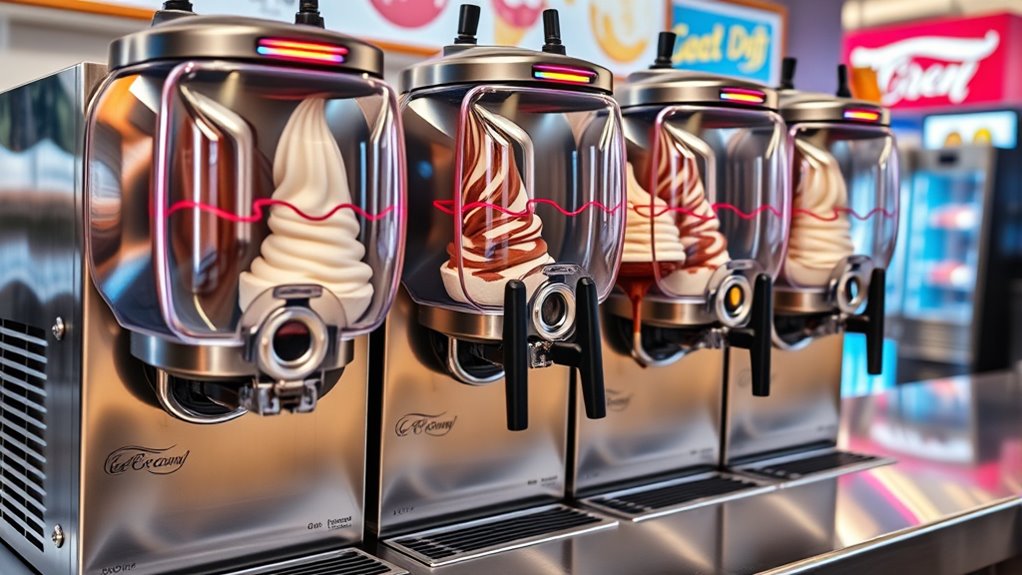

For a commercial soft serve machine with a mix of stated output, three-flavor service, and freestanding capacity, I’d start with the VEVOR 20–28 L/H 2200W model. The XPW stands out for its LCD touch screen and auto-clean function, while the VEVOR 22–30 L/H countertop model may suit operators who want a smaller footprint and a frozen yogurt option. These machines differ in stated capacity, format, controls, and cleaning features, so the right choice depends on your service volume and space. Higher output can bring greater power and space demands, while compact machines may require more frequent refills. Read on for my full comparison and buying guide.

Get baking supplies delivered free with Prime
- Fast, free delivery on millions of items
- Prime Video, Amazon Music and more included
- Member-only deals all year
Complete the kit


Key Takeaways
The VEVOR 20–28 L/H freestanding models combine a stated 2200W draw with two 6L hoppers, making them the lineup’s clearest fit for operators prioritizing capacity and floor placement.
The XPW is the standout for simplified controls and cleaning, with an LCD touch screen and auto-clean feature that may appeal to teams seeking a more guided workflow.
VEVOR’s 22–30 L/H countertop models claim the highest output range listed here, but buyers should check counter space, power, and cooling demands before choosing by yield alone.
Several listings describe similar VEVOR machines with different formats or sparse model details; confirm the exact configuration, hopper capacity, and included accessories before ordering.
The 4L hopper model and the 8L hopper model point to different service rhythms: smaller batches can suit limited demand, while larger capacity can reduce refill interruptions.


| commercial soft serve machine | Hopper capacity | Power | Material |
|---|---|---|---|
| VEVOR Commercial Soft Serve Ic | 2 × 6 L | 2200W | — |
| GSEICE Commercial Soft Serve I | 6 L | — | — |
| VEVOR Commercial Soft Serve Ic | 4 L | 1000W | — |
| VEVOR Commercial Soft Serve Ic | 2 × 6 L | 2200W | — |
| XPW Commercial Soft Serve Ice | 2 × 1.6 gallons (6 L each) | 2450W | Food-grade 304 stainless steel |
| GSEICE Commercial Soft Serve I | 1.58 gal | 120V/60Hz | — |
| VEVOR Commercial Soft Serve Ic | 2 × 6 L | 2200 W | Stainless steel |
| VEVOR Commercial Soft Serve Ic | 2 × 6 L | 2200 W | Stainless steel |
| VEVOR Commercial Soft Serve Ic | 2 × 6 L (1.6 gal) | — | SUS304 stainless steel |
| Commercial Soft Serve Ice Crea | 8 L (2 × 4 L) | 1800 W | 304 stainless steel |
| VEVOR Commercial Soft Serve Ic | 2 × 4 L | — | — |
| GSEICE Commercial Soft Serve I | 2 × 8 L | — | — |
| Garvee Commercial Soft Serve I | 1.6 gal | 2200 W | Stainless steel |
| VEVOR Commercial Soft Serve Ic | 2 × 6 L | — | SUS304 stainless steel |
| Commercial Soft Serve Ice Crea | 4 L | — | 304 stainless steel |
More Details on Our Top Picks
VEVOR Commercial Soft Serve Ice Cream Machine, 20-28L/H, 2200W, 3-Flavor Freestanding
For a shop that expects steady rushes, I’d rank this VEVOR freestanding model ahead of the smaller single-flavor VEVOR BQL-9200ST. Its stated output of 20–28 L/H and two 6 L hoppers are better suited to serving several flavors without frequent refills. The 2+1 setup adds a mixed option alongside two separate flavors, while pre-cooling is intended to help keep mix fresh during service. A puffing rate of 25–35% also gives operators some room to shape texture and yield. The tradeoff is footprint and infrastructure: this is a freestanding machine that needs substantial floor space and a 220V supply. I’d choose it for a dedicated dessert counter with the space and electrical service to support its throughput, rather than a café adding soft serve on a small counter.
Pros:- Stated 20–28 L/H output supports sustained service.
- Two 6 L hoppers feed a three-flavor 2+1 setup.
- Pre-cooling and low-mix alerts support ingredient management.
- One-touch self-cleaning and LED controls simplify routine operation.
Cons:- Requires a 220V power supply.
- Freestanding form needs substantial floor space.
- Its 2200W draw may be demanding for smaller operations.
Best for: Ice cream shops and dessert bars serving frequent rushes that can accommodate a freestanding unit and 220V power.
Not ideal for: Small cafés or mobile vendors with limited floor space or only standard 110V outlets.
- Brand:VEVOR
- Model:YKF-9236
- Power:2200W
- Output rate:20–28 L/H
- Flavors:3 (2+1 configuration)
- Hopper capacity:2 × 6 L
- First batch time:≤15 minutes
- Puffing rate:25–35%
Our verdict“Choose this VEVOR when high throughput and three flavors matter more than floor space and electrical flexibility.”
GSEICE Commercial Soft Serve Ice Cream Maker Machine
The GSEICE GT is the space-conscious pick in this group: at 8.3 inches wide, it is easier to fit into a tight service area than either 2200W, three-flavor VEVOR machine. Its stated yield of 3.5–4 gallons per hour and quick follow-up batches make it a more capable choice than a small countertop novelty machine, while the 6 L hopper gives staff a useful supply between refills. The three-step cleaning system requires no disassembly, which may ease daily close-down. In exchange for its compact size, it offers one hopper and no listed three-flavor configuration, so it cannot match the menu flexibility of the larger VEVOR models. I’d shortlist it for a café or dessert station where counter width matters more than serving multiple flavors at once.
Pros:- Narrow 8.3-inch width fits constrained counters.
- 6 L stainless steel hopper offers practical mix capacity.
- Follow-up batch time is listed at 2–3 minutes.
- Three-step cleaning does not require disassembly.
Cons:- Single 6 L hopper limits simultaneous flavor options.
- Listed yield is below the 20–28 L/H VEVOR models.
- One-year warranty may be limiting for a heavily used machine.
Best for: Cafés and small food-service counters that want commercial soft serve capacity in a narrow footprint.
Not ideal for: High-volume shops that need several flavors available simultaneously or the 20–28 L/H output of the larger VEVOR machines.
- Brand:GSEICE
- Model:GT
- Yield:3.5–4 gal/h
- First batch time:10 minutes
- Follow-up batch time:2–3 minutes
- Hopper capacity:6 L
- Width:8.3 inches
- Certification:ETL Certified
Our verdict“Pick the GSEICE GT for a narrow counter and quick service, provided one hopper meets your menu needs.”
VEVOR Commercial Soft Serve Ice Cream Machine
This countertop VEVOR is the straightforward choice for an operator who wants a dedicated soft-serve flavor without giving up a commercial form factor. Its stated 10 L/H output sits below the 20–28 L/H three-flavor VEVOR machines, but its smaller 4 L hopper and 1000W power rating make it a different fit for a focused menu or lower-volume service. The SUS304 cylinder is the food-contact component, while the touch screen, pre-cooling, and automatic cleaning target routine operation. Its initial freeze takes about 15 minutes, with later batches listed under six minutes. The clear compromise is single-flavor production: compared with the XPW’s three-flavor setup, this model offers less variety. I’d favor it when counter placement and a simple menu matter more than flavor choice.
Pros:- Countertop format suits installations without room for a freestanding unit.
- SUS304 stainless steel cylinder is specified for the freezing chamber.
- Touch controls include pre-cooling and automatic cleaning.
- Subsequent batch time is listed at under six minutes.
Cons:- Produces only one flavor, unlike the XPW three-flavor machine.
- 10 L/H stated capacity is below the larger VEVOR models.
- 4 L hopper means less mix capacity than the 6 L-hopper options.
Best for: Small restaurants or food stalls that want one dependable soft-serve flavor from a countertop machine.
Not ideal for: Businesses whose menu depends on multiple flavors or a mixed flavor option.
- Brand:VEVOR
- Model:BQL-9200ST
- Capacity:10 L/H (10.6 QT/H)
- Power:1000W
- Hopper capacity:4 L
- Cylinder capacity:1.6 L
- Flavor type:Single flavor
- Initial freeze time:About 15 minutes
Our verdict“Choose this VEVOR for a compact, single-flavor menu where countertop placement matters more than variety.”
VEVOR Commercial Soft Serve Ice Cream Machine, 20-28L/H, 2200W, 3-Flavor Countertop Maker with 2x6L Hoppers
This countertop VEVOR brings the same headline 20–28 L/H capacity and 2+1 flavor arrangement as the freestanding VEVOR, with a form factor suited to shops that plan to install the machine on a work surface. The pair of 6 L hoppers supports a larger reserve than the single-hopper GSEICE GT, and listed follow-up batches of 3–5 minutes suit a steady queue. Pre-cooling and automatic agitation are aimed at keeping mix ready and limiting ice crystals during operation. The practical tradeoff is that “countertop” does not mean small: the unit still needs significant counter space and draws 2200W. For a dedicated shop with room for a heavy commercial appliance, I’d favor it over the smaller single-flavor VEVOR; for a cramped café, the GSEICE is easier to place.
Pros:- Stated 20–28 L/H output is suited to busy service.
- Two 6 L hoppers support two base flavors and a mixed option.
- Pre-cooling and automatic agitation support mix quality during operation.
- Follow-up batches are listed at 3–5 minutes.
Cons:- Requires significant counter space despite its countertop format.
- 2200W power demand may challenge smaller electrical setups.
- Two hoppers and a commercial cleaning routine may be more machine than a low-volume café needs.
Best for: Ice cream shops and cafés with a broad counter that need high output and three dispensing options.
Not ideal for: Small counters or operators seeking a lower-power, narrow machine such as the GSEICE GT.
- Brand:VEVOR
- Production capacity:20–28 L/H
- Power:2200W
- Flavors:3 (2+1 configuration)
- Hopper capacity:2 × 6 L
- First batch time:13–17 minutes
- Subsequent batch time:3–5 minutes
- Pre-cooling temperature:≤53.6°F (12°C)
Our verdict“Choose this countertop VEVOR for high-volume, multi-flavor service when your counter and power supply can support it.”
XPW Commercial Soft Serve Ice Cream Machine – 3 Flavors, 2450W, LCD Touch Screen, Auto Clean
The XPW’s clearest distinction is its listed 110V voltage, giving it a different installation profile from the 2200W VEVOR machines, which may require a 220V supply. It still serves three options through two 6 L hoppers and a mixed flavor, with a stated capacity of 5.3–7.4 gallons per hour. That output is below the VEVOR machines’ stated 20–28 L/H, so I’d place the XPW with restaurants and bars that value a three-flavor menu and a standard-voltage connection over maximum throughput. Its LCD panel adjusts hardness, while freshness mode and shortage alerts add operating flexibility. The tradeoffs are its 2450W draw and significant counter footprint; it is not a low-power or space-saving alternative. Casters help move it for cleaning or repositioning, but do not shrink its working area.
Pros:- Three-flavor 2+1 arrangement adds a mixed option.
- Two 6 L stainless steel hoppers provide substantial mix capacity.
- Freshness mode supports overnight ingredient storage.
- LCD controls include hardness adjustment and shortage alerts.
Cons:- Listed 5.3–7.4 gallons per hour is below the 20–28 L/H VEVOR models.
- 2450W power draw may increase operating demands.
- Significant counter space is required.
Best for: Restaurants and bars that want three flavor options and a machine listed for 110V service.
Not ideal for: High-volume shops prioritizing the VEVOR 20–28 L/H capacity, or small counters with limited space and power headroom.
- Power:2450W
- Compressor power:1200W
- Voltage:110V
- Capacity:5.3–7.4 gal/h
- Hopper capacity:2 × 1.6 gallons (6 L each)
- Flavors:3 (2 single, 1 mixed)
- Noise level:68 dB
- Material:Food-grade 304 stainless steel
Our verdict“Pick the XPW for a three-flavor menu on a listed 110V connection, if its power draw and footprint suit your site.”
GSEICE Commercial Soft Serve Ice Cream Machine
Compact footprint is the main reason I’d place this GSEICE ahead of the larger VEVOR freestanding model for a small café or snack counter. Its stated output of 3.5 gallons per hour suits steady service without requiring the floor space of a high-volume freestanding unit. The 1.58-gallon hopper and 0.42-gallon freezer tank give operators a defined batch scale, while the maker’s double puffing technology is intended to improve texture and reduce mix use. A one-touch wash cycle also cuts down on routine cleanup steps. The tradeoff is slower startup: the first molding takes 10 minutes, so it needs advance planning before opening or a rush. Its 120V/60Hz requirement and lower stated output make it a weaker fit than the VEVOR countertop models for sustained peak demand.
Pros:- Compact design can fit tighter commercial work areas.
- Stated output of up to 3.5 gallons per hour supports moderate service.
- Double puffing technology is designed to improve texture while reducing mix use.
- One-touch automatic wash cycle simplifies cleaning.
Cons:- The 10-minute first molding time requires advance preparation.
- Lower stated output than the VEVOR machines rated at 20–30 L/H.
- Requires a 120V/60Hz power source.
Best for: Small cafés and dessert counters that need a compact machine for moderate, planned service.
Not ideal for: High-volume shops that need rapid startup and sustained output beyond 3.5 gallons per hour.
- Hopper capacity:1.58 gal
- Freezer tank capacity:0.42 gal
- Production rate:Up to 3.5 gal/h
- Power:120V/60Hz
- First molding time:10 minutes
- Subsequent forming time:4–6 minutes
- Working temperature:41°F–91.4°F
- Certification:ETL
Our verdict“Choose this GSEICE for a space-constrained counter with moderate demand and time to prepare the first batch.”
VEVOR Commercial Soft Serve Ice Cream Machine, 20-28L/H, 2200W, 3-Flavor Freestanding Maker with 2x6L Hoppers
For shops that can dedicate floor space to soft serve, this freestanding VEVOR pairs 20–28 L/H output with two 6L hoppers and three dispensing options. Its larger hoppers offer more mix capacity than the GSEICE compact machine, which can reduce how often staff need to replenish during busy stretches. Pre-cooling and hopper agitation are intended to help keep mix fresh and texture smooth between servings; self-cleaning and an LED display support routine operation. Compared with the VEVOR countertop maker with the same stated output range, this version shifts the footprint from counter to floor, which may help preserve counter workspace. The tradeoffs are substantial floor-space needs and 2200W power draw. Its first batch takes 13–17 minutes, so it still needs a head start before service.
Pros:- Stated 20–28 L/H output supports higher-volume service.
- Two 6L hoppers provide greater mix capacity than the GSEICE compact model.
- Pre-cooling and hopper agitation support mix freshness and smooth texture.
- Self-cleaning function and LED display simplify routine operation.
Cons:- Freestanding design requires significant floor space.
- 2200W power demand may be unsuitable for limited electrical capacity.
- First batch time of 13–17 minutes requires advance planning.
Best for: Busy snack shops and cafés with floor space for a freestanding machine and demand for three flavor options.
Not ideal for: Small counters or venues with limited floor area, modest demand, or restricted electrical capacity.
- Yield:20–28 L/H
- Power:2200 W
- Flavor configuration:3 flavors (2 + 1 mixed)
- Hopper capacity:2 × 6 L
- Pre-cooling temperature:≤53.6°F (12°C)
- First batch time:13–17 minutes
- Subsequent batch time:3–5 minutes
- Material:Stainless steel
Our verdict“Pick this VEVOR if your shop needs higher output and has both floor space and power capacity for a freestanding unit.”
VEVOR Commercial Soft Serve Ice Cream Machine, 20-28L/H, 2200W, 3-Flavor Countertop Maker with 2x6L Hoppers
This VEVOR countertop model keeps the 20–28 L/H stated output and dual 6L hoppers of its freestanding counterpart while fitting a counter-based setup. That makes it a natural choice for shops that want two individual flavors plus a mix option without allocating floor space to the VEVOR freestanding machine. An upgraded puffing pump and stated 25–35% puffing rate are aimed at a smoother product and greater yield from the mix. Pre-cooling, low-mix alerts, and self-cleaning address day-to-day handling, while the display keeps controls visible to staff. Its drawbacks are the substantial counter area required and 2200W draw. The VEVOR LCD frozen-yogurt model lists a higher 22–30 L/H range, so buyers focused on maximum stated throughput may prefer that alternative.
Pros:- Three dispensing options serve two flavors and a mixed flavor.
- Dual 6L hoppers support longer service between refills.
- Puffing pump and stated 25–35% rate target smooth texture and yield.
- Pre-cooling, low-mix alerts, and self-cleaning assist daily operation.
Cons:- Large hoppers and machine size require substantial counter space.
- 2200W power draw may add electrical and operating demands.
- Its stated 20–28 L/H output is below the 22–30 L/H range listed for the VEVOR LCD model.
Best for: Cafés and dessert shops that need three flavor choices, high stated output, and a countertop installation.
Not ideal for: Small kitchens with limited counter area or operators seeking the lowest power demand.
- Production rate:20–28 L/H
- Power:2200 W
- Flavor configuration:3 flavors (2 + 1 mixed)
- Hopper capacity:2 × 6 L
- First batch time:13–17 minutes
- Subsequent batch time:≤6 minutes
- Puffing rate:25–35%
- Pre-cooling temperature:≤53.6°F (12°C)
- Material:Stainless steel
Our verdict“Choose this countertop VEVOR for three flavor options and large hopper capacity when your counter and electrical setup can accommodate it.”
VEVOR Commercial Soft Serve Ice Cream Maker, 22-30L/H, Countertop Frozen Yogurt Machine with LCD Panel
Among these countertop options, this VEVOR lists the highest production range at 22–30 L/H, giving it an edge on paper over the 20–28 L/H VEVOR three-flavor countertop model. Its dual 6L hoppers and 2L freezing cylinders support two single flavors and a mixed option, while SUS304 stainless steel cylinders suit a commercial setting. The LCD panel lets operators adjust firmness, and pre-cooling and one-click cleaning address mix handling and cleanup. The stated capacity of up to 200 servings per hour could appeal to a busy frozen-yogurt shop, though actual service depends on portions and operating conditions. Its 29.3 × 21.3-inch footprint is a real constraint, and the machine may be excessive for small venues. The GSEICE is far more compact, though it has a much lower stated output.
Pros:- Highest stated production range in this group at 22–30 L/H.
- Dual 6L hoppers and three flavor combinations support menu variety.
- SUS304 cylinders are specified for commercial use.
- LCD firmness controls, pre-cooling, and one-click cleaning support daily service.
Cons:- Large countertop footprint can crowd preparation space.
- Its capacity may exceed the needs of smaller venues.
- Servings-per-hour figure depends on serving size and operating conditions.
Best for: High-demand frozen-yogurt or soft-serve venues that can dedicate a large counter area to a higher-output machine.
Not ideal for: Small cafés, home kitchens, or operators whose demand does not justify a 29.3 × 21.3-inch countertop unit.
- Yield:22–30 L/H (5.8–7.9 gal/h)
- Hopper capacity:2 × 6 L (1.6 gal)
- Cylinder capacity:2 × 2 L (0.5 gal)
- Dimensions:29.3 × 21.3 × 34 in
- Material:SUS304 stainless steel
- Flavor options:2 single flavors and 1 mixed flavor
- Stated servings:150–200 per hour
- Color:Silver
Our verdict“This VEVOR suits busy frozen-yogurt operators who value its higher stated output and can spare the counter space.”
Commercial Soft Serve Ice Cream Machine, 3 Flavors, 5.3-7.4 Gal/H, 8L Hopper, 1800W
This three-flavor countertop machine lists a 1800W draw, below the 2200W VEVOR countertop and freestanding models, while keeping a stated output range of 20–28 L/H. That combination may suit cafés comparing electrical demands without giving up two individual flavors and a mixed option. Its 304 stainless steel construction, pre-cooling, and auto-clean function cover the practical needs of regular service. The two 4L hoppers total 8L, less than the dual 6L hoppers on the VEVOR three-flavor models, so staff may need to replenish mix more often during a rush. First freezing takes 25 minutes, also longer than the 13–17 minutes listed for those VEVOR models. I’d shortlist it for moderate-to-busy counters where lower listed wattage matters more than maximum hopper capacity or faster startup.
Pros:- 1800W listed power is lower than the 2200W VEVOR alternatives.
- Three dispensers provide two single flavors and one mixed option.
- 304 stainless steel construction is suited to commercial use.
- Pre-cooling and auto-clean functions support routine mix handling and cleanup.
Cons:- Two 4L hoppers hold less mix than the VEVOR models’ combined 12L hopper capacity.
- First freezing time is 25 minutes, longer than the VEVOR models’ 13–17 minutes.
- Countertop installation requires dedicated work space.
Best for: Cafés and restaurants that want three flavor options and a lower listed wattage than the 2200W VEVOR machines.
Not ideal for: High-traffic shops that prioritize larger hoppers or a shorter first-batch wait.
- Production capacity:20–28 L/H (5.3–7.4 gal/h)
- Flavor configuration:3 flavors (2 single, 1 mixed)
- Hopper capacity:8 L (2 × 4 L)
- Power:1800 W
- Material:304 stainless steel
- Operating temperature:41–95°F (5–35°C)
- First batch time:25 minutes
- Subsequent batch time:Less than 6 minutes
Our verdict“Choose this machine if you need three flavors and prefer its lower listed wattage, with room to plan around smaller hoppers and slower startup.”
VEVOR Commercial Soft Serve Ice Cream Machine, 21 QT/H Yield
The VEVOR 21 QT/H suits a café or snack counter that needs quick recovery between servings without stepping up to a much larger hopper setup. Its stated 15-minute initial freeze and subsequent batches in six minutes or less support short waits during a rush, while the LCD timer and one-click cleaning make routine operation more approachable. Compared with the GSEICE 3 Flavor Countertop Model, it gives up a third flavor but has a simpler two-hopper arrangement and a clearer emphasis on quick batch turnaround. The tradeoff is its 4L-per-hopper capacity, which calls for more frequent replenishment than the GSEICE’s 8L hoppers. Its specified ambient range also limits where it can run reliably, and this level of equipment is excessive for occasional home use.
Pros:- Subsequent batches are listed at six minutes or less
- Two 4L hoppers support continuous service
- LCD panel includes a timer and monitoring
- One-click automatic cleaning reduces routine cleaning steps
Cons:- Smaller hoppers need more frequent refilling than the GSEICE 3 Flavor Countertop Model
- Performance is specified for an ambient range of 5–32°C
- Commercial capacity and equipment demands are excessive for most home use
Best for: Cafés and snack counters that need rapid batch recovery and can replenish two modest hoppers during service
Not ideal for: Home users or venues that need large flavor-specific reserves and cannot maintain the stated 5–32°C operating environment
- Yield:21 qt/h (20 L/h)
- Hopper capacity:2 × 4 L
- Initial freeze time:15 minutes
- Subsequent batch time:6 minutes or less
- Operating temperature:5–32°C (41–89.6°F)
- Materials:SUS201 stainless steel body; SUS304 stainless steel cylinder
- Controls:LCD with timer and monitoring
- Cleaning:One-click automatic cleaning
Our verdict“Choose this VEVOR for quick-turn service with moderate hopper needs; pick a larger-hopper model if refill intervals matter more.”
GSEICE Commercial Soft Serve Ice Cream Machine – 3 Flavor Countertop Model
The GSEICE 3 Flavor Countertop Model is the lineup’s clearest fit for a café or restaurant that wants two standalone flavors plus a twist from one counter unit. Its dual 8L hoppers hold more mix than the VEVOR 21 QT/H’s 4L hoppers, reducing refill interruptions, and touchscreen hardness adjustment gives staff a way to tune texture. The stated output is high, but the shared freezing system is a meaningful constraint: this is not two independently controlled freezing systems, so buyers should not assume each side can be managed separately. Pre-cooling, magnetic mixing, and night mode add operating flexibility, while wash-assist does not remove the need to disassemble and sanitize food-contact parts daily. Compared with the simpler VEVOR, this model offers more menu choice and hopper capacity at the cost of more involved sanitation and shared-system compromises.
Pros:- Serves two single flavors plus a twist
- Dual 8L hoppers hold more mix than the VEVOR 21 QT/H model
- Touchscreen offers adjustable hardness
- Pre-cooling, night mode, and wash-assist support daily service routines
Cons:- Shared freezing system does not provide independently controlled sides
- Food-contact parts still require daily disassembly, washing, and sanitizing
- Actual output varies with mix and environmental conditions
Best for: Cafés and restaurants that want two single flavors and a twist, with staff available for daily disassembly and sanitation
Not ideal for: Operators who need independently controlled flavor systems or minimal hands-on cleaning between shifts
- Voltage:110 V
- Hopper capacity:2 × 8 L
- Output rate:6.8–8.4 gal/h
- Flavor options:2 single flavors and 1 twist
- Controls:Touchscreen with adjustable hardness
- Freezing system:Shared freezing system
- Additional features:Magnetic mixing, pre-cooling, night mode, and wash-assist
Our verdict“Choose this GSEICE when three menu options and larger hoppers matter more than independent freezing control or simplified sanitation.”
Garvee Commercial Soft Serve Ice Cream Machine 2200W
With a stated 21.2 qt/hour production rate and up to 200 servings per hour, the Garvee is aimed at busy counters where throughput matters more than a broad flavor menu. Its LCD touchscreen, auto-cooling, and one-click cleaning features give staff straightforward controls for a commercial shift. Against the GSEICE 3 Flavor Countertop Model, Garvee’s appeal is simpler high-volume service, while GSEICE is the more suitable pick when customers expect two distinct flavors and a twist. The listed 1.6-gallon hopper is relatively compact for this output, so operators may need to plan refills carefully during sustained demand. The 2200W power draw and countertop footprint also require a suitable electrical setup and dedicated counter space; this is not a small or low-demand appliance.
Pros:- Listed output reaches 21.2 qt/hour
- Servings are listed at up to 200 per hour
- LCD touchscreen is designed for straightforward operation
- Auto-cooling and one-click cleaning are included
Cons:- The 1.6-gallon hopper may need frequent replenishment during sustained rushes
- 2200W power draw requires planning for the electrical setup
- Countertop unit may take substantial counter space
Best for: Ice cream shops and cafés serving a focused menu at high volume, with staff able to monitor mix levels
Not ideal for: Small counters, low-volume operators, or venues needing several flavors from one machine
- Power:2200 W
- Production rate:21.2 qt/h
- Listed servings:Up to 200 per hour
- Hopper capacity:1.6 gal
- First batch time:Approximately 15 minutes
- Subsequent batch time:Under 6 minutes
- Material:Stainless steel
- Controls and features:LCD touchscreen, auto-clean, auto-cooling, and timer
Our verdict“Pick Garvee for a high-throughput, focused soft-serve menu if your counter and electrical setup can accommodate it.”
VEVOR Commercial Soft Serve Ice Cream Maker, 22-30L/H, Countertop Frozen Yogurt Machine with LCD Panel
The VEVOR 22–30 L/H targets restaurants and snack bars that need substantial hourly output from a countertop machine. Its dual 6L hoppers and listed 2L cylinder give it more holding capacity than the VEVOR 21 QT/H model, while the panel allows texture adjustment and the machine is listed with thawing and self-cleaning functions. The stated capacity of 150–200 servings per hour makes it a stronger match for sustained queues than a smaller-hopper choice. That throughput comes with a substantial physical demand: at 29.3 × 21.3 × 34 inches, it needs a deliberate place on the counter and adequate clearance. Compared with the Garvee 2200W, this VEVOR provides explicit two-single-plus-mixed flavor capability and larger listed hoppers, but its size makes it a poor fit for compact cafés.
Pros:- Listed yield is 22–30 L/h
- Dual 6L hoppers and a 2L cylinder support service capacity
- Offers two single flavors and one mixed flavor
- LCD panel includes texture adjustment and listed self-cleaning functions
Cons:- Large dimensions require significant counter space and clearance
- Listed capacity is a substantial fit for low-volume venues
- The product data does not specify an ambient operating range
Best for: Restaurants, snack bars, and cafés with sustained demand, room for a large countertop unit, and use for three flavor options
Not ideal for: Small cafés or food trucks with limited counter area or tight overhead clearance
- Yield:22–30 L/h
- Hopper capacity:2 × 6 L
- Cylinder capacity:2 L
- Flavors:2 single flavors and 1 mixed flavor
- Listed servings:150–200 per hour
- Dimensions:29.3 × 21.3 × 34 in
- Material:SUS304 stainless steel
Our verdict“Choose this VEVOR for large service runs and a three-option menu if your counter can handle its footprint.”
Commercial Soft Serve Ice Cream Machine with 4L Hopper and LCD Touch Screen
A 12-minute initial freeze time gives this 4L-hopper machine a specific advantage for cafés, bars, or food trucks that need to bring a modest service station online quickly. Its touchscreen controls hardness and temperature, and pre-cooling plus a freshness system are intended to support preparation between service periods. Compared with the VEVOR 21 QT/H, this model has a faster stated initial freeze and a 1.6L cylinder, but its single 4L hopper offers less mix reserve than machines with dual 6L or 8L hoppers. The listed yield spans 10–20 per hour, so capacity depends on where demand falls within that range. Automatic cleaning helps with routine work, though commercial installation or maintenance may call for specialist support. Its specified temperature range is also a real operating limit.
Pros:- Initial freeze time is listed at 12 minutes
- Touchscreen controls hardness and temperature
- Pre-cooling and freshness system support preparation between service periods
- 304 stainless steel construction with automatic cleaning
Cons:- Single 4L hopper offers less reserve than dual-hopper alternatives
- Listed output range of 10–20 per hour may not suit sustained peak demand
- Specified operating temperature is limited to 5–35°C
Best for: Small cafés, bars, and food trucks that value quick startup and can serve from a single 4L hopper
Not ideal for: High-volume venues needing multiple flavors, large mix reserves, or operation outside the stated ambient range
- Yield:10–20 per hour (product data also lists 10–20 L/h)
- Hopper capacity:4 L
- Cylinder capacity:1.6 L
- Initial freeze time:12 minutes
- Subsequent batch time:6 minutes or less
- Operating temperature:5–35°C (41–95°F)
- Material:304 stainless steel
- Controls and features:LCD touchscreen, pre-cooling, auto-clean, and freshness system
Our verdict“Choose this model for a compact service operation that prioritizes quick startup over larger hopper capacity or multiple flavors.”

How We Picked
I compared the 15 listed machines using the details available in their product names: stated hourly output, hopper capacity, number of flavors, power draw, countertop or freestanding format, and controls or cleaning features. I gave more weight to specifications that help a buyer plan a real service station, such as capacity and machine footprint, than to broad category wording. Where a listing omits important details, I treat that uncertainty as a drawback rather than assuming the feature is present.
The order favors models with a clearer balance of capacity, format, and practical features, then separates options for particular needs such as touchscreen operation, smaller hoppers, or frozen yogurt. Similar VEVOR listings are grouped by their stated configuration instead of being treated as identical, since the names do not establish that every detail matches. I can’t confirm performance from these titles alone, so buyers should verify voltage, output conditions, cleaning requirements, warranty, and local service support with the seller before choosing.
Factors to Consider When Choosing Commercial Soft Serve Machine
I’d choose a machine around the way your business serves customers, then check that its installation and cleaning demands fit your operation. These decisions can matter more than a small difference in a stated output figure.
Match Stated Output to Your Rush Period
Hourly yield figures are useful for screening machines, but they do not tell the whole service story. Recipes, ambient heat, mix temperature, and how often the machine has to recover can affect what it dispenses during a rush. Estimate your busiest hour and leave room for recovery rather than planning around a full day’s average. A machine with a larger claim may still be a poor fit if demand arrives in short bursts and the unit cannot keep up between servings. Ask the seller how the output figure was measured and what conditions it assumes. If your volume varies widely, compare recovery behavior and standby operation as well as the headline yield.
Treat Hopper Size as a Workflow Choice
A bigger hopper can reduce how often staff need to refill mix, but it also means more product may sit in the machine between busy periods. Smaller capacity can suit a limited menu or a shop with uneven demand, though frequent refills can interrupt service. Consider how quickly your team can prepare mix, how much storage space it needs, and whether separate hoppers will support the flavors you actually plan to sell. Do not assume two hoppers mean two independent flavors; on a three-flavor unit, the center draw may combine both sides. Confirm hopper configuration and minimum fill requirements before purchase. Choose capacity around turnover and staffing, not simply the largest number on the listing.
Check the Site Before Choosing Countertop or Freestanding
Countertop models save floor space, but their weight, depth, and clearance needs can claim more counter area than a photo suggests. Freestanding units avoid taking over a prep surface, yet need a stable, accessible spot with enough room for ventilation and cleaning. Measure the route from delivery entrance to the final station, including doorways and turns. Check electrical supply, plug type, voltage, and circuit requirements with the seller and a qualified installer. Allow space for staff to load mix, dispense cones, and reach removable parts without blocking another station. A site check before ordering can prevent a high-capacity machine from becoming awkward to operate.
Compare Cleaning Steps, Not Just Cleaning Labels
An auto-clean feature may reduce some routine work, but it does not establish that the machine is fully self-cleaning or remove the need for disassembly. Ask which parts staff must remove, how often sanitizing is required, and whether the cleaning cycle needs a special solution. Daily labor adds up, especially when a machine has multiple hoppers and dispensing paths. Check whether replacement seals and other food-contact parts are readily available. Make sure the cleaning process matches local food-safety rules and the time your closing crew has. A simpler machine with clear instructions can be easier to manage than one with more controls and unclear upkeep.
Pay for Features Your Team Will Use
Touchscreens and automatic functions can make operation more consistent for a team with changing shifts, but they add value only if staff can learn and maintain them. For a small operation, straightforward controls and accessible parts may matter more than a long feature list. If you serve multiple flavors, verify how flavor selection works and whether the center draw blends both sides. Ask about warranty coverage, local repair options, and expected parts availability before committing to a machine. These support details affect how disruptive a breakdown could be during a busy week. I’d pay extra for a feature when it reduces a recurring workload or solves a clear service bottleneck.
Frequently Asked Questions
Should I choose a countertop or freestanding soft serve machine?
I’d start with the available installation space and service layout, then compare capacity. A countertop model can preserve floor space, but it needs a sturdy surface and enough clearance around the unit. A freestanding machine uses floor area while keeping counters available for prep or serving. Check the machine’s dimensions, weight, ventilation needs, and delivery route rather than relying on the format label. If you expect frequent service, make sure staff can reach the hoppers and dispensing area without crossing another workstation.
Can I compare the listed output figures directly?
Not confidently from the product names alone. This roundup includes figures in liters per hour, quarts per hour, and gallons per hour, and listings may use different test conditions. Ask each seller how yield was measured and whether the figure reflects continuous dispensing or a specific mix and temperature. Also ask about recovery time after a rush, since that can affect service more than a peak figure. Compare the answers using your expected serving size and busiest period.
Does a three-flavor machine make three separate flavors?
Often, a three-flavor setup uses one draw for each side and a center draw that combines them. That gives customers a blend but may not provide three fully independent hoppers. The product title alone does not confirm the machine’s internal configuration, so ask for a diagram or operating manual. Confirm whether both side hoppers need to be filled for the center option to work. This matters if you plan to rotate flavors or serve a limited menu.
Is an auto-clean feature enough to make daily maintenance easy?
It may simplify part of the process, but the label does not tell you what staff still need to do by hand. Ask for the cleaning procedure, including disassembly, sanitizing, and the time required between service days. Confirm which parts contact food and how often seals or other components need replacement. Check whether the machine supports the cleaning products and schedule required by your local rules. A clear manual and available replacement parts can be as useful as an automatic cycle.
What should I verify before ordering a machine with limited listing details?
Ask for the exact model number, full dimensions, hopper capacity, voltage, plug type, and required circuit. Request confirmation of the included accessories, flavor configuration, and whether the stated output depends on specific operating conditions. Check warranty terms, parts availability, and where service is handled. For similar VEVOR listings in this roundup, the names vary by format and stated features, so confirm that the listing matches the configuration you need. Get those details in writing before arranging installation.
Conclusion
For the strongest all-around starting point, I’d choose the VEVOR 20–28 L/H 2200W freestanding model if its footprint and power requirements fit the site. The clearest value direction is a VEVOR countertop listing with confirmed hopper capacity and configuration; I would verify the precise model before buying because several entries sound similar. For a premium feature set, the XPW with LCD touch screen and auto clean is the standout, while the simpler 4L hopper machine may suit a beginner or a business testing modest demand. Choose the VEVOR 22–30 L/H countertop model when a compact format and its stated output range meet your service needs, after checking actual operating conditions. For floor placement and larger listed hopper capacity, compare the freestanding VEVOR options; for any machine, confirm power, cleaning steps, warranty, and local service before making the final choice.