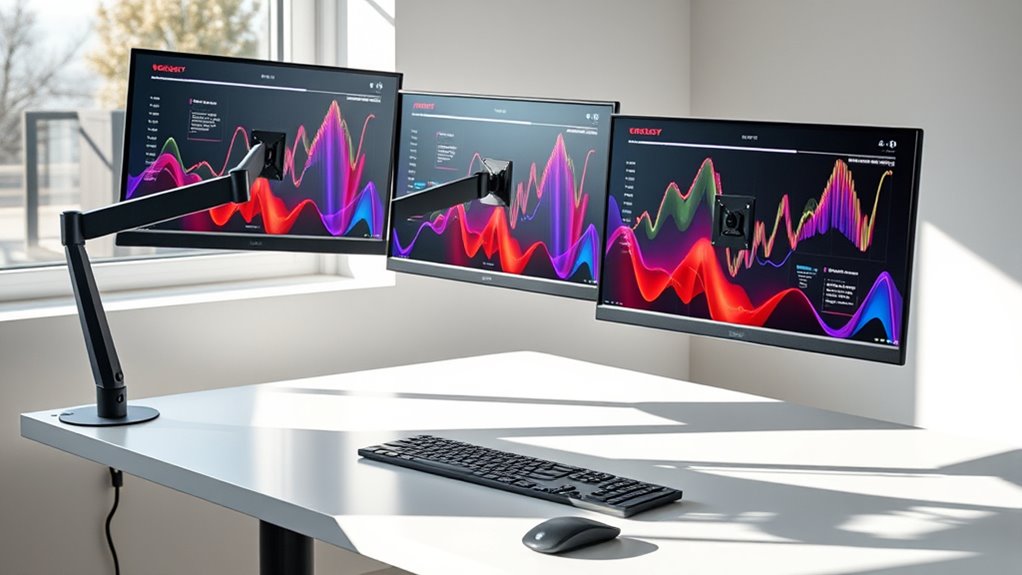

Adjustable monitor arms can free desk space and make it easier to position a screen, but the right choice depends on your monitor’s weight, your desk, and how much range of motion you need. My best overall pick is the VIVO Single Monitor Arm for its broad 13–38-inch screen range; the HUANUO FlowLift Dual suits a two-screen setup, while the ARES WING RGB Single accommodates screens up to 49 inches. The main tradeoffs are single versus dual mounting, supported screen size and weight, and whether the arm’s reach and adjustment style suit your desk. I compare all 15 options by fit, flexibility, and setup needs below. Read on for the full breakdown and a guide to choosing a mount that works with your equipment.

Get baking supplies delivered free with Prime
- Fast, free delivery on millions of items
- Prime Video, Amazon Music and more included
- Member-only deals all year
Complete the kit


Key Takeaways
- Screen range separates the single-monitor choices: the ARES WING RGB Single supports screens up to 49 inches, while the VIVO Single reaches 38 inches and several other single arms top out at 34 inches.
- Dual-arm designs serve different layouts: side-by-side models such as the HUANUO FlowLift Dual suit paired screens, while the ARES WING Stacked Dual is made for a vertical arrangement.
- Weight capacity matters as much as screen size: the WALI Adjustable Dual lists 22 pounds per arm, a useful detail for buyers whose monitors are heavy for their size.
- Extras are not a substitute for fit: USB-A and USB-C ports on the ARES WING Stacked Dual and RGB lighting on the ARES WING Single may appeal to some desks, but VESA compatibility, weight limits, and reach should come first.
- There are several ways to cover common setups: the list includes mechanical-spring options, including the NB SmooVex A5, as well as FlowLift models and basic single and dual mounts, so buyers can prioritize adjustment style or a simpler configuration.
| VIVO Single Monitor Arm Desk Mount for 13–38 Inch Screens |  | Best Overall Single Arm | Screen compatibility: 13–38 inches; standard screens up to 32 inches | Weight capacity: 22 lbs | VESA compatibility: 75×75 mm and 100×100 mm | VIEW ON AMAZON | See Our Full Breakdown |
| Acer Fully Adjustable Single Monitor Arm for 17–34-Inch Screens |  | Best for Gas-Spring Adjustment | Screen size: 17–34 inches | Supported monitor weight: 4.4–19.8 lbs (2–9 kg) | VESA compatibility: 75×75 mm and 100×100 mm | VIEW ON AMAZON | See Our Full Breakdown |
| HUANUO FlowLift Dual Monitor Desk Mount for 13–32-Inch Screens |  | Best Value Dual Arm | Screen size compatibility: 13–32 inches | Weight capacity: 4.4–19.8 lbs per arm | VESA compatibility: 75×75 mm and 100×100 mm | VIEW ON AMAZON | See Our Full Breakdown |
| ARES WING Stacked Dual Monitor Arm with USB-A and USB-C |  | Best for Large Stacked Displays | Monitor size: 17–49 inches | Weight capacity: 44 lbs per arm | Maximum height and extension: 27.9 inches high; 22.4 inches maximum extension | VIEW ON AMAZON | See Our Full Breakdown |
| VIVO Dual Monitor Stand with Fully Adjustable Arms for 17–32 Inch Screens |  | Best for Tool-Free Positioning | Screen size: 17–32 inches | Screen weight capacity: 4.4–19.8 lbs per screen | Supported VESA patterns: 75×75 mm and 100×100 mm | VIEW ON AMAZON | See Our Full Breakdown |
| MSI MAG MT201D Heavy-Duty Dual Monitor Stand |  | Best for Large, Heavy Dual Screens | Screen size support: 17–45 inches | Weight capacity: 2–20 kg (4.4–44 lb) per screen | VESA compatibility: 75 × 75 mm and 100 × 100 mm | VIEW ON AMAZON | See Our Full Breakdown |
| NB SmooVex Monitor Mount for Monitors up to 32 Inches, Mechanical Spring, VESA 75/100 mm, Model A5, Black |  | Best for Buyers Who Prefer a Mechanical Spring | Maximum monitor size: 32 inches | VESA compatibility: 75 × 75 mm and 100 × 100 mm | Spring system: Mechanical spring | VIEW ON AMAZON | See Our Full Breakdown |
| HUANUO FlowLift Single Monitor Mount for 13–32 Inch Monitors |  | Best for a Clearly Specified Everyday Fit | Compatible monitor size: 13–32 inches | Monitor weight capacity: 4.4–19.8 lb | VESA patterns: 75 × 75 mm and 100 × 100 mm | VIEW ON AMAZON | See Our Full Breakdown |
| MOUNTUP Dual Monitor Desk Mount for 17–32-Inch Screens |  | Best for a Standard Dual-Screen Desk | Screen size: 17–32 inches | Monitor capacity: 2 monitors | Weight capacity: 4.4–17.6 lb per monitor | VIEW ON AMAZON | See Our Full Breakdown |
| WALI Adjustable Single Monitor Arm for 13–34-Inch Screens |  | Best for Extended Reach | Screen size: 13–34 inches; up to 32 inches for regular screens | Maximum load: 26.4 lb for flat screens; 19.8 lb for curved screens | VESA compatibility: 75 × 75 mm and 100 × 100 mm | VIEW ON AMAZON | See Our Full Breakdown |
| HUANUO Dual Monitor Desk Mount for 13–32 Inch Screens, White |  | Best Dual Arm for Flexible Mounting | Monitor capacity: 2 screens | Screen size compatibility: 13–32 inches | Weight capacity: 4.4–19.8 lbs per arm | VIEW ON AMAZON | See Our Full Breakdown |
| ErGear Adjustable Single Monitor Arm for 13–34 Inch Screens |  | Best for Beginners | Screen compatibility: 13–34 inches | Maximum monitor weight: 19.8 lbs | VESA compatibility: 75x75mm and 100x100mm | VIEW ON AMAZON | See Our Full Breakdown |
| ErGear Dual Monitor Arm for 13–32-Inch Screens |  | Best Dual Arm for Tool-Free Setup | Monitor compatibility: 13–32-inch flat or curved screens | Maximum load: 19.8 lbs per monitor | VESA compatibility: 75x75mm and 100x100mm | VIEW ON AMAZON | See Our Full Breakdown |
| WALI Adjustable Dual Monitor Arm for 13–32-Inch Screens, 22 lbs per Arm |  | Best for Heavier Dual Monitors | Screen size compatibility: 13–32 inches | Maximum load: 22 lbs per arm | VESA compatibility: 75x75mm and 100x100mm | VIEW ON AMAZON | See Our Full Breakdown |
| ARES WING Single Monitor Arm with RGB Lighting, White, 17–49 Inch |  | Best for Large Displays | Screen size: 17–49 inches | Maximum weight: 44 lbs flat; 33 lbs curved | Materials: Steel, aluminum, and plastic | VIEW ON AMAZON | See Our Full Breakdown |
| adjustable monitor arm | VESA compatibility | Tilt |
|---|---|---|
| VIVO Single Monitor Arm Desk M | 75×75 mm and 100×100 mm | +90° to -90° |
| Acer Fully Adjustable Single M | 75×75 mm and 100×100 mm | — |
| HUANUO FlowLift Dual Monitor D | 75×75 mm and 100×100 mm | +85°/-50° |
| ARES WING Stacked Dual Monitor | 75×75 mm and 100×100 mm | — |
| VIVO Dual Monitor Stand with F | — | +90° to -90° |
| MSI MAG MT201D Heavy-Duty Dual | 75 × 75 mm and 100 × 100 mm | +50°/−20° |
| NB SmooVex Monitor Mount for M | 75 × 75 mm and 100 × 100 mm | −25° to 90° |
| HUANUO FlowLift Single Monitor | — | −50° to +85° |
| MOUNTUP Dual Monitor Desk Moun | 75 × 75 mm and 100 × 100 mm | — |
| WALI Adjustable Single Monitor | 75 × 75 mm and 100 × 100 mm | — |
| HUANUO Dual Monitor Desk Mount | 75x75mm and 100x100mm | — |
| ErGear Adjustable Single Monit | 75x75mm and 100x100mm | +80°/-50° |
| ErGear Dual Monitor Arm for 13 | 75x75mm and 100x100mm | +80°/-50° |
| WALI Adjustable Dual Monitor A | 75x75mm and 100x100mm | +70°/-45° |
| ARES WING Single Monitor Arm w | 75x75mm and 100x100mm | +50° to -20° |
More Details on Our Top Picks
VIVO Single Monitor Arm Desk Mount for 13–38 Inch Screens
The VIVO STAND-V001 is the most flexible single-screen pick here: it fits standard monitors up to 32 inches and ultrawides up to 38 inches, with tilt, swivel, rotation, and up to 16 inches of height adjustment. Its clamp and grommet options make it easier to match to different desk setups than the Acer arm, though the clamp only fits desks up to 3.25 inches thick. Compared with the Acer Fully Adjustable Single Monitor Arm, this VIVO supports larger ultrawides and carries a longer listed warranty, while Acer offers a gas spring and a higher stated maximum height. The VIVO’s 22-pound capacity gives it room for many compatible displays, but buyers still need a VESA pattern and a desk edge that works with its mount. I’d choose it for broad fit and straightforward positioning, not for a desk with a blocked mounting edge.
Pros:- Supports standard screens up to 32 inches and ultrawides up to 38 inches
- Offers tilt, swivel, rotation, and up to 16 inches of height adjustment
- Includes C-clamp and grommet mounting options
- Cable clips help route power and display cables
Cons:- Requires a compatible VESA mounting pattern
- The C-clamp is limited to desks up to 3.25 inches thick
Best for: Buyers with a compatible standard or ultrawide monitor who want flexible positioning and both clamp and grommet installation options
Not ideal for: Owners of monitors without VESA 75×75 mm or 100×100 mm holes, or desks thicker than 3.25 inches at the clamp point
- Screen compatibility:13–38 inches; standard screens up to 32 inches
- Weight capacity:22 lbs
- VESA compatibility:75×75 mm and 100×100 mm
- Tilt:+90° to -90°
- Swivel and rotation:360° each
- Height adjustment:Up to 16 inches along center pole
- Mounting:C-clamp or grommet; clamp fits desks up to 3.25 inches thick
- Warranty:3 years
Our verdict“Choose the VIVO if you want one adjustable arm with broad screen-size compatibility and two included desk-mounting methods.”
Acer Fully Adjustable Single Monitor Arm for 17–34-Inch Screens
The Acer AMS001 suits buyers who want a gas-spring arm for a single monitor within its defined weight range of 4.4–19.8 lbs. Its 18.1-inch maximum height and full rotation give more vertical reach than the VIVO STAND-V001’s stated 16-inch adjustment, while the VIVO accommodates larger ultrawides and has a higher weight limit. Acer’s C-clamp or grommet mounting adds setup flexibility, but the desk needs an accessible, secure mounting point; shelves, enclosed panels, or curved edges can rule it out. The gas spring also needs tension tuning to the monitor’s weight, so setup may take more adjustment than a fixed-feel arm. With a one-year warranty, this is a focused fit for compatible 17–34-inch displays, rather than the broader screen range offered by VIVO.
Pros:- Gas-spring arm supports adjustable positioning
- Fits monitors from 17 to 34 inches within a 4.4–19.8 lb weight range
- Provides up to 18.1 inches of height and 360° rotation
- Includes C-clamp and grommet mounting options
Cons:- Gas-spring tension must be adjusted to the monitor’s weight
- Desk shelves, enclosed panels, and curved edges can prevent secure installation
- One-year warranty is shorter than the VIVO STAND-V001’s listed three years
Best for: People with a 17–34-inch VESA monitor weighing 4.4–19.8 lbs who want gas-spring positioning and up to 18.1 inches of height
Not ideal for: Owners of ultrawides over 34 inches, heavier displays, or desks with enclosed backs, shelves, or curved clamp edges
- Screen size:17–34 inches
- Supported monitor weight:4.4–19.8 lbs (2–9 kg)
- VESA compatibility:75×75 mm and 100×100 mm
- Tilt and swivel:-60° to +90° tilt; ±90° swivel
- Rotation:360°
- Maximum height:18.1 inches from desk
- Desk thickness:15–80 mm (0.59–3.15 inches)
- Mounting and warranty:C-clamp or grommet; 1-year warranty
Our verdict“Pick the Acer for a compatible mid-size monitor when gas-spring adjustment and extra vertical reach matter more than ultrawide support.”
HUANUO FlowLift Dual Monitor Desk Mount for 13–32-Inch Screens
The HUANUO FlowLift gives two compatible screens independent tilt, swivel, and rotation, with height adjustment up to 15.75 inches. Its 4.4–19.8 lb capacity per arm covers a useful range for common 13–32-inch monitors, while the ARES WING Stacked Dual Monitor Arm is the better match for much larger, heavier screens and adds charging ports. HUANUO’s more modest size range makes more sense for a typical side-by-side workspace, but the desk material and underside layout matter: it is recommended for wood, and cross beams or panels may obstruct mounting. The C-clamp and grommet choices help with installation on suitable desks, and cable management can reduce clutter around two displays. I’d skip it for glass or plastic desks, or for a stacked setup needing the ARES WING’s greater reach and capacity.
Pros:- Supports two monitors weighing 4.4–19.8 lbs each
- Provides tilt, swivel, and 360° rotation for both screens
- Includes C-clamp and grommet installation options
- Integrated cable management helps organize a two-screen setup
Cons:- Not recommended for plastic or glass desks
- Desk cross beams or panels can interfere with mounting
- Maximum height of 15.75 inches is lower than the ARES WING’s 27.9 inches
Best for: Buyers setting up two standard 13–32-inch monitors on a compatible wooden desk
Not ideal for: People with glass or plastic desks, obstructed mounting points, or large and heavy screens beyond the per-arm limits
- Screen size compatibility:13–32 inches
- Weight capacity:4.4–19.8 lbs per arm
- VESA compatibility:75×75 mm and 100×100 mm
- Tilt:+85°/-50°
- Swivel and rotation:±90° swivel; 360° rotation
- Maximum height:15.75 inches
- Desk thickness compatibility:0.59–3.54 inches
- Mounting and desk material:C-clamp or grommet; recommended for wood desks
Our verdict“Choose the HUANUO FlowLift for a pair of standard monitors on a suitable wood desk when you do not need heavy-duty capacity or tall stacked positioning.”
ARES WING Stacked Dual Monitor Arm with USB-A and USB-C
For a stacked pair of oversized displays, the ARES WING has the strongest stated capacity in this group: up to 44 lbs per arm and screens as large as 49 inches. Its 27.9-inch maximum height and 22.4-inch extension give more room to separate large screens than the HUANUO FlowLift Dual Monitor Desk Mount, which tops out at 32-inch monitors and 15.75 inches of height. The added USB-A and USB-C ports provide convenient charging access at the desk, though each is specified at 5V/2A. That reach and capacity come with specific mounting limits: the clamp fits desks 0.5–1.8 inches thick, while the grommet option fits 0.5–2 inches. Some monitors may also need a separate VESA adapter, so I’d verify fit before choosing this arm for a premium or unusually shaped display.
Pros:- Supports screens up to 49 inches and 44 lbs per arm
- Offers up to 27.9 inches of height and 22.4 inches of extension
- Includes USB-A and USB-C ports rated at 5V/2A
- Supports C-clamp and grommet installation
Cons:- Some monitors may require a separate VESA adapter
- Clamp and grommet desk-thickness ranges are narrower than the HUANUO FlowLift’s stated range
- USB ports are specified at 5V/2A each
Best for: Users stacking two large flat or curved VESA displays who need high per-arm capacity, extended reach, and desk-side charging ports
Not ideal for: Owners of desks thicker than the stated mounting limits or monitors that need an unavailable VESA adapter
- Monitor size:17–49 inches
- Weight capacity:44 lbs per arm
- Maximum height and extension:27.9 inches high; 22.4 inches maximum extension
- Tilt and swivel:-50° to +20° tilt; ±90° swivel
- Rotation:360°
- USB ports:1 USB-C and 1 USB-A, each 5V/2A
- VESA compatibility:75×75 mm and 100×100 mm
- Desk thickness:C-clamp: 0.5–1.8 inches; grommet: 0.5–2 inches
Our verdict“Choose the ARES WING when your stacked screens are too large or heavy for a conventional dual arm and your desk fits its mount limits.”
VIVO Dual Monitor Stand with Fully Adjustable Arms for 17–32 Inch Screens
The VIVO STAND-V002O is aimed at a two-screen setup where frequent manual repositioning matters: its mechanical spring arms are designed for tool-free adjustment, and each supports a compatible 17–32-inch monitor weighing 4.4–19.8 lbs. It offers broad tilt and full rotation, but its 180° swivel is less than the HUANUO FlowLift’s ±90° range, so turning screens outward for a shared viewing position may be more limited. Compared with the ARES WING Stacked Dual Monitor Arm, VIVO is for lighter, smaller displays and gives up the charging ports and tall stacked reach. In return, it fits a more conventional side-by-side setup and supports a C-clamp or optional grommet mount. Its arms extend beyond the desk edge, so allow space behind the workstation.
Pros:- Supports two 17–32-inch screens weighing 4.4–19.8 lbs each
- Mechanical spring arms allow tool-free positioning
- Provides ±90° tilt and 360° screen rotation
- C-clamp or optional grommet installation frees desk surface
Cons:- Arms extend past the desk edge and need rear clearance
- Grommet mount is optional rather than included
- 180° swivel is more limited than the HUANUO FlowLift’s ±90° swivel specification
Best for: People with two mid-size VESA monitors who want to reposition them by hand without tools
Not ideal for: Users who need a compact desk footprint, wide swivel range, or an included grommet mount
- Screen size:17–32 inches
- Screen weight capacity:4.4–19.8 lbs per screen
- Supported VESA patterns:75×75 mm and 100×100 mm
- Tilt:+90° to -90°
- Swivel and rotation:180° swivel; 360° rotation
- Mounting options:C-clamp or optional bolt-through grommet mount
- Maximum desk thickness:C-clamp: 3.1 inches; grommet: 1.9 inches
- Model and color:STAND-V002O; Black
Our verdict“Pick this VIVO for two compatible mid-size monitors you plan to reposition by hand, provided your desk has room behind it.”
MSI MAG MT201D Heavy-Duty Dual Monitor Stand
The MSI MAG MT201D is the strongest fit here when two large or heavy displays push past the limits of lighter dual arms. Its stated range reaches 45 inches and 20 kg per screen, while the MOUNTUP MU0005 tops out at 32 inches and 17.6 lb per monitor. Clamp and grommet mounting give buyers two ways to secure it, and quick-release VESA plates can make monitor attachment less awkward. Tilt, swivel, and rotation allow each screen to face a different seat or switch orientation. The tradeoff is that this is a heavier-duty choice than most standard desk setups need; buyers should confirm their desktop and monitors fall within the mount’s specified ranges. I’d choose it for demanding dual-screen setups, not simply to add basic height adjustment.
Pros:- Supports screens from 17 to 45 inches
- Rated for 2–20 kg per screen
- Offers both clamp and grommet mounting
- Quick-release VESA plates and three adjustment types
Cons:- Its heavy-duty capacity may be unnecessary for typical lightweight monitors
- Desktop thickness must fit the mount’s specified clamp or grommet range
Best for: People mounting two large or heavy monitors who need both clamp and grommet installation options
Not ideal for: Owners of lightweight, compact displays who do not need the higher per-screen capacity
- Screen size support:17–45 inches
- Weight capacity:2–20 kg (4.4–44 lb) per screen
- VESA compatibility:75 × 75 mm and 100 × 100 mm
- Mounting options:Clamp or grommet
- Clamp desktop thickness:10–85 mm
- Grommet desktop thickness:10–35 mm
- Tilt:+50°/−20°
- Swivel and rotation:±90° swivel; ±180° rotation
Our verdict“Choose the MSI MAG MT201D for two large or heavy displays; the MOUNTUP MU0005 is a better match for lighter screens up to 32 inches.”
NB SmooVex Monitor Mount for Monitors up to 32 Inches, Mechanical Spring, VESA 75/100 mm, Model A5, Black
The NB SmooVex A5 stands apart from the gas-assisted options in this group with its mechanical spring system. That may appeal to buyers who specifically want spring-based support, while the HUANUO FlowLift offers a more clearly documented fit for monitors from 4.4 to 19.8 lb. The SmooVex accommodates flat or curved displays up to 32 inches and gives 230 mm of height travel, plus a wide tilt range for adjusting the viewing angle. Clamp and grommet mounting add flexibility for compatible desks. Its central limitation is missing fit information: the monitor weight capacity and desk requirements are not stated in the supplied product data. I’d only select it after confirming those limits for the intended screen and desktop.
Pros:- Uses a mechanical spring system
- Supports flat and curved monitors up to 32 inches
- Provides 230 mm of height travel
- Includes C-clamp and grommet mounting options
Cons:- Monitor weight capacity is not specified in the supplied product data
- Desk compatibility requirements are not specified
Best for: Buyers who want a mechanical-spring arm for a monitor up to 32 inches and can confirm compatibility before purchase
Not ideal for: Anyone who needs a published weight limit or clear desk compatibility requirements to check fit
- Maximum monitor size:32 inches
- VESA compatibility:75 × 75 mm and 100 × 100 mm
- Spring system:Mechanical spring
- Height travel:230 mm
- Tilt:−25° to 90°
- Rotation:±90°
- Mounting options:C-clamp and grommet
- Color and model:Black; A5
Our verdict“Pick the SmooVex A5 if mechanical-spring support is your priority and you can verify screen and desk fit; choose the HUANUO FlowLift for a stated weight range.”
HUANUO FlowLift Single Monitor Mount for 13–32 Inch Monitors
The HUANUO FlowLift is a practical single-screen pick for buyers whose monitor falls within its clearly stated 4.4–19.8 lb capacity. That weight range makes compatibility easier to judge than with the NB SmooVex A5, whose supplied details leave its monitor capacity unspecified. The FlowLift supports 13–32 inch screens, raises the display up to 39.6 cm, and offers tilt, swivel, and full rotation for switching between landscape and portrait. Clamp and grommet mounting suit different desk setups, provided the tabletop meets the stated thickness range. Its limits are familiar: it handles one monitor, and desktop fit still matters. I’d choose it for a conventional single-screen workstation; the WALI arm offers more reach and supports some larger displays.
Pros:- Supports 13–32 inch monitors weighing 4.4–19.8 lb
- Raises the screen up to 39.6 cm
- Provides tilt, swivel, and 360° rotation
- Includes C-clamp and grommet mounting options
Cons:- Supports only one monitor
- Compatible tabletop thickness is limited to the stated range
Best for: Single-monitor users who want a published weight range, flexible positioning, and clamp or grommet mounting
Not ideal for: People mounting two screens or displays larger than 32 inches
- Compatible monitor size:13–32 inches
- Monitor weight capacity:4.4–19.8 lb
- VESA patterns:75 × 75 mm and 100 × 100 mm
- Maximum screen lift:39.6 cm
- Tilt:−50° to +85°
- Swivel:±90°
- Rotation:360°
- Mounting and tabletop thickness:C-clamp or grommet; 0.59–3.54 inches
Our verdict“Choose the FlowLift for a single monitor with a documented fit range; the WALI arm suits buyers who need greater extension or support for some larger screens.”
MOUNTUP Dual Monitor Desk Mount for 17–32-Inch Screens
For a conventional two-monitor workstation, the MOUNTUP MU0005 combines independent positioning with useful arm reach and built-in cable management. Each pneumatic arm supports a 17–32 inch screen weighing 4.4–17.6 lb, a more modest range than the heavy-duty MSI MAG MT201D, which supports screens up to 45 inches and 20 kg each. That makes MOUNTUP a better fit for typical desk monitors than oversized or especially heavy displays. Its stated 17.3-inch extension can help arrange screens side by side, while C-clamp and grommet installation offer mounting flexibility. The weight ceiling is the key constraint, and buyers also need to check desk and grommet compatibility. I’d favor it when cable tidiness and two-screen adjustment matter more than maximum capacity.
Pros:- Supports two flat or curved monitors
- Allows tilt, swivel, and rotation
- Extends up to 17.3 inches
- Includes cable management and clamp or grommet mounting
Cons:- Each monitor must weigh 4.4–17.6 lb
- Desk thickness and grommet dimensions must match mounting requirements
Best for: People setting up two standard flat or curved monitors who want adjustable arms and integrated cable management
Not ideal for: Owners of monitors over 17.6 lb each or larger than 32 inches
- Screen size:17–32 inches
- Monitor capacity:2 monitors
- Weight capacity:4.4–17.6 lb per monitor
- VESA compatibility:75 × 75 mm and 100 × 100 mm
- Arm extension:17.3 inches
- Height adjustment:9.4 inches
- Tilt, swivel, and rotation:135° tilt; 180° swivel; 360° rotation
- Mounting options:C-clamp or grommet
Our verdict“Choose the MOUNTUP MU0005 for two standard monitors and tidy cable routing; the MSI MAG MT201D is the better fit for heavier or larger screens.”
WALI Adjustable Single Monitor Arm for 13–34-Inch Screens
The WALI adjustable arm makes the most sense for a single-screen setup that needs more reach than the HUANUO FlowLift offers. It extends up to 19.3 inches and raises the display as much as 17.3 inches above the desktop, giving users more freedom to move a screen across a broad work area. It also supports screens up to 34 inches, though regular screens are limited to 32 inches, and the load limit changes by screen type: 26.4 lb for flat displays and 19.8 lb for curved ones. Tilt, swivel, and rotation cover common positioning needs. The meaningful restriction is desk material: the supplied details recommend installation only on wooden desks. I’d choose WALI for reach and adjustment range when that desk requirement fits.
Pros:- Extends up to 19.3 inches
- Raises the screen up to 17.3 inches above the desktop
- Offers tilt, swivel, and 360° rotation
- Supports clamp or grommet mounting and includes cable management
Cons:- Installation is recommended only on wooden desks
- Curved-screen capacity is lower than flat-screen capacity
- Regular screens are limited to 32 inches
Best for: People with wooden desks who need long extension and substantial height adjustment for one monitor
Not ideal for: Buyers with non-wood desks or curved monitors above 19.8 lb
- Screen size:13–34 inches; up to 32 inches for regular screens
- Maximum load:26.4 lb for flat screens; 19.8 lb for curved screens
- VESA compatibility:75 × 75 mm and 100 × 100 mm
- Extension:Up to 19.3 inches
- Height adjustment:Up to 17.3 inches above the desktop
- Tilt and swivel:+70°/−45° tilt; ±180° swivel
- Rotation:360°
- Desk and mounting:Recommended for wood; C-clamp or grommet base; 0.39–2.76 inch desk thickness
Our verdict“Choose WALI for a wooden desk and a single monitor that benefits from extra reach; the HUANUO FlowLift has a more straightforward stated capacity for screens up to 32 inches.”
HUANUO Dual Monitor Desk Mount for 13–32 Inch Screens, White
The HUANUO HNDS6 suits two-screen desks where mounting flexibility matters as much as positioning. Its C-clamp or grommet base gives buyers a choice based on their desk, while height adjustment and swivel, tilt, and rotation make it easier to align both screens. Compared with the ErGear Dual Monitor Arm, this model has a narrower stated weight ceiling of 19.8 pounds per arm, but its supplied mounting choices and clean white finish may better suit a coordinated workspace. The tradeoff is the fit checklist: each display must fall within the 13–32-inch and 4.4–19.8-pound range and use a supported VESA pattern. I’d choose it for a conventional two-monitor setup, but not for heavier displays or buyers seeking a clearly specified long extension range.
Pros:- Supports two monitors from 13 to 32 inches
- Height, swivel, tilt, and rotation adjustments help align screens
- Includes C-clamp and grommet mounting options
- Cable management helps keep the desk neater
Cons:- Each monitor must weigh at least 4.4 pounds and no more than 19.8 pounds
- Monitor size, VESA pattern, and mounting hardware need checking before installation
Best for: People setting up two compatible monitors who want a white arm and a choice between clamp and grommet installation
Not ideal for: Owners of monitors over 19.8 pounds per arm, outside the 13–32-inch range, or without 75x75mm or 100x100mm VESA holes
- Monitor capacity:2 screens
- Screen size compatibility:13–32 inches
- Weight capacity:4.4–19.8 lbs per arm
- VESA compatibility:75x75mm and 100x100mm
- Adjustments:Height, swivel, tilt, and rotation
- Mounting options:C-clamp or grommet base
- Color:White
- Cable management:Yes
Our verdict“Choose the HUANUO if you want a white dual arm with two desk mounting methods and both monitors fit its stated limits.”
ErGear Adjustable Single Monitor Arm for 13–34 Inch Screens
For a first monitor arm, the ErGear single mount makes its range easy to judge: it lists up to 17.5 inches of height adjustment and 18.1 inches of reach, alongside tool-free VESA mounting. That reach gives a buyer room to pull a screen forward or move it aside without lifting the display off the desk. Compared with the ErGear Dual Monitor Arm, this version keeps the setup to one screen and avoids coordinating two arms, though it can’t support a second display. It fits many flat or curved screens up to 34 inches and 19.8 pounds, and the clamp and grommet options cover a range of desk thicknesses. The key tradeoff is desk fit: measure before buying, since the listed clamp and grommet thickness limits differ.
Pros:- Supports compatible flat or curved screens from 13 to 34 inches
- Lists up to 17.5 inches of height adjustment and 18.1 inches of reach
- Tool-free VESA mounting simplifies attaching a compatible display
- Offers C-clamp and grommet installation
Cons:- Supports only one monitor
- Desk thickness must fit the different clamp or grommet limits
Best for: First-time arm buyers with one compatible monitor who want clearly stated reach, height, and straightforward VESA attachment
Not ideal for: People planning a dual-screen setup or using a desk outside the mount’s stated thickness ranges
- Screen compatibility:13–34 inches
- Maximum monitor weight:19.8 lbs
- VESA compatibility:75x75mm and 100x100mm
- Height adjustment:Up to 17.5 inches
- Reach:Up to 18.1 inches
- Tilt:+80°/-50°
- Swivel and rotation:±90° swivel; 360° rotation
- Desk mount options:C-clamp or grommet
- Warranty:2 years
Our verdict“Pick this ErGear arm for a first single-screen setup when its reach range and desk fit match your workspace.”
ErGear Dual Monitor Arm for 13–32-Inch Screens
The ErGear dual arm pairs two-screen support with a tool-free VESA plate, a useful detail when fitting both monitors is likely to take more than one adjustment. Its stated 17.5-inch height adjustment, 18.1-inch extension, and full rotation give buyers specific movement ranges to compare against their desk layout. The HUANUO Dual Monitor Desk Mount also offers height and angle changes, while this ErGear model adds listed reach and movement-testing details. Both support up to 19.8 pounds per arm, so neither is the choice for a monitor that exceeds that limit. ErGear’s guidance favors a wooden desk without an underside crossbeam; check that structure and desk thickness before mounting. I’d favor it for buyers who want two screens and defined reach, provided their desk meets those conditions.
Pros:- Supports two flat or curved monitors from 13 to 32 inches
- Tool-free VESA plate installation can simplify screen attachment
- Lists up to 17.5 inches of height adjustment and 18.1 inches of extension
- Includes cable clips and C-clamp or grommet mounting
Cons:- Maximum load is 19.8 pounds per monitor
- Manufacturer recommends a wooden desk without an underside crossbeam
- Monitor size, weight, VESA pattern, and desk thickness require checking
Best for: Two-monitor users with compatible displays and a wooden desk who value tool-free VESA attachment and specified reach
Not ideal for: People with heavier monitors, desks with an obstructing underside crossbeam, or desk thickness outside the mount limits
- Monitor compatibility:13–32-inch flat or curved screens
- Maximum load:19.8 lbs per monitor
- VESA compatibility:75x75mm and 100x100mm
- Maximum height adjustment:17.5 inches
- Maximum extension:18.1 inches
- Tilt:+80°/-50°
- Swivel and rotation:±90° swivel; 360° rotation
- Desk thickness:C-clamp: 0.39–2.56 inches; grommet: 0.39–2.95 inches
- Movement testing:Over 20,000 cycles
Our verdict“Choose this ErGear dual arm if you want tool-free VESA mounting and your desk and monitors meet its stated fit requirements.”
WALI Adjustable Dual Monitor Arm for 13–32-Inch Screens, 22 lbs per Arm
The WALI’s main advantage over the ErGear Dual Monitor Arm is its 22-pound-per-arm capacity, three pounds more for each screen. That extra headroom can make it a better fit for heavier displays, as long as their size and VESA pattern also qualify. It extends up to 19.3 inches, slightly beyond the ErGear’s listed 18.1 inches, which helps when a screen needs to sit farther from its mount. WALI gives up some tilt range, listing +70°/-45° against ErGear’s +80°/-50°. Both arms offer full rotation and C-clamp or grommet mounting. Its recommendation for a wooden desk without an obstructing crossbeam is a real constraint, so check the underside before choosing this model.
Pros:- Supports up to 22 pounds per arm
- Extends up to 19.3 inches
- Provides height adjustment, swivel, tilt, and 360° rotation
- Offers C-clamp and grommet mounting with cable management
Cons:- Manufacturer recommends a wooden desk without an underside crossbeam
- Tilt range is narrower than the ErGear Dual Monitor Arm’s listed range
- Monitor and desk compatibility must be checked before mounting
Best for: Dual-monitor users with screens weighing more than 19.8 pounds but no more than 22 pounds each, on a suitable wooden desk
Not ideal for: People with non-wood desks, an obstructing underside crossbeam, or monitors over 22 pounds per arm
- Screen size compatibility:13–32 inches
- Maximum load:22 lbs per arm
- VESA compatibility:75x75mm and 100x100mm
- Maximum extension:19.3 inches
- Maximum height above desktop:17.3 inches
- Tilt:+70°/-45°
- Swivel and rotation:±90° swivel; 360° rotation
- Desk thickness:0.39–2.76 inches
- Mounting options:C-clamp or grommet base
Our verdict“Pick the WALI when its 22-pound capacity and longer listed extension suit your two monitors and your desk meets the mounting guidance.”
ARES WING Single Monitor Arm with RGB Lighting, White, 17–49 Inch
With support for flat monitors up to 49 inches and 44 pounds, the ARES WING reaches beyond the size and load limits of the single-screen ErGear Adjustable Single Monitor Arm. That makes it the more suitable option for a large display, while ErGear covers a broader range of smaller screens starting at 13 inches and specifies height and reach measurements. The ARES WING provides tilt, swivel, and rotation, plus 16 RGB lighting effects that can be turned off. Its tradeoffs are meaningful: curved screens have a lower 33-pound limit, its listed rotation is ±180°, and the allowable desk thickness depends on whether you use the clamp or grommet. Check both the monitor’s VESA pattern and the chosen mounting point before committing.
Pros:- Supports flat screens up to 49 inches and 44 pounds
- Provides tilt, swivel, and rotation adjustments
- Includes clamp and grommet mounting options
- RGB lighting offers 16 effects and can be turned off
Cons:- Curved screens have a lower 33-pound weight limit
- Grommet mounting supports a narrower desk-thickness range than clamp mounting
- Does not list height adjustment or extension measurements in the supplied specifications
Best for: Owners of a large flat monitor up to 49 inches and 44 pounds who want an adjustable arm with optional RGB lighting
Not ideal for: Buyers of curved displays over 33 pounds, screens under 17 inches, or users whose desk thickness falls outside the selected mount’s range
- Screen size:17–49 inches
- Maximum weight:44 lbs flat; 33 lbs curved
- Materials:Steel, aluminum, and plastic
- Tilt:+50° to -20°
- Swivel:±90°
- Rotation:±180°
- VESA compatibility:75x75mm and 100x100mm
- Mounting options:Clamp or grommet
- RGB lighting:16 dynamic effects
Our verdict“Choose the ARES WING for a large compatible display that exceeds the ErGear single arm’s size range, after checking its weight and desk limits.”

How We Picked
I compared these arms on the details that affect whether they will work at a desk: supported screen size and weight, VESA fit, adjustment range, single or dual configuration, and the information provided about installation and desk attachment. I also looked at practical distinctions such as stacked versus side-by-side positioning, mechanical-spring or FlowLift designs, and added features like built-in USB ports or RGB lighting. A wide screen range can make an arm more versatile, but it does not confirm that every monitor in that range is within the arm’s weight limit.
The ranking gives priority to useful flexibility and clearly stated fit details, then accounts for how well each model suits a particular setup. That puts adaptable single-screen choices near the top for general use, with capable dual mounts close behind for buyers who need two displays. More specialized options rank for the specific layouts or extras they offer. Before buying, match your monitor’s weight and VESA pattern to the product specifications and check that your desk can accept its clamp or mounting hardware.
Factors to Consider When Choosing Adjustable Monitor Arms
Choosing an arm starts with the monitor and desk you already own. I would check physical compatibility first, then think about how the screen should move and how the setup may change over time. These checks can prevent a mount that fits the screen by diagonal measurement but cannot hold it or reach the position you want.
Match Weight, Not Just Screen Size
A screen’s diagonal measurement only tells part of the story: two monitors of the same size can weigh quite differently. Find the monitor’s weight without its stand and compare it with the arm’s stated capacity, checking the limit for each arm on a dual mount. Leave some headroom if you plan to add a heavier monitor later, since an arm operating at its limit may be harder to position reliably. Pay attention to whether a listing gives a per-arm limit or a total capacity. If the weight is missing from the product details, look it up in the monitor manual before choosing. Screen size compatibility is still useful, but it should be treated as a separate check rather than proof of support.
Check VESA Fit and Desk Attachment
Most monitor arms attach through VESA mounting holes, commonly in a 75-by-75 mm or 100-by-100 mm pattern. Check the back of the monitor or its manual, especially if the screen has an unusual housing or a recessed mount. Some monitors need an adapter, and an arm’s advertised screen range does not tell you whether that adapter is included. On the desk side, check the required edge clearance, thickness range, and whether a clamp or grommet mount matches your surface. A crossbar, lip, cable tray, or wall position can block a clamp even when the desk is otherwise sturdy. Confirm both attachment points before ordering to avoid a mismatch that cannot be solved by adjusting the arm.
Choose a Layout That Fits How You Work
For one screen, an arm frees the space the original stand used and can make it easier to move the display between tasks. Two arms work well when you regularly keep reference material beside your main screen, but they need enough desk depth and width to position both displays comfortably. Stacked arms suit vertical arrangements where side-by-side screens would take up too much width, though the upper display needs to sit at a comfortable viewing height. Consider where the monitor centers should land, not just how many screens the arm holds. A dual mount can limit independent placement if the displays differ in size or need different angles. Sketching the intended arrangement before buying can reveal whether a single, side-by-side, or stacked setup fits the workspace.
Measure Reach and Desk Clearance
An arm can support a monitor and still fail to move it where you need it. Measure the distance from the attachment point to your preferred screen position, then compare that with the arm’s reach and extension details. Also account for a deep desk, a nearby wall, shelves, and the space behind the monitor when it swings. If you share a desk or shift between sitting and standing, vertical adjustment and smooth repositioning may matter more than maximum extension. Large screens need room to rotate without colliding with a second display or wall. Thinking through the full movement path helps avoid buying an arm that only works in one fixed position.
Pick the Adjustment Style You Will Use
Different mechanisms suit different habits. A spring-assisted arm is useful when you often reposition a screen, while a simpler design may be enough when the monitor usually stays in one place. Product names such as “FlowLift” describe a design, but they do not replace checking the adjustment directions, tilt range, and setup instructions. If more than one person uses the desk, quick height and position changes can be worth prioritizing. For a fixed home office, the movement range and stable placement may matter more than frequent adjustment. Look for clear instructions on balancing or tension adjustment, since setup can affect how well a movable arm holds its position.
Decide Which Extras Earn Their Space
Integrated USB ports can keep frequently used connections within reach, and lighting may suit a desk where appearance matters. Those features add convenience, but they do not improve load capacity, VESA fit, or movement range. If you already use a powered USB hub or separate desk lighting, built-in extras may add little to your setup. On the other hand, a port on a stacked dual mount may be useful when the computer sits under the desk or out of reach. Compare cable routing and power requirements too; an extra feature can mean another cable to manage. I would settle compatibility and positioning first, then decide whether the convenience features justify choosing a particular model.
Frequently Asked Questions
Will a monitor arm fit any screen within its advertised size range?
No. The stated size range is only one part of the fit check. Your monitor also needs a compatible VESA pattern, and its weight must stay within the arm’s limit. Check whether the screen needs a mounting adapter and whether the product listing includes one. Confirming all three details—size, weight, and mounting pattern—can prevent a screen that appears compatible from being unusable with the arm.
Should I choose a dual monitor arm if I might add a second screen later?
Choose a dual arm now if you have a realistic plan to use two screens and enough desk space for their intended arrangement. A dual mount can reduce flexibility when one monitor is much larger or heavier than the other, so verify the per-arm capacity and available positioning. If you are unsure whether a second screen will fit your work, a single arm keeps the current setup simpler. Also check whether the dual mount’s bar or joints allow independent adjustment. The best choice depends on the screens you expect to use, not only the possibility of adding one later.
Can I use a monitor arm on a thin, glass, or unusually shaped desk?
It depends on the desk’s construction and the arm’s mounting method. Check the stated desk thickness range and attachment requirements, and inspect the edge for a lip, support rail, or other obstruction that could prevent the clamp from seating. Glass surfaces and fragile desk edges may need a mounting solution designed for that material or a reinforcement plate. Do not assume a clamp is safe just because it fits around the edge. If the product information does not address your desk type, confirm the requirements before installing a monitor above the work surface.
Is a spring-assisted arm useful if I rarely move my monitor?
It can still make initial positioning easier, but frequent movement is where an adjustable spring-assisted design is most useful. If your display stays in one place, prioritize stable support, the correct weight range, and the position you want over a more involved adjustment mechanism. Check how the arm is balanced, since some designs need tension set for the monitor’s weight. Consider who will adjust the screen and how often before paying more for features you may rarely use. A simpler arm can be a sensible fit for a mostly fixed workspace.
How much clearance do I need behind my desk for an adjustable arm?
There is no single clearance figure for every arm: the clamp, joint design, monitor size, and range of motion all affect the space needed. Measure from the desk edge to the wall or shelf, then compare that space with the arm’s mounting depth and extension details. Account for the monitor’s thickness as it tilts and swings, especially if it is large or curved. A stacked setup also needs vertical space, while two side-by-side screens need room to move without hitting each other. Checking the full movement path can matter more than measuring the mount alone.
Conclusion
For a versatile one-screen setup, I would start with the VIVO Single Monitor Arm, whose 13–38-inch range gives it broad stated screen coverage. Buyers who need two displays should compare the HUANUO FlowLift Dual and VIVO Dual Monitor Stand against their monitor weights and preferred layout; the ARES WING Stacked Dual is the more specialized choice for vertical placement and built-in USB ports. For a premium large-screen setup, the ARES WING Single with RGB Lighting supports screens up to 49 inches, provided its weight and mounting requirements match. Beginners who want a straightforward single-screen choice can look at the Acer Fully Adjustable Single or ErGear Adjustable Single and confirm desk and VESA fit before deciding. For specific needs, the WALI Adjustable Dual states 22 pounds per arm, while the NB SmooVex A5 offers a mechanical-spring design for buyers who value that adjustment style. Match the arm to your actual screens and desk, then choose extras and layout to suit how you work.


